Nepal Floods: India Embassy Issues Guidelines For Repatriating Victims
India Embassy in Kathmandu shares 9-step process for identifying and repatriating victims' remains. Over 1,000 lives lost in Nepal floods.
'%3E%3Crect%20width%3D'96'%20height%3D'96'%20fill%3D'%234A235A'%2F%3E%3Ccircle%20cx%3D'30'%20cy%3D'24'%20r%3D'44'%20fill%3D'%23fff'%20opacity%3D'.12'%2F%3E%3Ccircle%20cx%3D'60'%20cy%3D'74'%20r%3D'40'%20fill%3D'%23000'%20opacity%3D'.10'%2F%3E%3C%2Fg%3E%3Cg%20fill%3D'none'%20stroke%3D'%23fff'%20stroke-width%3D'3'%3E%3Ccircle%20cx%3D'48'%20cy%3D'48'%20r%3D'16'%2F%3E%3Cellipse%20cx%3D'48'%20cy%3D'48'%20rx%3D'6.5'%20ry%3D'16'%2F%3E%3Cline%20x1%3D'32'%20y1%3D'42'%20x2%3D'64'%20y2%3D'42'%2F%3E%3Cline%20x1%3D'32'%20y1%3D'54'%20x2%3D'64'%20y2%3D'54'%2F%3E%3C%2Fg%3E%3C%2Fsvg%3E)
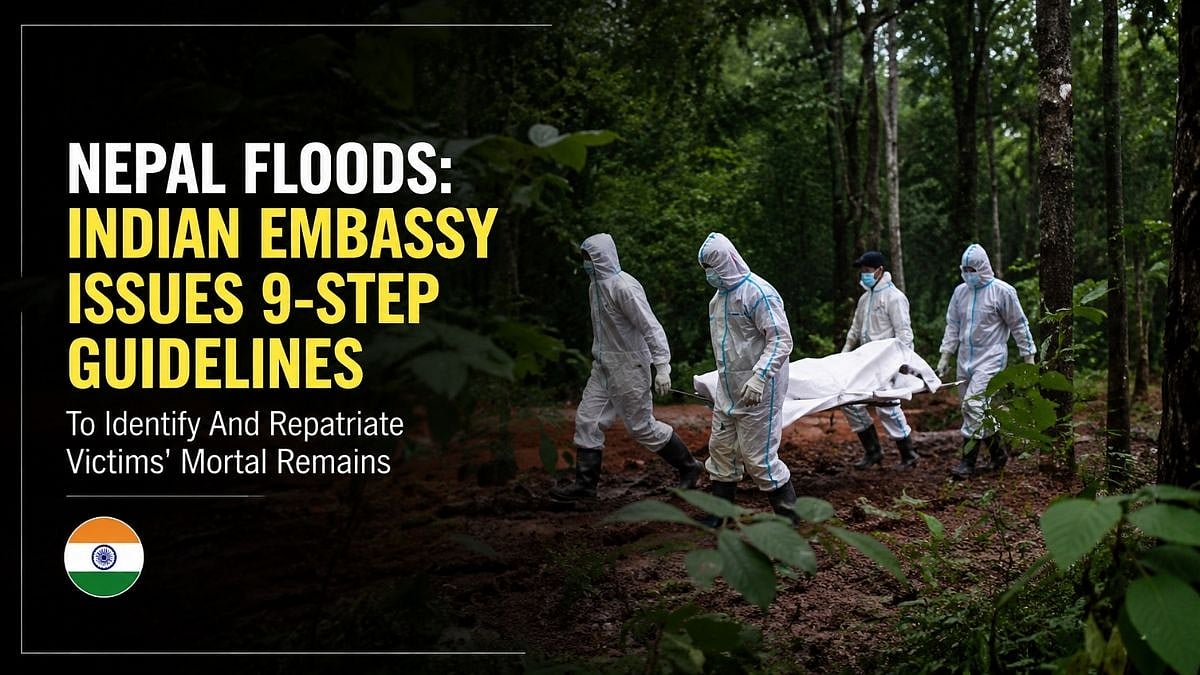
The Indian Embassy in Kathmandu has issued a 9-step guideline for the identification and repatriation of mortal remains of victims of the recent flash floods in Nepal. The floods have claimed more than 1,000 lives, and the embassy has shared the process to help foreign nationals, including Indians, who have lost their loved ones.
The 9-step process involves documentation of mortal remains, recording photographs and details, post-mortem examination, verification of the cause of death, formal establishment of identification, collection of fingerprints, DNA or forensic samples, verification of the deceased's passport or ID, completion of embassy/consular coordination, and completion of handover/release memo and receipt.
The first four steps will be carried out by Nepali authorities, while the remaining steps will involve coordination with the embassy and consular services. The embassy has also announced that it will help coordinate with local authorities for the handover and repatriation process if relatives are able to identify the mortal remains through photographs and descriptions published on the Nepal Police website.
The Nepal government has temporarily interred a large number of mortal remains to prevent health risks, and identification of these remains will require DNA matching with first-degree relatives. The Nepali authorities are collecting DNA samples from the mortal remains to create their DNA profiles, and first-degree relatives of those reported missing can send their DNA profiles by email to Nepal Police or provide blood samples along with preliminary information required by the authorities.
The Embassy of India has also provided helpline numbers with WhatsApp facility for further assistance and enquiries. The helpline numbers are +977 985 131 6807. Relatives can also share their DNA profiles with the embassy's flood-support email address for assistance.
The recent flash floods in Nepal have caused widespread destruction and loss of life, and the Indian Embassy's guidelines are aimed at helping families of victims to identify and repatriate their loved ones. The embassy's efforts are part of a larger relief and rescue operation being carried out by the Indian government to assist Nepal in the aftermath of the floods.
The floods have highlighted the need for closer cooperation and coordination between India and Nepal in times of natural disasters. The Indian government has been providing assistance to Nepal, including search and rescue teams, medical aid, and relief supplies.
In the coming days, the Indian Embassy in Kathmandu will continue to work closely with Nepali authorities to facilitate the identification and repatriation of victims' remains. The embassy's guidelines and helpline numbers will provide much-needed support to families of victims who are struggling to come to terms with their loss.
The situation in Nepal remains grim, with many families still searching for their loved ones. The Indian Embassy's efforts are a testament to the strong ties between India and Nepal, and the commitment of the Indian government to provide assistance and support to its neighbor in times of need.
As the situation continues to unfold, the Indian Embassy in Kathmandu will remain a crucial point of contact for families of victims and for those seeking assistance. The embassy's guidelines and helpline numbers will provide a lifeline to those affected by the floods, and will help to facilitate the identification and repatriation of victims' remains.
In conclusion, the Indian Embassy's guidelines for the identification and repatriation of victims' remains are an important step in providing support to families of victims of the Nepal floods. The embassy's efforts, along with the Indian government's relief and rescue operation, demonstrate the strong commitment of India to assisting Nepal in times of need.
The floods in Nepal are a reminder of the importance of regional cooperation and coordination in times of natural disasters. The Indian government's response to the floods, including the provision of search and rescue teams, medical aid, and relief supplies, highlights the need for closer ties between India and Nepal.
As the people of Nepal continue to struggle with the aftermath of the floods, the Indian Embassy's guidelines and helpline numbers will provide much-needed support and assistance. The embassy's efforts are a testament to the strong ties between India and Nepal, and the commitment of the Indian government to provide assistance and support to its neighbor in times of need.
Frequently asked questions
What is the process for identifying and repatriating victims' remains in Nepal?
The Indian Embassy in Kathmandu has issued a 9-step guideline for the identification and repatriation of mortal remains of victims of the recent flash floods in Nepal.
How can relatives identify the mortal remains of their loved ones?
Relatives can identify the mortal remains through photographs and descriptions published on the Nepal Police website, and can also send their DNA profiles by email to Nepal Police or provide blood samples along with preliminary information required by the authorities.