Iran-Linked Oil Vessels Break Free In Mumbai Storm
Three seized oil vessels dragged away, one runs aground. Crew safe.

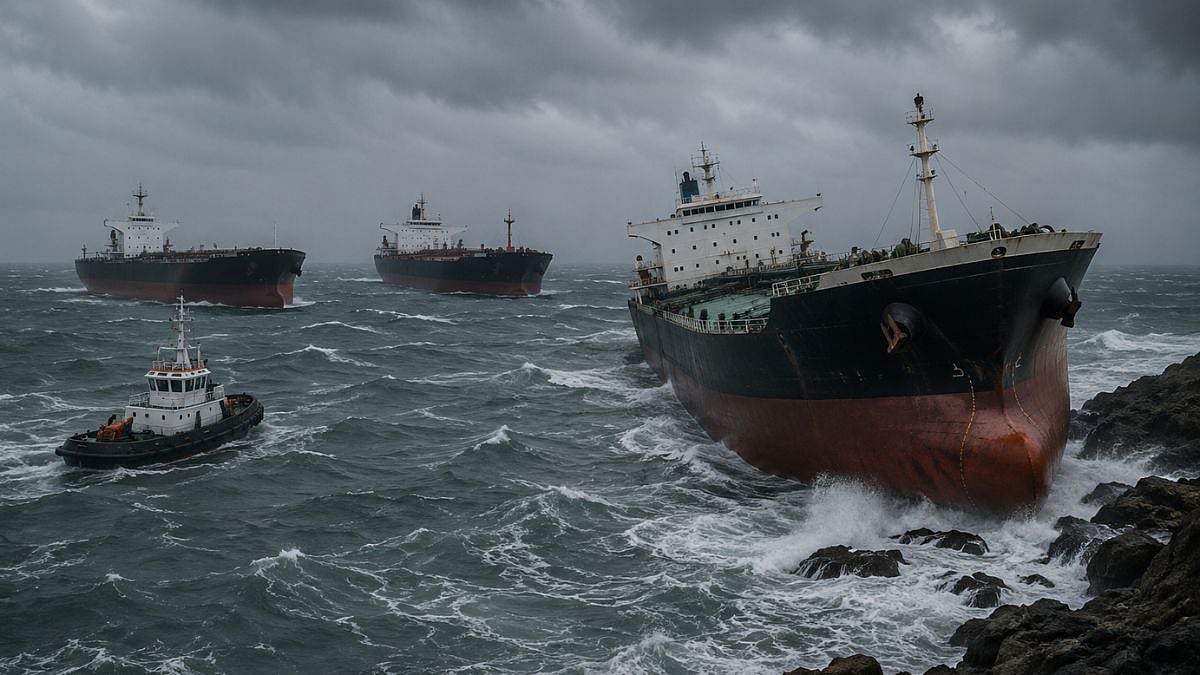
A major maritime security operation was launched off the coast of north Mumbai after three detained merchant tankers linked to an international Iranian oil-smuggling ring broke free from their anchorage due to severe monsoon weather. The incident occurred on Sunday, when the Directorate General of Shipping sent an emergency alert to the Indian Coast Guard (ICG) regarding the three vessels - Nicaragua-flagged MT Al Jafzia, Mali-flagged MT Asphalt Star, and Iran-flagged MT Stellar Ruby.
The vessels, which have been under Indian state custody since February 2026, were seized for operating in violation of international sanctions. They were intercepted by the Indian Coast Guard roughly 100 nautical miles west of Mumbai for routinely masking their identities and executing illicit mid-sea ship-to-ship transfers of Iranian bitumen and petroleum products. The Indian Coast Guard immediately mobilised its regional assets to assess the situation and secure the vessels. ICGS Samrat, an advanced offshore patrol vessel, was diverted to the area to establish visual contact and render necessary maritime assistance.
Upon the maritime law enforcement agency's request, DG Shipping deployed the emergency towing vessel (ETV) Water Lily to the site to provide heavy-weather towing and salvage support. Additionally, specialised pollution control vessel ICGS Samudra Prahari was deployed to maintain a strict vigil in the area to handle potential environmental fallout or logistical emergencies. Following the ICG's intervention, MT Asphalt Star and MT Stellar Ruby were anchored and stabilised under observation, while the crew onboard were reported to be safe and secure. However, MT Al Jafzia was unmanned and presumed to have run aground.
The vessel was left completely unmanned following the Bombay High Court's order to repatriate around 50 stranded seafarers who had been abandoned by the ships' overseas owners under severe humanitarian distress. The incident has raised concerns about the potential environmental impact and navigational blockage along Mumbai's heavily trafficked coast. ICG assets and emergency towing crews remain on high alert in the area, continuously monitoring the structural integrity of the vessels to prevent a secondary environmental crisis.
The three tankers have been sanctioned by the United States and were seized for operating in violation of international sanctions. An FIR was registered against the shipowners and eight others under the Customs Act, Petroleum Act, and Essential Commodities Act. The Indian Coast Guard's swift response has prevented a major disaster, and the situation is being closely monitored to ensure the safety of the crew and the environment.
The incident highlights the importance of maritime security and the need for effective measures to prevent such incidents in the future. The Indian Coast Guard's actions have ensured the safety of the crew and the prevention of potential environmental damage. The investigation into the incident is ongoing, and further actions will be taken to prevent such incidents in the future.
In conclusion, the incident involving the three seized oil vessels is a significant development in the ongoing efforts to combat international oil smuggling. The Indian Coast Guard's response has been swift and effective, and the situation is being closely monitored to ensure the safety of the crew and the environment. The incident highlights the importance of maritime security and the need for effective measures to prevent such incidents in the future.