Bombay HC Quashes Detention Of Pregnant Woman Under MPDA Act
Pregnant woman's detention order set aside, police failed to use normal legal remedies.
'%3E%3Crect%20width%3D'96'%20height%3D'96'%20fill%3D'%23B3261E'%2F%3E%3Ccircle%20cx%3D'30'%20cy%3D'24'%20r%3D'44'%20fill%3D'%23fff'%20opacity%3D'.12'%2F%3E%3Ccircle%20cx%3D'60'%20cy%3D'74'%20r%3D'40'%20fill%3D'%23000'%20opacity%3D'.10'%2F%3E%3C%2Fg%3E%3Cg%20fill%3D'%23fff'%3E%3Crect%20x%3D'29'%20y%3D'49'%20width%3D'8'%20height%3D'19'%20rx%3D'1'%2F%3E%3Crect%20x%3D'39'%20y%3D'40'%20width%3D'9'%20height%3D'28'%20rx%3D'1'%2F%3E%3Crect%20x%3D'50'%20y%3D'45'%20width%3D'8'%20height%3D'23'%20rx%3D'1'%2F%3E%3Crect%20x%3D'60'%20y%3D'53'%20width%3D'7'%20height%3D'15'%20rx%3D'1'%2F%3E%3Crect%20x%3D'41'%20y%3D'34'%20width%3D'5'%20height%3D'6'%2F%3E%3C%2Fg%3E%3C%2Fsvg%3E)
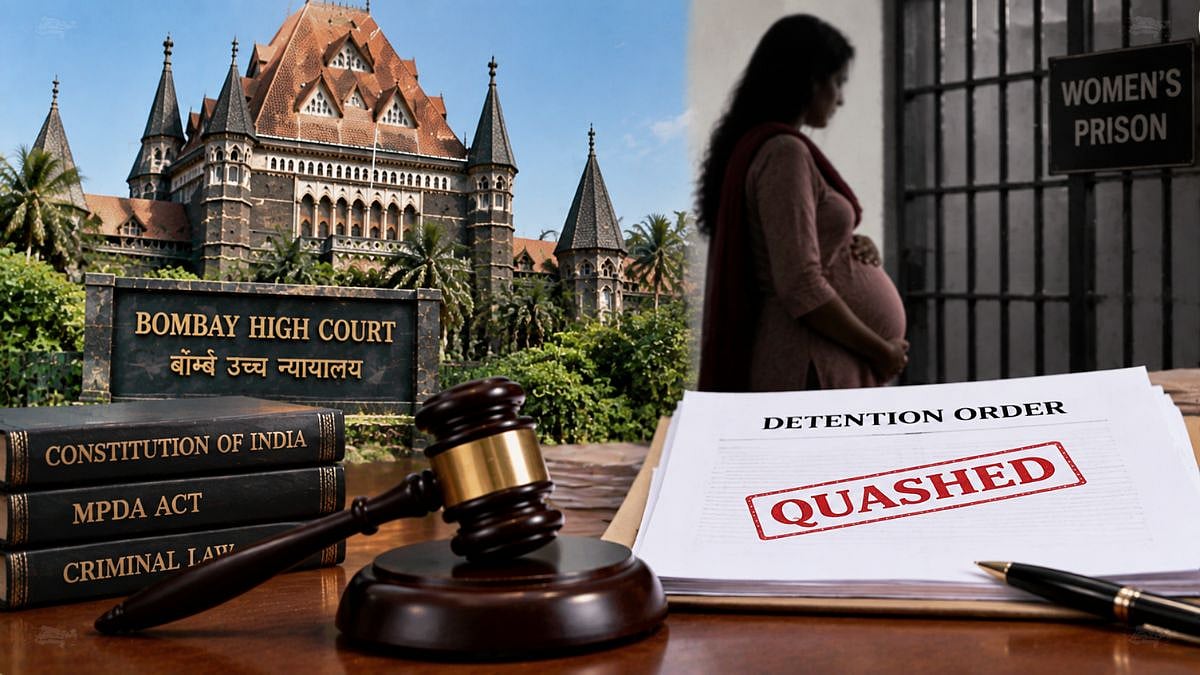
The Bombay High Court has quashed the preventive detention of a four-month pregnant woman from Pune under the Maharashtra Prevention of Dangerous Activities (MPDA) Act.
The court observed that the police could not claim that ordinary laws were insufficient when they had failed to use available legal remedies against her. A bench of Justices Sarang Kotwal and Ranjitsinha Raja Bhonsale set aside the June 30 detention order against Usha Sakat, who had been detained in Kolhapur Central Prison after being classified as a “bootlegger” under the MPDA Act.
Sakat had challenged the detention order, arguing that she was four months pregnant and there was no need for her continued detention. Her counsel also contended that the authorities had wrongly concluded that ordinary criminal laws were inadequate to curb her alleged activities.
The State, however, opposed the petition, submitting that Sakat had repeatedly committed offences and that she would receive proper medical care and facilities during her pregnancy. The court noted that 11 offences had been registered against her between 2023 and 2025, all relating to alleged violations of the Maharashtra Prohibition Act.
However, she was arrested only once. On the other occasions, she was served notices and was not arrested. The detention order was primarily based on one registered offence from February 2026 and two confidential or “in-camera” witness statements.
The court found that the allegations in the two confidential statements related to acts that could fall within the definition of a “dangerous person” and not a “bootlegger” under the MPDA Act. The judges also noted that Sakat had executed a Rs 50,000 bond for good behaviour for two years in May 2025.
The bond remained in force until May 2027. According to the police, she committed another offence during this period. However, instead of taking action for an alleged breach of the bond, the authorities withdrew the preventive proceedings and passed the detention order within four days.
The court said the authorities had powers under the Bharatiya Nagarik Suraksha Sanhita to cancel the bond and take her into custody if she had breached its conditions. The court also noted that Sakat was not arrested in connection with the February 2026 offence and was only served a notice.
The court ordered her immediate release, unless required in any other case. This decision highlights the importance of using normal legal remedies before invoking preventive detention laws.
The Maharashtra Prevention of Dangerous Activities (MPDA) Act is a law that allows for the preventive detention of individuals who are deemed to be a threat to public safety. However, the court's decision in this case suggests that the police must first exhaust all other available legal remedies before invoking this law.
In this case, the court found that the police had failed to do so, and therefore, the detention order was set aside. The decision is a significant one, as it underscores the need for the police to follow proper procedures and use available legal remedies before resorting to preventive detention.
The case also raises questions about the use of preventive detention laws, particularly in cases where the individual is pregnant or has other vulnerable circumstances. The court's decision in this case suggests that the police must take a more nuanced approach when dealing with such cases, and consider all available options before invoking preventive detention laws.
In conclusion, the Bombay High Court's decision to quash the detention order of the pregnant woman is a significant one, as it highlights the importance of using normal legal remedies and following proper procedures before invoking preventive detention laws. The decision is a reminder that the police must always act in accordance with the law and respect the rights of individuals, particularly those who are vulnerable or in sensitive circumstances.
The court's decision will have implications for the use of preventive detention laws in Maharashtra, and will likely be closely watched by human rights activists and lawyers. The decision is also a testament to the importance of an independent judiciary in ensuring that the rights of individuals are protected and that the rule of law is upheld.
The case is a reminder that the police and other law enforcement agencies must always act in accordance with the law and respect the rights of individuals. The decision is a significant one, and will likely have far-reaching implications for the use of preventive detention laws in India.
The Bombay High Court's decision is a victory for human rights and the rule of law, and will likely be welcomed by human rights activists and lawyers. The decision is a reminder that the judiciary plays a crucial role in protecting the rights of individuals and ensuring that the police and other law enforcement agencies act in accordance with the law.
In the end, the decision is a significant one, and will likely have far-reaching implications for the use of preventive detention laws in India. The case is a reminder that the police and other law enforcement agencies must always act in accordance with the law and respect the rights of individuals, particularly those who are vulnerable or in sensitive circumstances.
Frequently asked questions
What was the reason for the detention of the pregnant woman?
The woman was detained under the Maharashtra Prevention of Dangerous Activities (MPDA) Act for allegedly being a bootlegger.
Why did the Bombay High Court quash the detention order?
The court quashed the detention order because the police had failed to use normal legal remedies and had not followed proper procedures.