Supreme Court Approves Uttarakhand High Court Shift To Haldwani
Uttarakhand High Court to move from Nainital to Haldwani. Supreme Court sets aside referendum order.
'%3E%3Crect%20width%3D'96'%20height%3D'96'%20fill%3D'%23B3261E'%2F%3E%3Ccircle%20cx%3D'30'%20cy%3D'24'%20r%3D'44'%20fill%3D'%23fff'%20opacity%3D'.12'%2F%3E%3Ccircle%20cx%3D'60'%20cy%3D'74'%20r%3D'40'%20fill%3D'%23000'%20opacity%3D'.10'%2F%3E%3C%2Fg%3E%3Cg%20fill%3D'%23fff'%3E%3Crect%20x%3D'29'%20y%3D'49'%20width%3D'8'%20height%3D'19'%20rx%3D'1'%2F%3E%3Crect%20x%3D'39'%20y%3D'40'%20width%3D'9'%20height%3D'28'%20rx%3D'1'%2F%3E%3Crect%20x%3D'50'%20y%3D'45'%20width%3D'8'%20height%3D'23'%20rx%3D'1'%2F%3E%3Crect%20x%3D'60'%20y%3D'53'%20width%3D'7'%20height%3D'15'%20rx%3D'1'%2F%3E%3Crect%20x%3D'41'%20y%3D'34'%20width%3D'5'%20height%3D'6'%2F%3E%3C%2Fg%3E%3C%2Fsvg%3E)
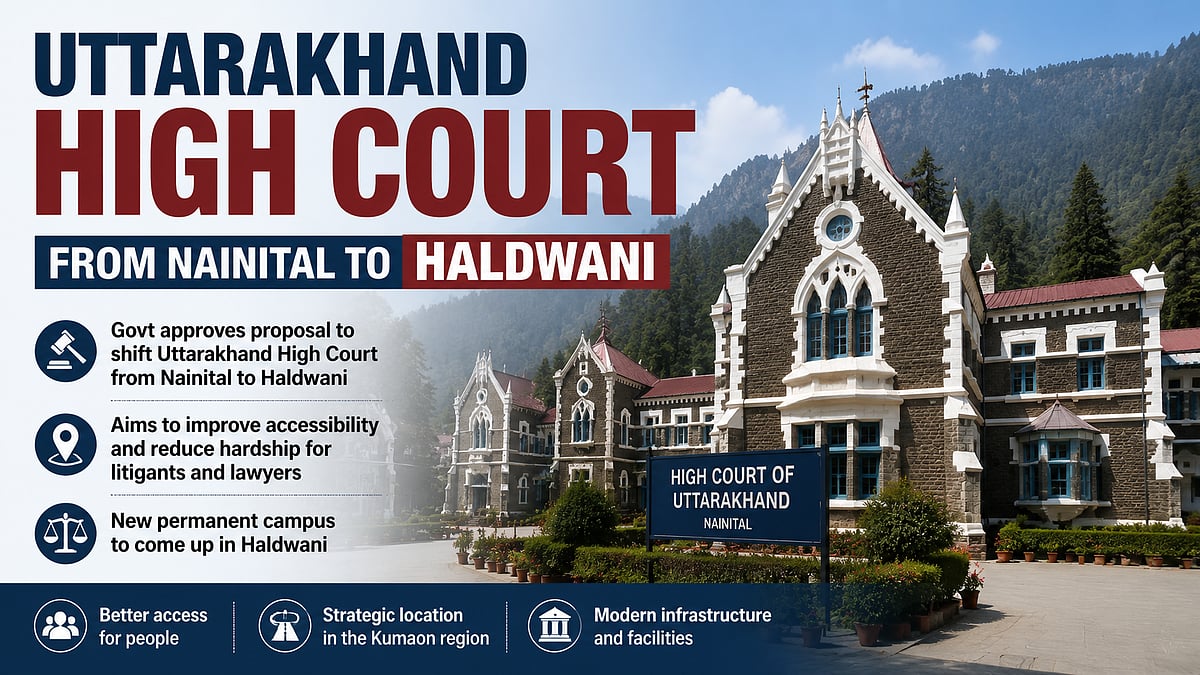
The Supreme Court has given the green light for the Uttarakhand High Court to be shifted from Nainital to Haldwani. This decision was made on Wednesday, setting aside the High Court's 2024 order that rejected the State government's proposal for the new site.
The top court ruled that decisions regarding the location of the High Court should be made on the administrative side, in consultation with the State government, rather than through judicial proceedings. A Bench of Chief Justice of India Surya Kant, Justice Joymalya Bagchi, and Justice V Mohana directed the State Government to hand over possession of the earmarked land in Haldwani to the High Court at the earliest.
The Bench also ordered the State to issue the land transfer notification within eight weeks. The court noted that some trees stand on the site but stated that possession could be handed over with the trees, emphasizing that the greenery of the area should not be disturbed.
The Supreme Court allowed the appeal filed by the Uttarakhand High Court Bar Association, stating that the High Court had no authority to pass such directions on the judicial side. The court observed that infrastructure-related issues must be resolved administratively between the High Court and the State government.
The Uttarakhand Cabinet had approved the proposal to shift the High Court from Nainital to Haldwani in 2022. However, the High Court later rejected the 26-hectare site identified at Golapar, citing concerns over the removal of trees, traffic congestion, poor connectivity, inadequate medical facilities, accommodation issues for lawyers, and hardships faced by litigants traveling from remote districts.
The Supreme Court set aside the High Court's direction to conduct a referendum among lawyers and the public on whether the High Court should be shifted. The High Court had ordered the Registrar General to create an online portal to gather opinions after directing the Chief Secretary to identify a more suitable site.
With this ruling, the Supreme Court has cleared the path for the long-pending relocation of the Uttarakhand High Court to Haldwani, leaving the remaining infrastructure-related decisions to be worked out.
The relocation of the High Court is expected to have significant implications for the administration of justice in Uttarakhand. The new location in Haldwani is likely to improve access to justice for people living in the region.
In the broader context, this decision highlights the importance of administrative decisions being made in consultation with relevant stakeholders, rather than through judicial proceedings. It also underscores the need for effective coordination between the judiciary and the executive in matters related to infrastructure development.
The Supreme Court's ruling is a significant development in the ongoing efforts to improve the administration of justice in India. It is likely to have far-reaching implications for the country's judicial system and may serve as a precedent for similar decisions in the future.
In conclusion, the Supreme Court's approval of the Uttarakhand High Court's shift to Haldwani marks an important milestone in the development of India's judicial infrastructure. The decision is expected to have a positive impact on the administration of justice in the region and may pave the way for similar developments in other parts of the country.
The significance of this decision extends beyond the realm of judicial administration, as it highlights the importance of effective governance and coordination between different branches of government. As India continues to evolve and grow, decisions like these will play a crucial role in shaping the country's future and ensuring that its institutions are equipped to meet the challenges of the 21st century.
Ultimately, the relocation of the Uttarakhand High Court to Haldwani is a testament to the Indian judiciary's commitment to improving access to justice and promoting the rule of law. It is a decision that will have far-reaching implications for the people of Uttarakhand and may serve as a model for similar initiatives in other parts of the country.