Australian Caves Preserve Ancient Bones
Underwater caves in South Australia reveal unique bone preservation. Algae marks contrast with pristine bones.
'%3E%3Crect%20width%3D'96'%20height%3D'96'%20fill%3D'%23B3261E'%2F%3E%3Ccircle%20cx%3D'30'%20cy%3D'24'%20r%3D'44'%20fill%3D'%23fff'%20opacity%3D'.12'%2F%3E%3Ccircle%20cx%3D'60'%20cy%3D'74'%20r%3D'40'%20fill%3D'%23000'%20opacity%3D'.10'%2F%3E%3C%2Fg%3E%3Cg%20fill%3D'%23fff'%3E%3Crect%20x%3D'29'%20y%3D'49'%20width%3D'8'%20height%3D'19'%20rx%3D'1'%2F%3E%3Crect%20x%3D'39'%20y%3D'40'%20width%3D'9'%20height%3D'28'%20rx%3D'1'%2F%3E%3Crect%20x%3D'50'%20y%3D'45'%20width%3D'8'%20height%3D'23'%20rx%3D'1'%2F%3E%3Crect%20x%3D'60'%20y%3D'53'%20width%3D'7'%20height%3D'15'%20rx%3D'1'%2F%3E%3Crect%20x%3D'41'%20y%3D'34'%20width%3D'5'%20height%3D'6'%2F%3E%3C%2Fg%3E%3C%2Fsvg%3E)
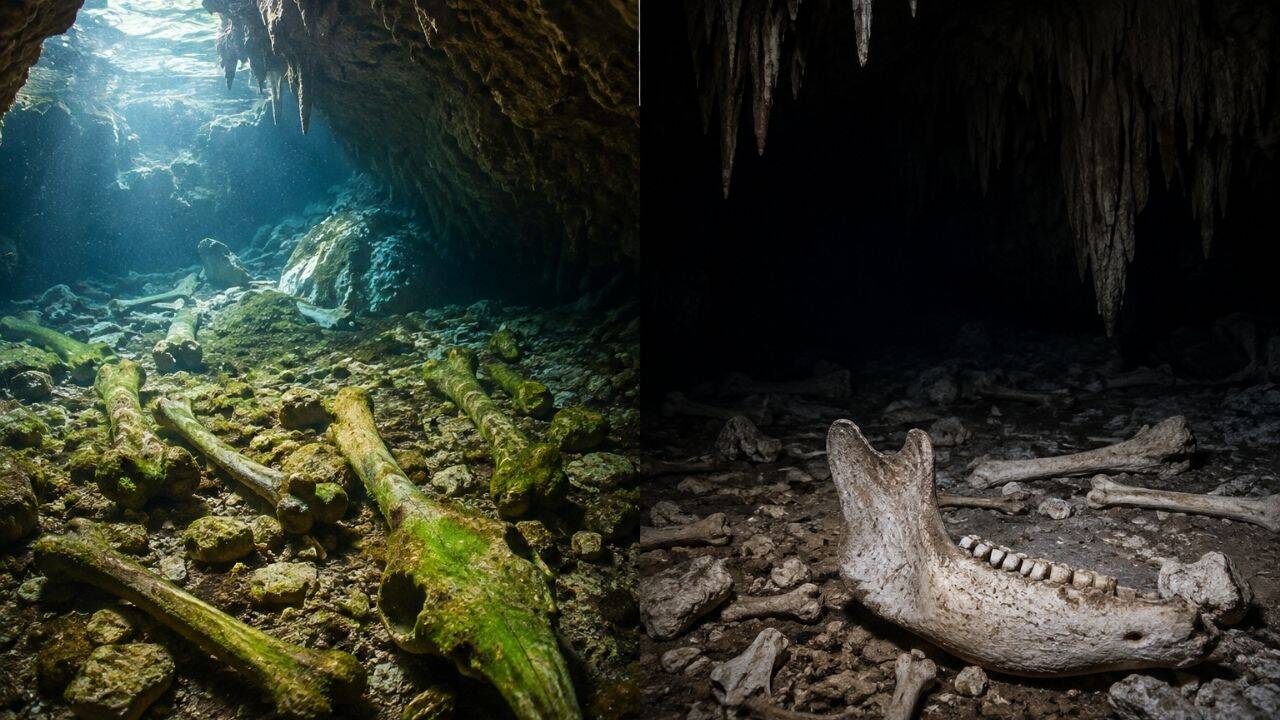
In the underwater caves of South Australia, a fascinating phenomenon has been observed. Animal bones found in these caves exhibit distinct characteristics shaped by their aquatic environment. The interplay of light and shadow in these caves leads to the development of algae, while also preserving the bones in an exceptional manner.
The contrast between the areas exposed to light and those in darkness is striking. In the light-exposed areas, algae growth is prominent, leaving visible marks on the surrounding surfaces. On the other hand, the areas in darkness remain pristine, with minimal signs of degradation or damage.
This unique preservation of bones in the underwater caves of South Australia has significant implications for scientists. By analyzing the distinct changes that occur in these environments, researchers can reconstruct ancient ecosystems and geological transformations. This, in turn, provides valuable insights into the history of our planet.
The study of these underwater caves and their contents has far-reaching consequences for the field of fossil interpretation. It establishes a new framework for understanding how fossils are formed and preserved, which can be applied to fossil discoveries worldwide.
The preservation of bones in these caves is a result of the stable and calm environment, which slows down the process of decay and degradation. This allows scientists to study the bones in detail, gaining a deeper understanding of the ancient animals that once inhabited these areas.
The underwater caves of South Australia are a remarkable natural laboratory, providing scientists with a unique opportunity to study the interplay between light, shadow, and the preservation of ancient remains. As research continues to uncover the secrets of these caves, our understanding of the ancient world and its ecosystems will continue to evolve.
The significance of this discovery extends beyond the field of paleontology, as it sheds light on the complex relationships between organisms and their environments. By studying the preservation of bones in these underwater caves, scientists can gain a deeper understanding of the delicate balance of ecosystems and the factors that influence their evolution over time.
In conclusion, the preservation of animal bones in the underwater caves of South Australia is a fascinating phenomenon that has far-reaching implications for our understanding of ancient ecosystems and geological transformations. As scientists continue to study these unique environments, we can expect to gain new insights into the history of our planet and the complex relationships between organisms and their environments.
Frequently asked questions
What is unique about the underwater caves in South Australia?
The caves have a unique environment that preserves animal bones in an exceptional manner, with algae growth in light-exposed areas and pristine bones in dark areas.
Why is the preservation of bones in these caves significant?
The preservation of bones in these caves provides valuable insights into ancient ecosystems and geological transformations, and establishes a new framework for fossil interpretation worldwide.