Supreme Court: Electoral Roll Removal Doesn't Mean Loss Of Citizenship
SC reiterates ECI not authority to determine citizenship. Deletion from electoral rolls doesn't deprive citizenship.
'%3E%3Crect%20width%3D'96'%20height%3D'96'%20fill%3D'%231A5276'%2F%3E%3Ccircle%20cx%3D'30'%20cy%3D'24'%20r%3D'44'%20fill%3D'%23fff'%20opacity%3D'.12'%2F%3E%3Ccircle%20cx%3D'60'%20cy%3D'74'%20r%3D'40'%20fill%3D'%23000'%20opacity%3D'.10'%2F%3E%3C%2Fg%3E%3Cg%20fill%3D'%23fff'%3E%3Cpath%20d%3D'M31%2041%20L48%2031%20L65%2041%20Z'%2F%3E%3Crect%20x%3D'33'%20y%3D'43'%20width%3D'4'%20height%3D'17'%2F%3E%3Crect%20x%3D'41'%20y%3D'43'%20width%3D'4'%20height%3D'17'%2F%3E%3Crect%20x%3D'51'%20y%3D'43'%20width%3D'4'%20height%3D'17'%2F%3E%3Crect%20x%3D'59'%20y%3D'43'%20width%3D'4'%20height%3D'17'%2F%3E%3Crect%20x%3D'30'%20y%3D'62'%20width%3D'36'%20height%3D'4'%20rx%3D'1'%2F%3E%3C%2Fg%3E%3C%2Fsvg%3E)
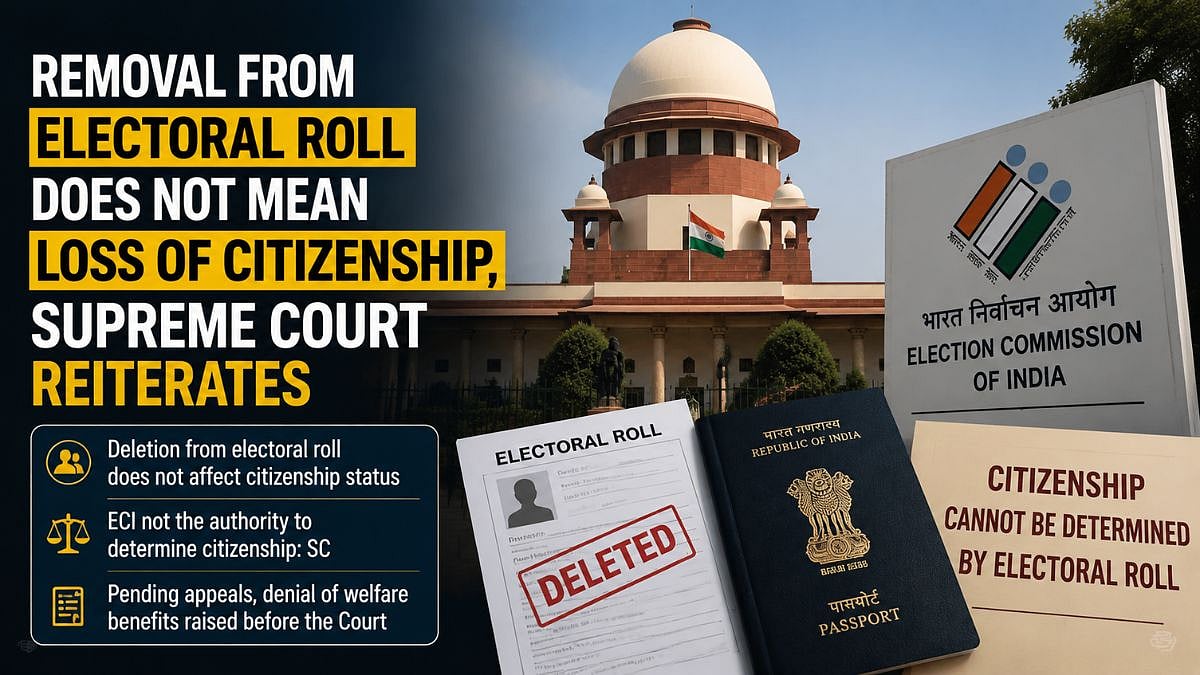
The Supreme Court has reiterated that removal of a person's name from the electoral roll does not automatically result in the loss of citizenship. This clarification was made by the court on Friday while hearing a petition related to the Special Intensive Revision (SIR) exercise.
The court, comprising Chief Justice of India Surya Kant, Justice Joymalya Bagchi, and Justice V Mohana, emphasized that the Election Commission of India (ECI) is not the authority to determine citizenship. The ECI's role is limited to maintaining electoral rolls, and it is not empowered to decide on citizenship matters.
The petition, filed by Prasenjit Bose, sought directions to streamline the functioning of Appellate Tribunals constituted to hear appeals filed by persons excluded from the electoral rolls during the SIR exercise. Senior Advocate Gopal Sankaranarayanan, appearing for the petitioner, informed the court that around 34 lakh appeals are still pending before 19 Appellate Tribunals.
Sankaranarayanan also submitted that while appeals remain pending, the West Bengal government has issued notifications denying benefits under the Public Distribution System (PDS) and welfare schemes such as Annapurna Yojana to people whose names were deleted from the electoral rolls. He further stated that caste certificates were being denied to such persons.
Responding to the submissions, Justice Bagchi referred to the Supreme Court's Bihar SIR judgment and said that once a person's name is removed from the electoral roll on the ground of doubtful citizenship, the ECI has a corresponding duty to refer the matter to the Central Government for adjudication under the Citizenship Act. Until such a determination is made, the person's citizenship status continues.
The court's clarification is significant, as it reinforces the distinction between electoral roll maintenance and citizenship determination. The ECI's role is limited to ensuring the accuracy of electoral rolls, and it is not empowered to decide on citizenship matters.
The issue of welfare benefits for persons whose names have been deleted from electoral rolls is also under scrutiny. Sankaranarayanan argued that neither the petitioners nor the court had anticipated that the deletion of names from electoral rolls would lead to the withdrawal of welfare benefits. He submitted that with nearly 33.5 lakh appeals still pending, those affected continue to lose access to welfare schemes despite the fact that 70% of the appeals decided so far have been allowed.
The Supreme Court's reiteration of the ECI's limited role in citizenship matters is a reminder that citizenship determination is a complex process that involves multiple authorities and laws. The court's clarification is expected to provide relief to individuals who have been affected by the deletion of their names from electoral rolls.
In the broader context, the issue highlights the need for coordination between different government agencies and authorities to ensure that citizens' rights are protected. The Supreme Court's decision is a step towards ensuring that the rights of citizens are safeguarded, and it is expected to have implications for the functioning of Appellate Tribunals and the adjudication of citizenship matters.
The significance of the Supreme Court's decision extends beyond the specific case, as it reinforces the principles of citizenship and the rule of law. The court's clarification is a reminder that citizenship is a fundamental right, and it is essential to ensure that citizens' rights are protected and respected.
In conclusion, the Supreme Court's reiteration that removal from the electoral roll does not mean loss of citizenship is a significant development that highlights the need for coordination between different government agencies and authorities to ensure that citizens' rights are protected. The court's clarification is expected to provide relief to individuals who have been affected by the deletion of their names from electoral rolls and reinforces the principles of citizenship and the rule of law.