Scientists Discover Invisible Gold Off Japan
Japanese researchers find vast gold deposits near underwater volcano. Extraction poses technical and environmental challenges.
'%3E%3Crect%20width%3D'96'%20height%3D'96'%20fill%3D'%23B3261E'%2F%3E%3Ccircle%20cx%3D'30'%20cy%3D'24'%20r%3D'44'%20fill%3D'%23fff'%20opacity%3D'.12'%2F%3E%3Ccircle%20cx%3D'60'%20cy%3D'74'%20r%3D'40'%20fill%3D'%23000'%20opacity%3D'.10'%2F%3E%3C%2Fg%3E%3Cg%20fill%3D'%23fff'%3E%3Crect%20x%3D'29'%20y%3D'49'%20width%3D'8'%20height%3D'19'%20rx%3D'1'%2F%3E%3Crect%20x%3D'39'%20y%3D'40'%20width%3D'9'%20height%3D'28'%20rx%3D'1'%2F%3E%3Crect%20x%3D'50'%20y%3D'45'%20width%3D'8'%20height%3D'23'%20rx%3D'1'%2F%3E%3Crect%20x%3D'60'%20y%3D'53'%20width%3D'7'%20height%3D'15'%20rx%3D'1'%2F%3E%3Crect%20x%3D'41'%20y%3D'34'%20width%3D'5'%20height%3D'6'%2F%3E%3C%2Fg%3E%3C%2Fsvg%3E)
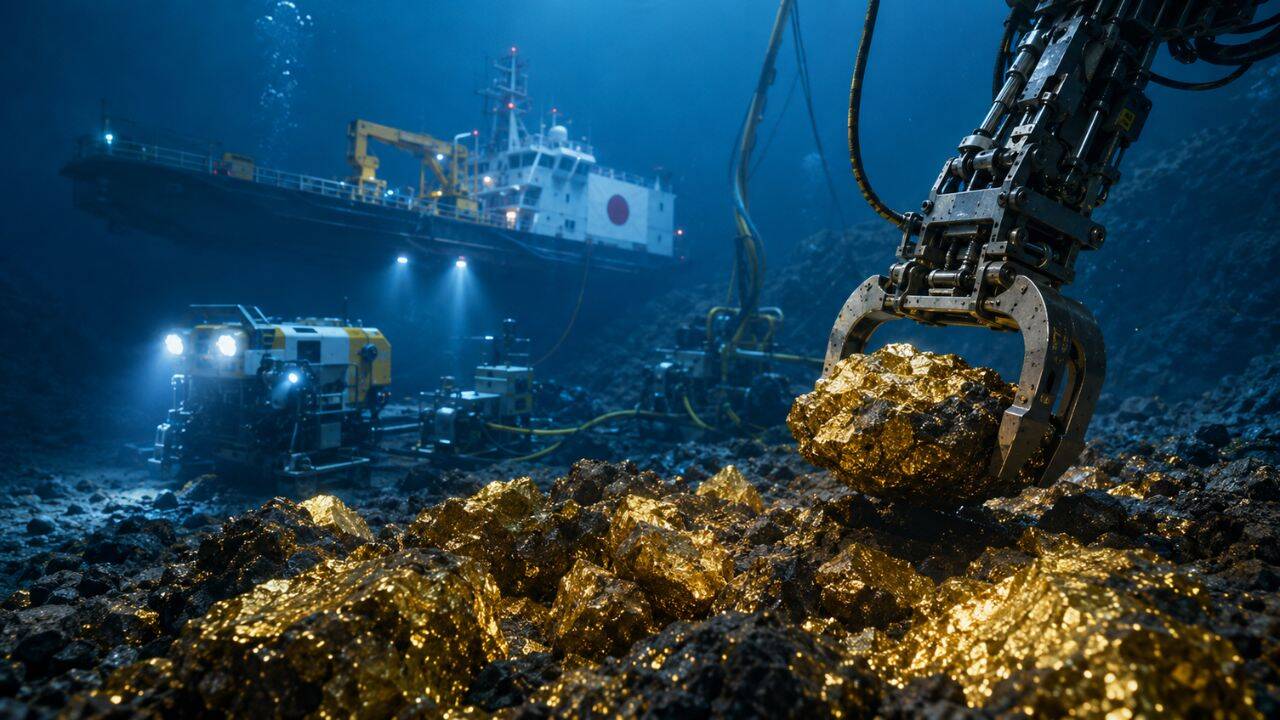
A team of Japanese scientists has made a groundbreaking discovery of 'invisible gold' in an underwater volcano off the coast of Japan. The gold deposits were found near the Higashi-Aogashima caldera, a submerged volcanic crater located in the Pacific Ocean.
The researchers discovered that the gold is locked within pyrite minerals on the seafloor, which are formed through hydrothermal activity. These unique ecosystems, hosted by the hydrothermal vents, are still being studied by scientists to understand their complexities.
The discovery of invisible gold in such large quantities has significant implications for the mining industry. However, extracting this hidden treasure poses substantial technical and environmental challenges. The process of extracting gold from pyrite minerals requires advanced technology and careful planning to avoid damaging the surrounding ecosystem.
The Higashi-Aogashima caldera is a unique environment, with its own set of flora and fauna that have adapted to the harsh conditions surrounding the hydrothermal vents. The discovery of invisible gold in this region has prompted scientists to consider the trade-offs between resource acquisition and ecological impact.
The Japanese researchers' findings have shed new light on the potential for gold deposits in underwater volcanoes. As the world's gold reserves continue to dwindle, the discovery of new gold deposits is crucial for meeting the increasing demand for this precious metal.
However, the extraction of gold from these deposits must be carefully managed to avoid harming the delicate ecosystems that exist in these underwater environments. The Japanese government and other regulatory bodies will need to work closely with mining companies to ensure that any extraction activities are carried out in a responsible and sustainable manner.
The discovery of invisible gold off the coast of Japan is a significant breakthrough, with far-reaching implications for the mining industry and the environment. As scientists continue to study this phenomenon, they will need to balance the potential benefits of extracting this valuable resource with the need to protect the unique ecosystems that exist in these underwater environments.
In conclusion, the discovery of invisible gold in an underwater volcano off Japan is a remarkable find that highlights the complexities of extracting valuable resources from unique and fragile ecosystems. As the world continues to demand more gold, scientists and policymakers will need to work together to ensure that any extraction activities are carried out in a responsible and sustainable manner.
The significance of this discovery extends beyond the mining industry, as it also highlights the importance of preserving our planet's unique ecosystems. The underwater volcano and its surrounding environment are a treasure trove of scientific discovery, and it is crucial that we prioritize their protection for future generations.