Kerala HC Rules ₹20,000 Cap Not Limit For Wild Animal Attack Compensation
Kerala High Court rules that ₹20,000 cap cannot limit compensation for wild animal attack victims. The court says the State must provide just and adequate compensation.
'%3E%3Crect%20width%3D'96'%20height%3D'96'%20fill%3D'%23B3261E'%2F%3E%3Ccircle%20cx%3D'30'%20cy%3D'24'%20r%3D'44'%20fill%3D'%23fff'%20opacity%3D'.12'%2F%3E%3Ccircle%20cx%3D'60'%20cy%3D'74'%20r%3D'40'%20fill%3D'%23000'%20opacity%3D'.10'%2F%3E%3C%2Fg%3E%3Cg%20fill%3D'%23fff'%3E%3Crect%20x%3D'29'%20y%3D'49'%20width%3D'8'%20height%3D'19'%20rx%3D'1'%2F%3E%3Crect%20x%3D'39'%20y%3D'40'%20width%3D'9'%20height%3D'28'%20rx%3D'1'%2F%3E%3Crect%20x%3D'50'%20y%3D'45'%20width%3D'8'%20height%3D'23'%20rx%3D'1'%2F%3E%3Crect%20x%3D'60'%20y%3D'53'%20width%3D'7'%20height%3D'15'%20rx%3D'1'%2F%3E%3Crect%20x%3D'41'%20y%3D'34'%20width%3D'5'%20height%3D'6'%2F%3E%3C%2Fg%3E%3C%2Fsvg%3E)
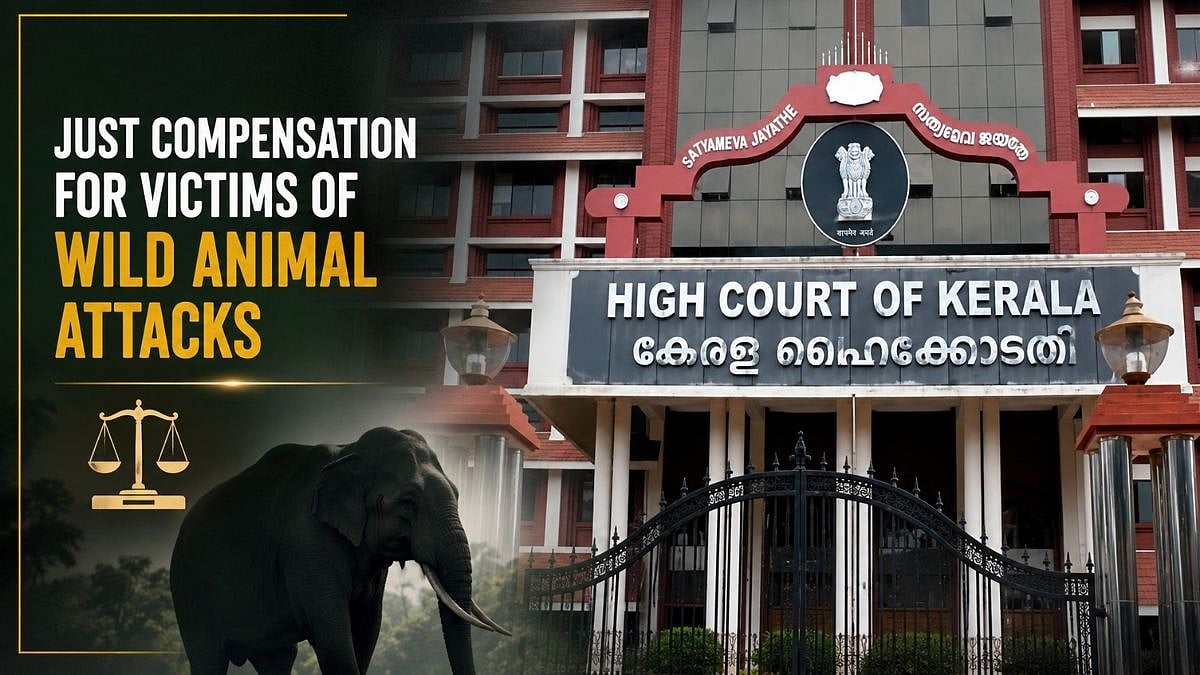
The Kerala High Court has made a significant ruling regarding compensation for victims of wild animal attacks. On August 31, 2026, Justice Mohammed Nias CP dismissed a regular second appeal filed by Forest Department officials, upholding the lower courts' decision to award compensation to the family of a man who died in a wild elephant attack.
The High Court observed that the right to claim just and adequate compensation for loss of life or injury is rooted in Article 21 of the Constitution and the common law principle of strict liability. These rights exist independently of any executive compensation scheme. The court stated that the amount prescribed under the Kerala Rules for Payment of Compensation to Victims of Attack by Wild Animals, 1980, is only the minimum payable by the State as ex gratia compensation.
The court emphasized that the ₹20,000 cap is a floor, not a ceiling, and that courts are duty-bound to ensure that the compensation awarded is just, fair, and reasonable, commensurate with the nature and extent of the injury suffered. The compensation must reflect the true value of the loss suffered, and the worth of a human life cannot be reduced to an amount that fails to adequately recognize the magnitude of the loss.
The High Court also held that the State, as the deemed owner and custodian of wild animals, can be held liable under the principle of strict liability when such animals cause injury or damage. The court said the State could be liable even in the absence of negligence because the liability was strict. The government has a duty to take adequate measures to prevent wild animals from entering human habitations or agricultural properties.
The court's ruling underlines an important distinction between compensation fixed under a government scheme and the power of courts to award an amount they consider just and reasonable. In effect, the ₹20,000 provided under the Rules cannot become a ceiling when the actual loss warrants higher compensation.
The Kerala High Court's decision is significant, as it ensures that victims of wild animal attacks receive fair and adequate compensation for their losses. The ruling also highlights the State's responsibility to protect its citizens from such attacks and to take measures to prevent them.
The court's observation that the State has strict liability for wild animal attacks is also noteworthy. This means that the State can be held liable for damages caused by wild animals, even if there is no negligence on the part of the State.
In conclusion, the Kerala High Court's ruling is a significant step towards ensuring that victims of wild animal attacks receive the compensation they deserve. The decision emphasizes the importance of fair and adequate compensation and the State's responsibility to protect its citizens.
The implications of this ruling are far-reaching, and it is likely to have a significant impact on the way compensation is awarded to victims of wild animal attacks in Kerala. The decision is also likely to be cited in similar cases in other states, and it may lead to a re-evaluation of the compensation schemes in place for such attacks.
Overall, the Kerala High Court's ruling is a welcome move towards ensuring that justice is served for victims of wild animal attacks. It is a significant step towards recognizing the rights of citizens to fair and adequate compensation for their losses, and it emphasizes the importance of the State's responsibility to protect its citizens.
The ruling is also a reminder that the courts have the power to award compensation that is just and reasonable, and that the amounts fixed under government schemes are not the only consideration. The decision is a significant milestone in the journey towards ensuring that victims of wild animal attacks receive the compensation they deserve, and it is likely to have a lasting impact on the way such cases are handled in the future.
In the context of Kerala, where wild animal attacks are a significant concern, this ruling is particularly important. The State has a large population of wild animals, and attacks on humans are not uncommon. The ruling ensures that victims of such attacks receive fair and adequate compensation, and it emphasizes the State's responsibility to protect its citizens.
In the broader context of India, this ruling is also significant. It highlights the importance of fair and adequate compensation for victims of wild animal attacks, and it emphasizes the responsibility of the State to protect its citizens. The decision is likely to be cited in similar cases in other states, and it may lead to a re-evaluation of the compensation schemes in place for such attacks.
In conclusion, the Kerala High Court's ruling is a significant step towards ensuring that victims of wild animal attacks receive the compensation they deserve. The decision emphasizes the importance of fair and adequate compensation, and it highlights the State's responsibility to protect its citizens. The ruling is likely to have a lasting impact on the way such cases are handled in the future, and it is a welcome move towards ensuring that justice is served for victims of wild animal attacks.
What it means for Mumbai or India is that the ruling sets a precedent for other states to follow, ensuring that victims of wild animal attacks receive fair and adequate compensation. The decision also emphasizes the importance of the State's responsibility to protect its citizens, which is a significant consideration in the context of India's growing population and increasing human-wildlife conflict.
The ruling is a significant step towards recognizing the rights of citizens to fair and adequate compensation for their losses, and it emphasizes the importance of the State's responsibility to protect its citizens. The decision is likely to have a lasting impact on the way such cases are handled in the future, and it is a welcome move towards ensuring that justice is served for victims of wild animal attacks.
The Kerala High Court's decision is a significant milestone in the journey towards ensuring that victims of wild animal attacks receive the compensation they deserve. The ruling emphasizes the importance of fair and adequate compensation, and it highlights the State's responsibility to protect its citizens. The decision is likely to be cited in similar cases in other states, and it may lead to a re-evaluation of the compensation schemes in place for such attacks.
In the end, the Kerala High Court's ruling is a significant step towards ensuring that victims of wild animal attacks receive the compensation they deserve. The decision emphasizes the importance of fair and adequate compensation, and it highlights the State's responsibility to protect its citizens. The ruling is likely to have a lasting impact on the way such cases are handled in the future, and it is a welcome move towards ensuring that justice is served for victims of wild animal attacks.
Frequently asked questions
What is the Kerala High Court's ruling on wild animal attack compensation?
The Kerala High Court has ruled that the ₹20,000 cap cannot limit compensation for wild animal attack victims, and that the State must provide just and adequate compensation.
What is the principle of strict liability in the context of wild animal attacks?
The principle of strict liability holds that the State, as the deemed owner and custodian of wild animals, can be held liable for damages caused by wild animals, even if there is no negligence on the part of the State.