India's New Wealth Exposes Old Social Problem
India's economic growth has led to increased prosperity, but also a widening social gap. Affluent individuals often display disrespect towards those with less power.
'%3E%3Crect%20width%3D'96'%20height%3D'96'%20fill%3D'%23B3261E'%2F%3E%3Ccircle%20cx%3D'30'%20cy%3D'24'%20r%3D'44'%20fill%3D'%23fff'%20opacity%3D'.12'%2F%3E%3Ccircle%20cx%3D'60'%20cy%3D'74'%20r%3D'40'%20fill%3D'%23000'%20opacity%3D'.10'%2F%3E%3C%2Fg%3E%3Cg%20fill%3D'%23fff'%3E%3Crect%20x%3D'29'%20y%3D'49'%20width%3D'8'%20height%3D'19'%20rx%3D'1'%2F%3E%3Crect%20x%3D'39'%20y%3D'40'%20width%3D'9'%20height%3D'28'%20rx%3D'1'%2F%3E%3Crect%20x%3D'50'%20y%3D'45'%20width%3D'8'%20height%3D'23'%20rx%3D'1'%2F%3E%3Crect%20x%3D'60'%20y%3D'53'%20width%3D'7'%20height%3D'15'%20rx%3D'1'%2F%3E%3Crect%20x%3D'41'%20y%3D'34'%20width%3D'5'%20height%3D'6'%2F%3E%3C%2Fg%3E%3C%2Fsvg%3E)
India's economic mobility is a cause for celebration, with many families now able to afford luxuries their parents could only dream of. However, this newfound prosperity has also exposed an old social problem - the widening gap between the haves and have-nots.
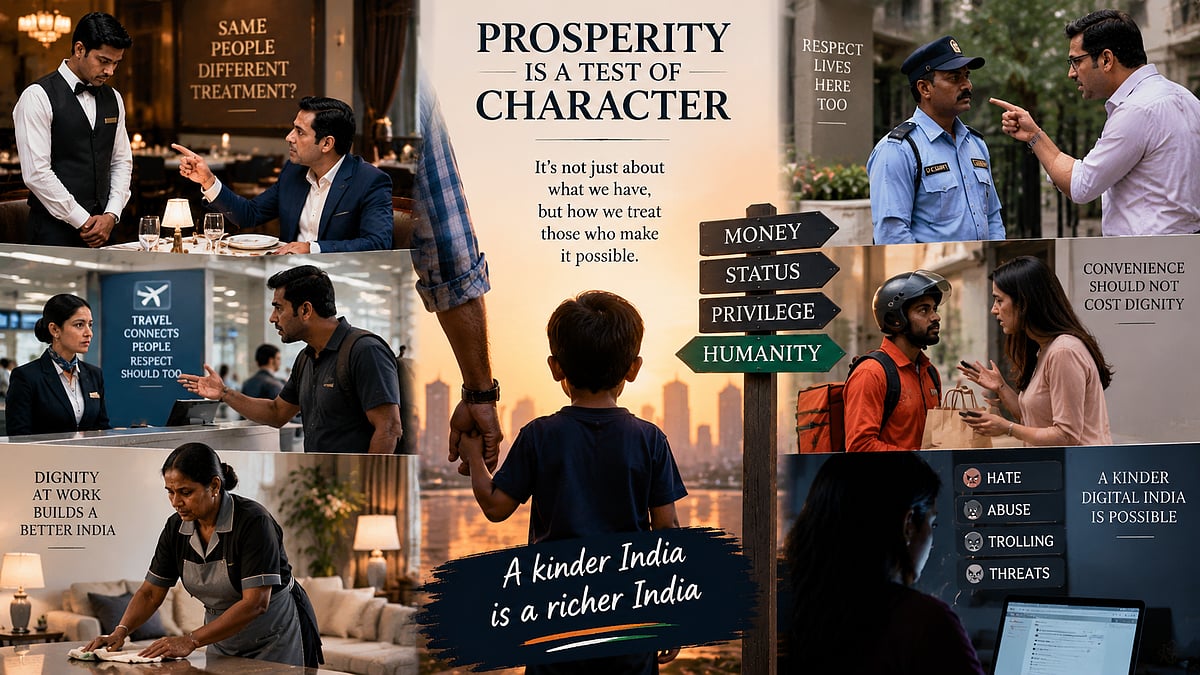
A simple test of prosperity can be observed in how affluent individuals interact with those who have less money or power, such as waiters, security guards, or airline employees. The tone and language used can be condescending and dismissive, highlighting the uncomfortable possibility that India's new wealth has not necessarily led to a greater understanding of social equality.
Despite economic mobility disrupting some old hierarchies, the instinct to rank people remains intact. A person's designation, surname, accent, school, occupation, neighbourhood, or connection can still determine how quickly respect is offered. The service economy has made this particularly visible, with essential workers such as waiters, drivers, and cleaners often being treated as inferior.
Domestic workers, in particular, expose a deeper faultline in Indian society. Many households of educated professionals expect their domestic workers to reorganise their lives around theirs, without regard for their dignity or well-being. The physical burden of domestic life may have been reduced, but the responsibility and dignity attached to care work have not improved.
Status anxiety has also contributed to this problem, with many families using their wealth and consumption as a signal of their social status. Social media has turned private consumption into public comparison, creating a culture of entitlement and competition. The ability to pay has become mistaken for a claim over another person's dignity, leading to a lack of respect and empathy towards those with less power.
The obsession with convenience has also come at a cost, with many individuals absorbing the inconvenience that others no longer see. The rider who navigates traffic to deliver dinner, the driver who waits outside the school, and the cleaner who adjusts to household schedules are all examples of this invisible transfer of time, effort, and risk from those with less bargaining power to those with more.
In conclusion, India's new wealth has exposed an old social problem that needs to be addressed. While economic mobility is a cause for celebration, it is also important to recognize the need for greater social equality and respect for all individuals, regardless of their wealth or status.
The significance of this issue for India lies in its impact on social cohesion and equality. As the country continues to grow and develop, it is essential to address the underlying social problems that threaten to undermine this progress. By recognizing the dignity and worth of all individuals, regardless of their wealth or status, India can work towards creating a more just and equitable society.
Ultimately, the solution to this problem lies in a fundamental shift in mindset and behaviour. It requires a recognition of the inherent dignity and worth of all individuals, regardless of their wealth or status. It also requires a willingness to listen, learn, and empathize with those who have less power and privilege. By working together to address this issue, India can create a more just and equitable society, where everyone has the opportunity to thrive and reach their full potential.
Frequently asked questions
What is the main issue highlighted in the article?
The article highlights the widening social gap between the haves and have-nots in India, and how affluent individuals often display disrespect towards those with less power.
How has the service economy contributed to this problem?
The service economy has made social inequality more visible, with essential workers such as waiters, drivers, and cleaners often being treated as inferior.