Scientists Map Mount St. Helens Magma
23 blasts reveal magma depth, aid eruption forecasts
'%3E%3Crect%20width%3D'96'%20height%3D'96'%20fill%3D'%23B3261E'%2F%3E%3Ccircle%20cx%3D'30'%20cy%3D'24'%20r%3D'44'%20fill%3D'%23fff'%20opacity%3D'.12'%2F%3E%3Ccircle%20cx%3D'60'%20cy%3D'74'%20r%3D'40'%20fill%3D'%23000'%20opacity%3D'.10'%2F%3E%3C%2Fg%3E%3Cg%20fill%3D'%23fff'%3E%3Crect%20x%3D'29'%20y%3D'49'%20width%3D'8'%20height%3D'19'%20rx%3D'1'%2F%3E%3Crect%20x%3D'39'%20y%3D'40'%20width%3D'9'%20height%3D'28'%20rx%3D'1'%2F%3E%3Crect%20x%3D'50'%20y%3D'45'%20width%3D'8'%20height%3D'23'%20rx%3D'1'%2F%3E%3Crect%20x%3D'60'%20y%3D'53'%20width%3D'7'%20height%3D'15'%20rx%3D'1'%2F%3E%3Crect%20x%3D'41'%20y%3D'34'%20width%3D'5'%20height%3D'6'%2F%3E%3C%2Fg%3E%3C%2Fsvg%3E)
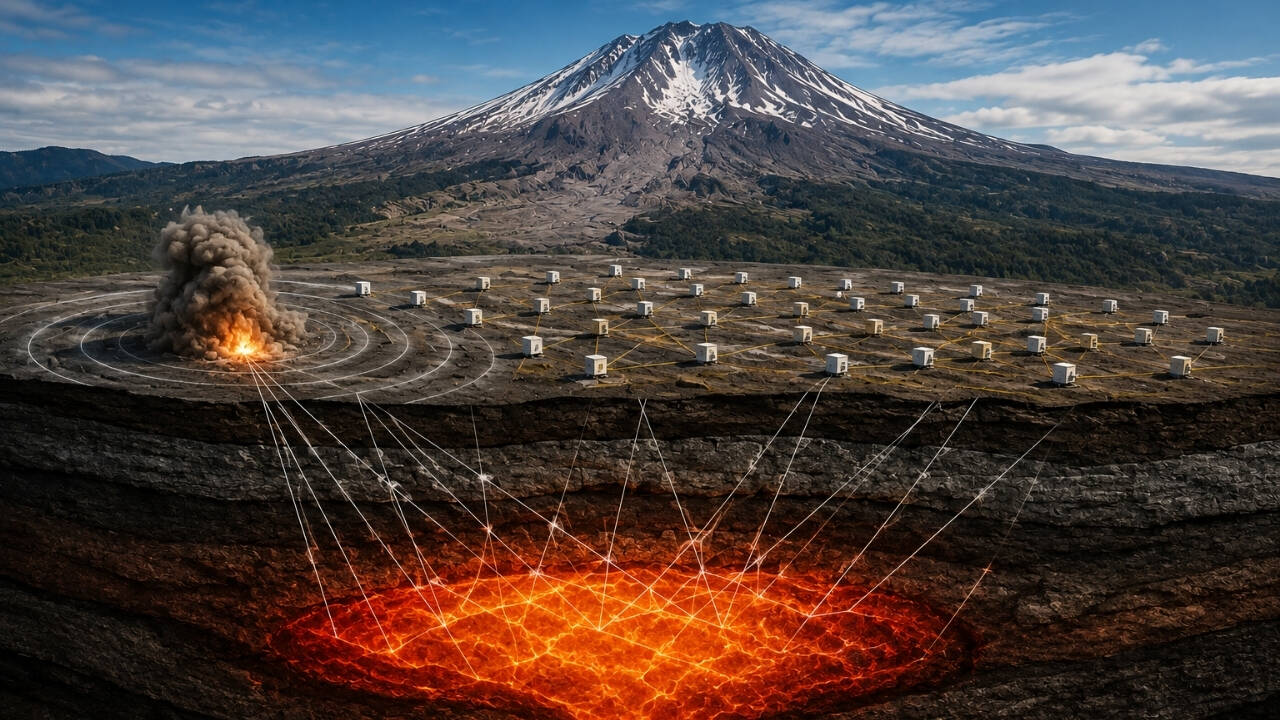
In 2014, a team of scientists conducted a groundbreaking study to map the magma beneath Mount St. Helens. The researchers used 23 controlled explosions, paired with advanced seismic technology, to investigate the volcano's subterranean magma systems. This innovative approach allowed them to discover a large magma reservoir located between four and fifteen kilometers deep.
The study employed a range of instruments to track seismic waves within the volcano, providing vital information about magma movements. By analyzing these waves, the scientists gained a better understanding of the volcano's internal structure and the behavior of the magma.
The discovery of the magma reservoir is significant, as it can help scientists forecast volcanic activity and potential eruptions. Mount St. Helens is an active volcano, and understanding its magma systems is crucial for predicting when and how it might erupt.
The use of controlled explosions and seismic technology is a relatively new approach in volcanology. It allows scientists to gather detailed information about a volcano's internal structure, which can be used to improve eruption forecasts.
The study's findings have important implications for volcano monitoring and eruption prediction. By understanding the movement of magma beneath a volcano, scientists can better predict when an eruption might occur. This can help save lives and reduce the impact of volcanic eruptions on nearby communities.
The research team's work on Mount St. Helens is part of a broader effort to improve our understanding of volcanic activity and to develop more effective eruption forecasting tools. As scientists continue to study and monitor volcanoes around the world, they are gaining a better understanding of the complex processes that drive volcanic eruptions.
The study's results are a significant step forward in the field of volcanology, and they demonstrate the importance of continued research and monitoring of volcanic activity. By improving our understanding of volcanoes and their internal processes, scientists can help reduce the risks associated with volcanic eruptions and save lives.
Frequently asked questions
What method did scientists use to map Mount St. Helens' magma?
They used controlled explosions paired with seismic technology.
Why is understanding magma movements important?
It helps scientists forecast volcanic activity and potential eruptions.