Maharashtra Freedom Of Religion Act Faces Supreme Court Challenge
Civil society groups oppose new law, plan Supreme Court challenge. Law set to come into force on August 28.
'%3E%3Crect%20width%3D'96'%20height%3D'96'%20fill%3D'%231A5276'%2F%3E%3Ccircle%20cx%3D'30'%20cy%3D'24'%20r%3D'44'%20fill%3D'%23fff'%20opacity%3D'.12'%2F%3E%3Ccircle%20cx%3D'60'%20cy%3D'74'%20r%3D'40'%20fill%3D'%23000'%20opacity%3D'.10'%2F%3E%3C%2Fg%3E%3Cg%20fill%3D'%23fff'%3E%3Cpath%20d%3D'M31%2041%20L48%2031%20L65%2041%20Z'%2F%3E%3Crect%20x%3D'33'%20y%3D'43'%20width%3D'4'%20height%3D'17'%2F%3E%3Crect%20x%3D'41'%20y%3D'43'%20width%3D'4'%20height%3D'17'%2F%3E%3Crect%20x%3D'51'%20y%3D'43'%20width%3D'4'%20height%3D'17'%2F%3E%3Crect%20x%3D'59'%20y%3D'43'%20width%3D'4'%20height%3D'17'%2F%3E%3Crect%20x%3D'30'%20y%3D'62'%20width%3D'36'%20height%3D'4'%20rx%3D'1'%2F%3E%3C%2Fg%3E%3C%2Fsvg%3E)
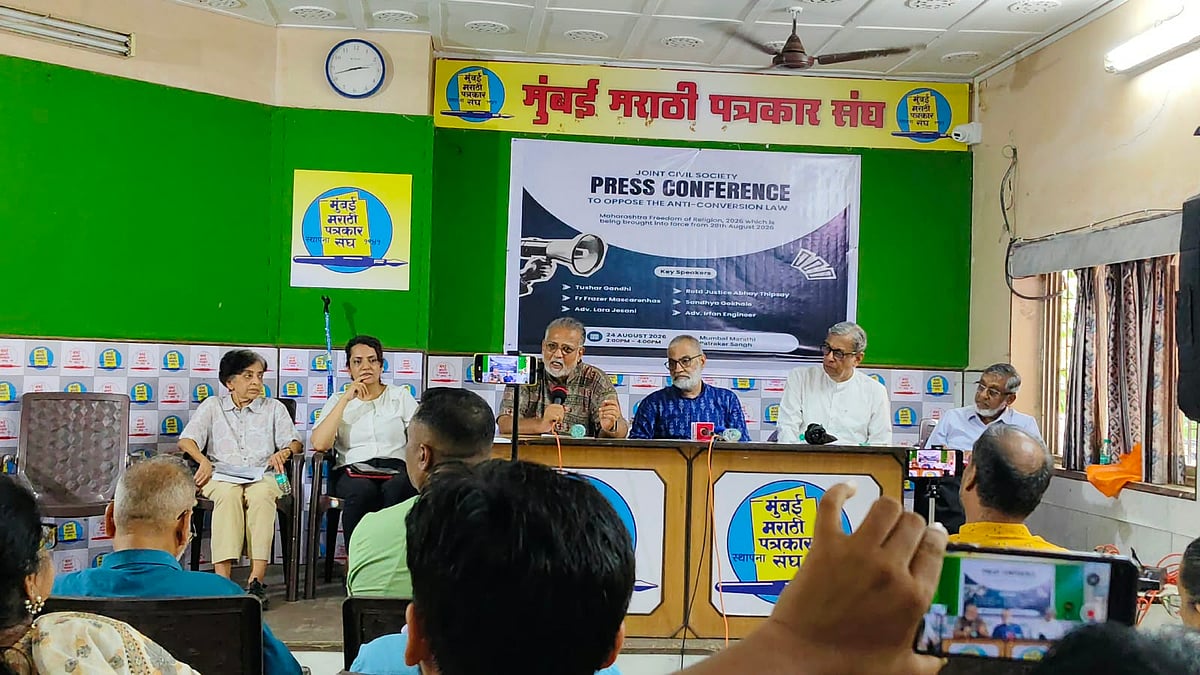
A coalition of 20 civil society organisations, women's rights groups, and religious bodies has issued a joint declaration against the Maharashtra Freedom of Religion Act, 2026. The groups announced that three member organisations are preparing to move the Supreme Court of India to challenge the constitutional validity of the law.
The legislation, scheduled to come into force on August 28, has triggered widespread alarm over potential state surveillance, interference in personal autonomy, and targeted harassment of vulnerable communities. The law enforces advance notice requirements, mandatory declarations, and post-conversion reporting obligations for anyone intending to change their faith.
Constitutional experts, legal advocates, and community leaders addressed a press conference at the Mumbai Marathi Patrakar Sangh, where they collectively demanded that the state government immediately withdraw the notification or place the law on hold, pending the apex court's decisions on similar state-level anti-conversion statutes.
The groups raised concerns over the law's provisions, which will make alleged violations cognisable and non-bailable, while placing the onus on the accused to prove their innocence. They also highlighted that vaguely defined terms such as 'allurement' risk criminalising routine charitable work, educational assistance, religious preaching, or syncretic cultural practices.
According to the panelists, the People's Union for Civil Liberties (PUCL), Association for Protection of Civil Rights (APCR), and Forum Against Oppression of Women are working on challenging the legality of the law in the Supreme Court of India.
Legal experts allege that the law may affect religious minorities and individual freedoms. Adv. Irfan Engineer, Director at Centre for Study of Society and Secularism, said that the law will be used to harass Christians and Muslims, violating the Indian Constitution's Right to Life and Religion.
The law has been criticised for establishing an unprecedented administrative regime over private matters of faith, marriage, and individual choice. The groups demand that the state government withdraw the notification pending Supreme Court review.
The Supreme Court challenge is expected to be filed soon, with the groups arguing that the law is unconstitutional and violates individual freedoms. The outcome of the challenge will have significant implications for religious minorities and individual freedoms in Maharashtra.
In the meantime, the groups have called on the state government to withdraw the notification or place the law on hold, pending the apex court's decision. The issue has sparked widespread debate and concern among civil society groups, religious bodies, and human rights advocates.
The Maharashtra Freedom of Religion Act, 2026, has been criticised for its potential to harass vulnerable communities and interfere with personal autonomy. The Supreme Court challenge is seen as a crucial step in protecting individual freedoms and ensuring that the law is constitutional.
The case is expected to be closely watched, with significant implications for the future of religious freedom and individual autonomy in India. The groups have vowed to continue their fight against the law, arguing that it is essential to protect the rights of all citizens, regardless of their religion or faith.
In conclusion, the Maharashtra Freedom of Religion Act, 2026, faces a significant challenge in the Supreme Court, with civil society groups, women's rights groups, and religious bodies arguing that the law is unconstitutional and violates individual freedoms. The outcome of the challenge will have far-reaching implications for religious minorities and individual freedoms in Maharashtra and beyond.
Frequently asked questions
What is the Maharashtra Freedom Of Religion Act, 2026?
The Maharashtra Freedom Of Religion Act, 2026, is a law that enforces advance notice requirements, mandatory declarations, and post-conversion reporting obligations for anyone intending to change their faith.
Why are civil society groups opposing the law?
Civil society groups are opposing the law because they believe it is unconstitutional and violates individual freedoms, and may be used to harass vulnerable communities and interfere with personal autonomy.