Bhopal Lake Hyacinth Removal Raises Aquatic Life Concerns
Bhopal Municipal Corporation's water hyacinth removal drive sparks concerns over aquatic life. NGT steps in to protect the lake.
'%3E%3Crect%20width%3D'96'%20height%3D'96'%20fill%3D'%23B3261E'%2F%3E%3Ccircle%20cx%3D'30'%20cy%3D'24'%20r%3D'44'%20fill%3D'%23fff'%20opacity%3D'.12'%2F%3E%3Ccircle%20cx%3D'60'%20cy%3D'74'%20r%3D'40'%20fill%3D'%23000'%20opacity%3D'.10'%2F%3E%3C%2Fg%3E%3Cg%20fill%3D'%23fff'%3E%3Crect%20x%3D'29'%20y%3D'49'%20width%3D'8'%20height%3D'19'%20rx%3D'1'%2F%3E%3Crect%20x%3D'39'%20y%3D'40'%20width%3D'9'%20height%3D'28'%20rx%3D'1'%2F%3E%3Crect%20x%3D'50'%20y%3D'45'%20width%3D'8'%20height%3D'23'%20rx%3D'1'%2F%3E%3Crect%20x%3D'60'%20y%3D'53'%20width%3D'7'%20height%3D'15'%20rx%3D'1'%2F%3E%3Crect%20x%3D'41'%20y%3D'34'%20width%3D'5'%20height%3D'6'%2F%3E%3C%2Fg%3E%3C%2Fsvg%3E)
Bhopal's Upper Lake is facing a significant threat to its aquatic ecosystem due to the removal of water hyacinth by the Bhopal Municipal Corporation (BMC). The National Green Tribunal (NGT) has intervened to protect the lake's aquatic life from the harmful impact of pesticide spraying on water chestnut crops.
The NGT took suo motu cognizance of pesticide spraying on nearly 60 hectares of water chestnut cultivation in the Upper Lake, raising concerns over the rapid spread of water hyacinth, declining dissolved oxygen levels, and fish deaths. A three-member joint committee was constituted to inspect the lake and submit a factual and action-taken report within six weeks.
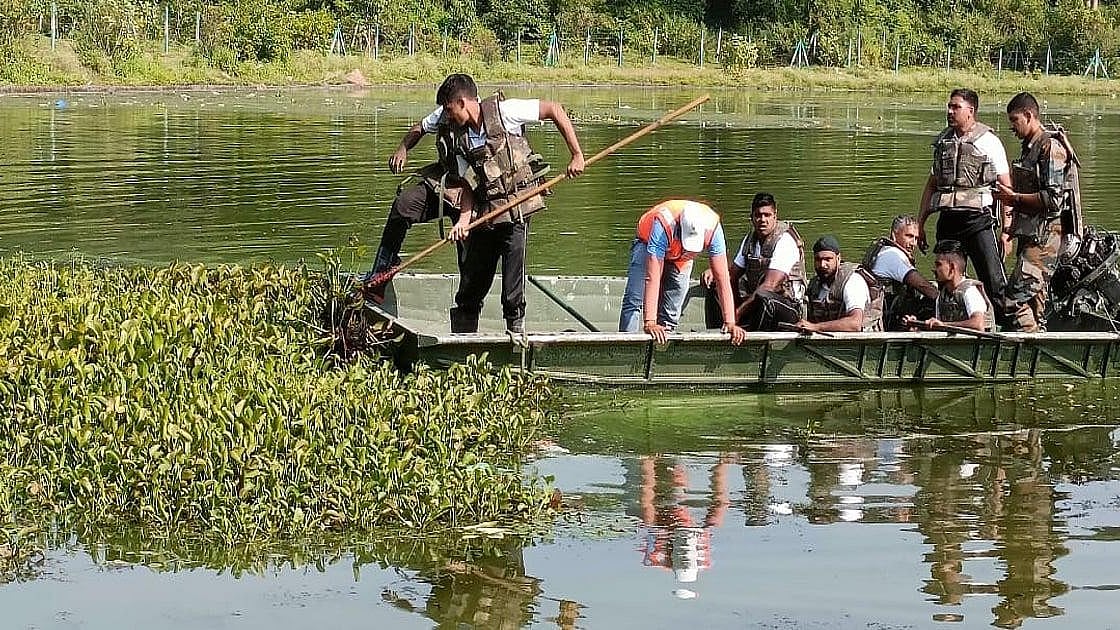
Following the hearing, the BMC's lake conservation cell carried out a major clean-up operation in Upper Lake, removing large quantities of water hyacinth from a 100-metre stretch beneath the solar panels along VIP Road. However, the manner in which the removal is being carried out has triggered questions over whether the drive is being undertaken without adequate ecological planning.
The thick layers of water hyacinth have become habitats for several species, including birds that have built nests among the vegetation, with eggs and hatchlings present in some areas. During mechanical removal, these sections are lifted along with the weed, creating a risk to nests and young birds. Turtles, fish, and frogs may also get trapped in the machinery during the operation, raising concerns that an exercise intended to protect the lake could inadvertently damage its ecosystem.
According to Saurabh Popli, associate professor at School of Planning and Architecture, the shoreline ecosystem should not be disturbed in the name of removing water hyacinth. He emphasized that any operation to remove water hyacinth should be conducted with the assistance of ecosystem experts, rather than assigning the work to engineers using heavy machinery.
Popli pointed out that the proliferation of water hyacinth is not merely a surface-level problem, but rather a result of polluted water and sewage entering the lake. He called for an integrated plan to stop sewage inflow, rather than fragmented action by different departments.
The BMC chief engineer, Santosh Gupta, stated that the removal process is being carried out with care, and no aquatic life is being deliberately removed, though some may have been taken out inadvertently.
The situation highlights the need for a balanced approach to lake conservation, taking into account the potential impact on aquatic life. The NGT's intervention and the joint committee's report will be crucial in determining the best course of action to protect the Upper Lake's ecosystem.
The concerns raised by experts and the NGT's intervention underscore the importance of considering the long-term effects of human activities on the environment. The removal of water hyacinth, while necessary, must be done in a way that minimizes harm to the lake's aquatic life.
In conclusion, the Bhopal Municipal Corporation's water hyacinth removal drive has sparked concerns over aquatic life in Upper Lake. The NGT's intervention and the need for a balanced approach to lake conservation highlight the importance of protecting the environment while addressing the issues facing the lake.
Frequently asked questions
What is the main concern with the water hyacinth removal drive?
The main concern is the potential harm to aquatic life, including birds, turtles, fish, and frogs.
What is the root cause of the water hyacinth proliferation?
The root cause is polluted water and sewage entering the lake.