USGS Releases 72kg Dye into Idaho River
USGS tracks water flow, 72kg dye used, Idaho river studied
'%3E%3Crect%20width%3D'96'%20height%3D'96'%20fill%3D'%23B3261E'%2F%3E%3Ccircle%20cx%3D'30'%20cy%3D'24'%20r%3D'44'%20fill%3D'%23fff'%20opacity%3D'.12'%2F%3E%3Ccircle%20cx%3D'60'%20cy%3D'74'%20r%3D'40'%20fill%3D'%23000'%20opacity%3D'.10'%2F%3E%3C%2Fg%3E%3Cg%20fill%3D'%23fff'%3E%3Crect%20x%3D'29'%20y%3D'49'%20width%3D'8'%20height%3D'19'%20rx%3D'1'%2F%3E%3Crect%20x%3D'39'%20y%3D'40'%20width%3D'9'%20height%3D'28'%20rx%3D'1'%2F%3E%3Crect%20x%3D'50'%20y%3D'45'%20width%3D'8'%20height%3D'23'%20rx%3D'1'%2F%3E%3Crect%20x%3D'60'%20y%3D'53'%20width%3D'7'%20height%3D'15'%20rx%3D'1'%2F%3E%3Crect%20x%3D'41'%20y%3D'34'%20width%3D'5'%20height%3D'6'%2F%3E%3C%2Fg%3E%3C%2Fsvg%3E)
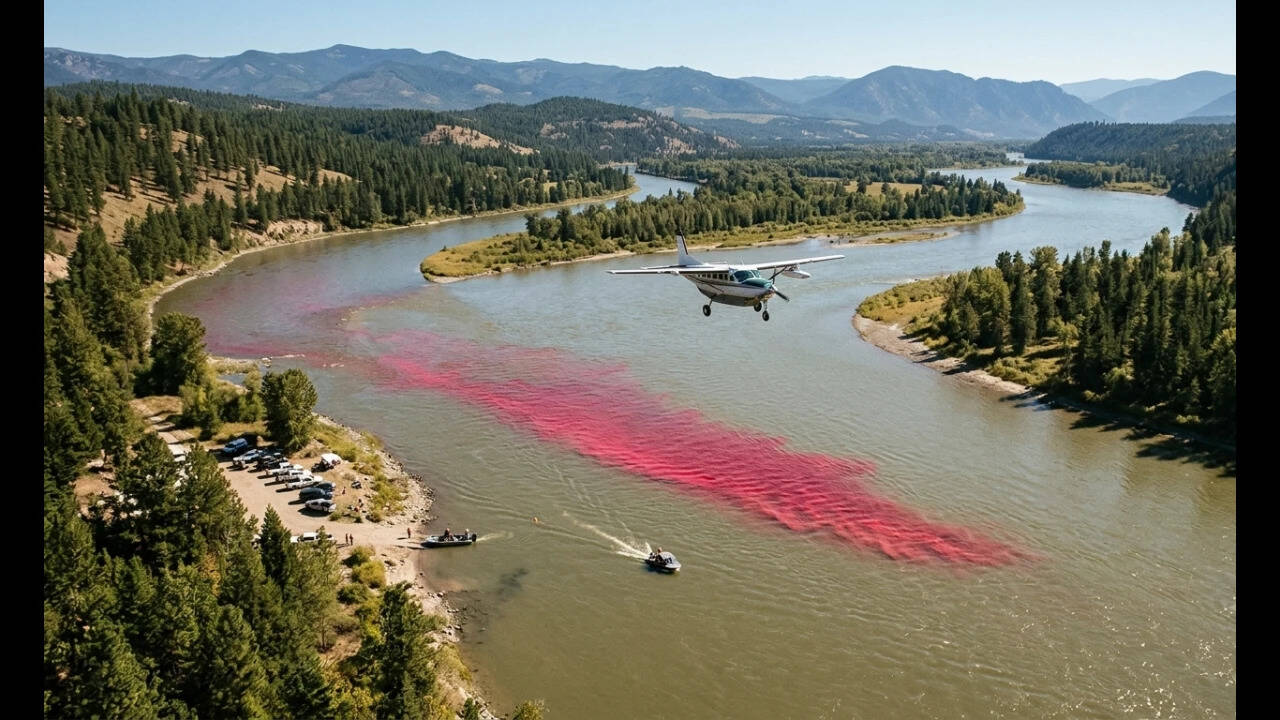
The US Geological Survey (USGS) conducted an experiment in 2017 where 72.57 kg of Rhodamine WT dye was released into Idaho's Kootenai River. This was done to study how a tracer moves through flowing water.
The dye was released over a period of 90 seconds, allowing researchers to track its movement. To monitor the dye's dispersal, instruments were placed in the river to collect data.
In addition to the river-based instruments, an aircraft was used to capture hyperspectral images of the dye's movement. The aircraft flew 1,000 metres above the ground, taking images with a resolution of 0.5-metre pixels across 48 spectral bands.
The use of hyperspectral imaging allowed researchers to gather detailed information about the dye's movement and how it interacted with the surrounding environment. This data can be used to improve our understanding of water flow and dispersal in rivers.
The Kootenai River, where the experiment took place, is located in Idaho and is an important part of the region's ecosystem. The river flows through a variety of landscapes, including rural and urban areas, and is home to a range of plant and animal species.
The USGS is a scientific organization that studies the Earth's natural resources, including water. The organization's research focuses on understanding the Earth's systems and processes, and how they impact the environment and human societies.
The experiment in the Kootenai River is an example of the USGS's work to improve our understanding of water flow and dispersal. By studying how tracers move through rivers, researchers can gain insights into the complex processes that shape our environment.
The findings of this study can have important implications for a range of fields, including environmental science, engineering, and natural resource management. By improving our understanding of water flow and dispersal, researchers can develop more effective strategies for managing water resources and mitigating the impacts of human activities on the environment.
In conclusion, the USGS's experiment in the Kootenai River demonstrates the organization's commitment to advancing our understanding of the Earth's natural systems. The use of innovative techniques, such as hyperspectral imaging, allows researchers to gather detailed information about complex environmental processes, and can inform the development of more effective strategies for managing water resources.
Frequently asked questions
Why did the USGS release dye into the Idaho river?
The USGS released dye into the Idaho river to study how a tracer moves through flowing water.
How did the USGS track the dye's movement?
The USGS used instruments in the river and hyperspectral images captured from an aircraft to track the dye's movement.