Kuno National Park Frees 3rd-Gen Cheetahs Without Radio Collars
Third-gen cheetahs in Kuno to roam free, only a few to be radio-collared, says park director.
'%3E%3Crect%20width%3D'96'%20height%3D'96'%20fill%3D'%231B5E20'%2F%3E%3Ccircle%20cx%3D'30'%20cy%3D'24'%20r%3D'44'%20fill%3D'%23fff'%20opacity%3D'.12'%2F%3E%3Ccircle%20cx%3D'60'%20cy%3D'74'%20r%3D'40'%20fill%3D'%23000'%20opacity%3D'.10'%2F%3E%3C%2Fg%3E%3Cg%3E%3Ccircle%20cx%3D'48'%20cy%3D'48'%20r%3D'15'%20fill%3D'%23fff'%2F%3E%3Cpath%20d%3D'M43%2034%20Q50%2048%2043%2062'%20fill%3D'none'%20stroke%3D'%238a94a6'%20stroke-width%3D'2.4'%2F%3E%3Cpath%20d%3D'M47%2033%20Q54%2048%2047%2063'%20fill%3D'none'%20stroke%3D'%238a94a6'%20stroke-width%3D'1.8'%20stroke-dasharray%3D'1.5%203'%2F%3E%3C%2Fg%3E%3C%2Fsvg%3E)
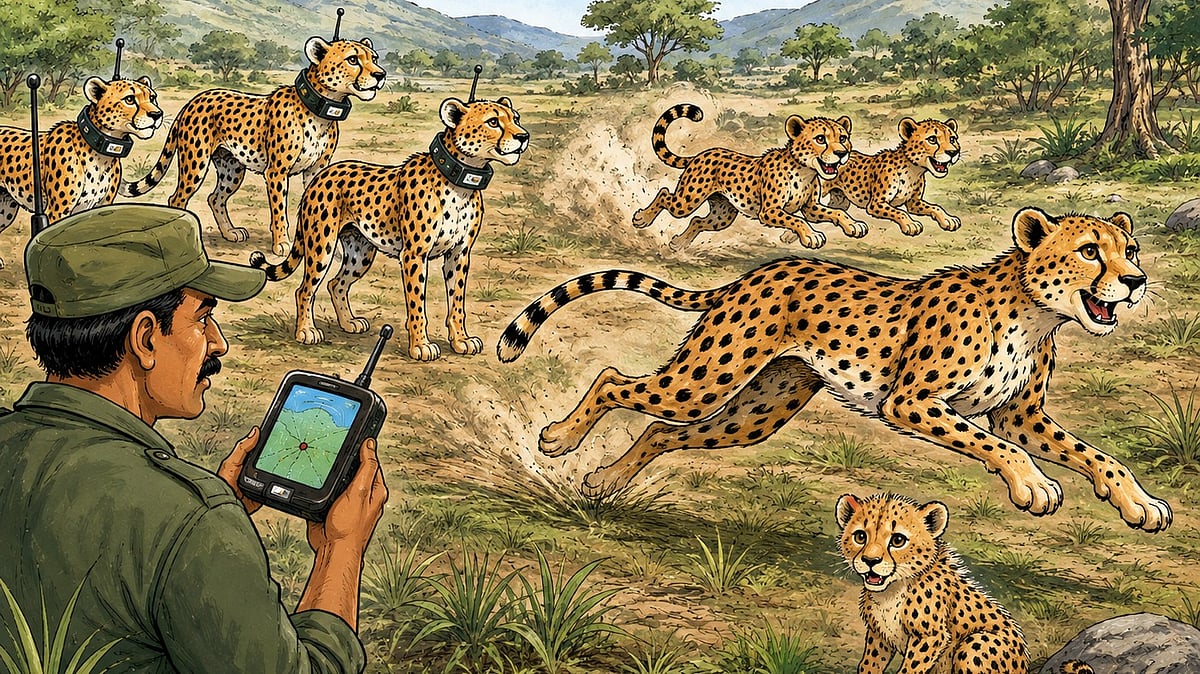
In a significant development, the third generation of cheetahs in Kuno National Park, Madhya Pradesh, will be released into the wild without radio collars. This decision has been taken as the cheetah population is growing, and it is becoming impractical to radio-collar all of them.
Currently, there are 30 radio-collared cheetahs in Kuno, with 18 of them roaming in the wild. However, as the population increases, the park authorities have decided to radio-collar only a few of them for monitoring purposes.
According to Uttam Sharma, Field Director of Kuno National Park, the decision to release cheetahs without radio collars is part of the Cheetah Action Plan. He added that even in tiger reserves, only a few tigers are radio-collared, and the rest roam free without the devices.
The tracking of radio-collared cheetahs is a costly affair, with each radio collar costing Rs 4 lakh and having a lifespan of only one year. Additionally, a tracking device costing Rs 3 lakh is used to monitor each radio-collared cheetah, and nine forest personnel are deputed to track them.
As the cheetah population grows, with 19 cubs set to become one year old in March 2027, it will become impossible to radio-collar all of them. Several female cheetahs will also reach reproductive age, leading to a further increase in the population.
The decision to release cheetahs without radio collars is a significant step towards establishing a self-sustaining population in Kuno National Park. As the cheetahs adapt to their environment, the need for radio collars will decrease, and the park authorities can focus on other aspects of conservation.
The Cheetah Project, which is set to enter its seventh year, aims to establish a viable population of cheetahs in Kuno National Park. The project has made significant progress so far, with the cheetah population growing steadily.
The release of cheetahs without radio collars is a positive development for the conservation of these majestic animals. It is a testament to the success of the Cheetah Project and the efforts of the park authorities to establish a self-sustaining population of cheetahs in Kuno National Park.
In the coming years, the cheetah population in Kuno is expected to grow further, and the park authorities will have to ensure that the animals are protected and conserved. The decision to release cheetahs without radio collars is a significant step towards achieving this goal.
Overall, the release of third-generation cheetahs without radio collars is a significant development for the conservation of these animals. It is a positive step towards establishing a self-sustaining population of cheetahs in Kuno National Park and ensuring the long-term survival of these majestic creatures.
Frequently asked questions
Why are cheetahs being released without radio collars in Kuno National Park?
The cheetah population is growing, and it is becoming impractical to radio-collar all of them. The decision is part of the Cheetah Action Plan.
How many cheetahs are currently radio-collared in Kuno National Park?
There are 30 radio-collared cheetahs in Kuno, with 18 of them roaming in the wild.