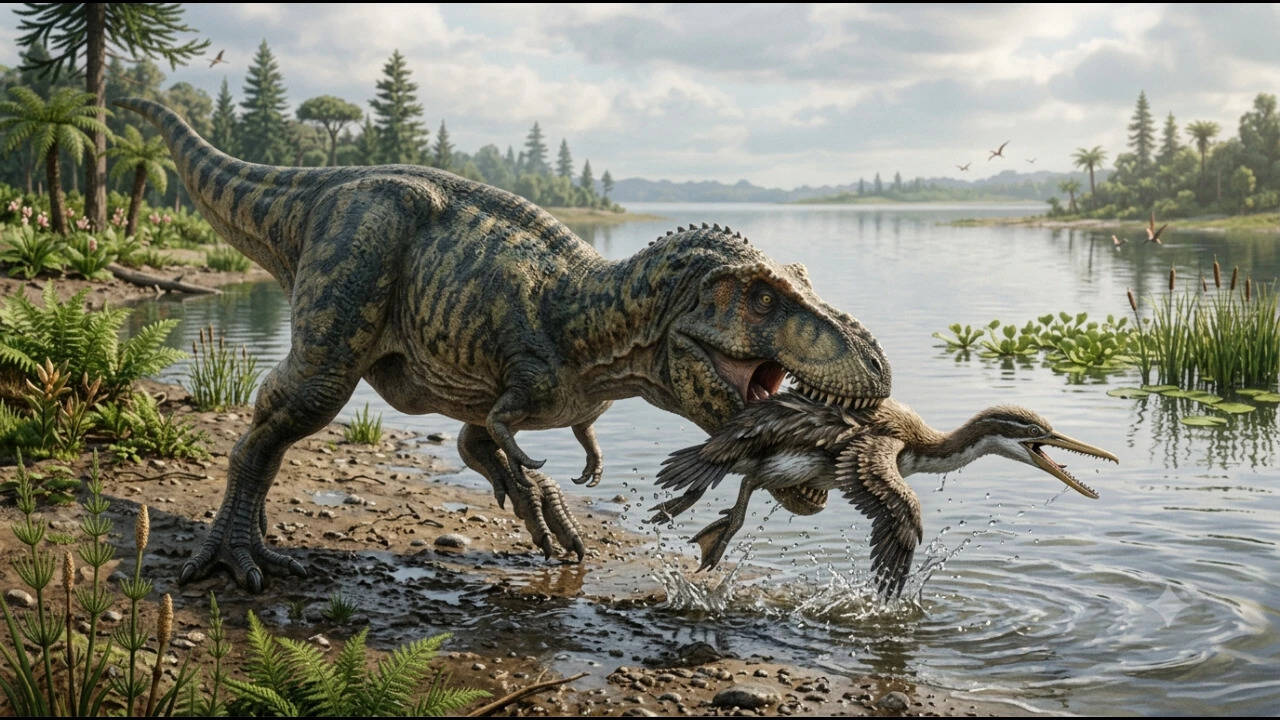
T Rex Walked, Not Ran, Say Scientists
New study reveals T Rex walking pace, contradicting popular image
'%3E%3Crect%20width%3D'96'%20height%3D'96'%20fill%3D'%23B3261E'%2F%3E%3Ccircle%20cx%3D'30'%20cy%3D'24'%20r%3D'44'%20fill%3D'%23fff'%20opacity%3D'.12'%2F%3E%3Ccircle%20cx%3D'60'%20cy%3D'74'%20r%3D'40'%20fill%3D'%23000'%20opacity%3D'.10'%2F%3E%3C%2Fg%3E%3Cg%20fill%3D'%23fff'%3E%3Crect%20x%3D'29'%20y%3D'49'%20width%3D'8'%20height%3D'19'%20rx%3D'1'%2F%3E%3Crect%20x%3D'39'%20y%3D'40'%20width%3D'9'%20height%3D'28'%20rx%3D'1'%2F%3E%3Crect%20x%3D'50'%20y%3D'45'%20width%3D'8'%20height%3D'23'%20rx%3D'1'%2F%3E%3Crect%20x%3D'60'%20y%3D'53'%20width%3D'7'%20height%3D'15'%20rx%3D'1'%2F%3E%3Crect%20x%3D'41'%20y%3D'34'%20width%3D'5'%20height%3D'6'%2F%3E%3C%2Fg%3E%3C%2Fsvg%3E)
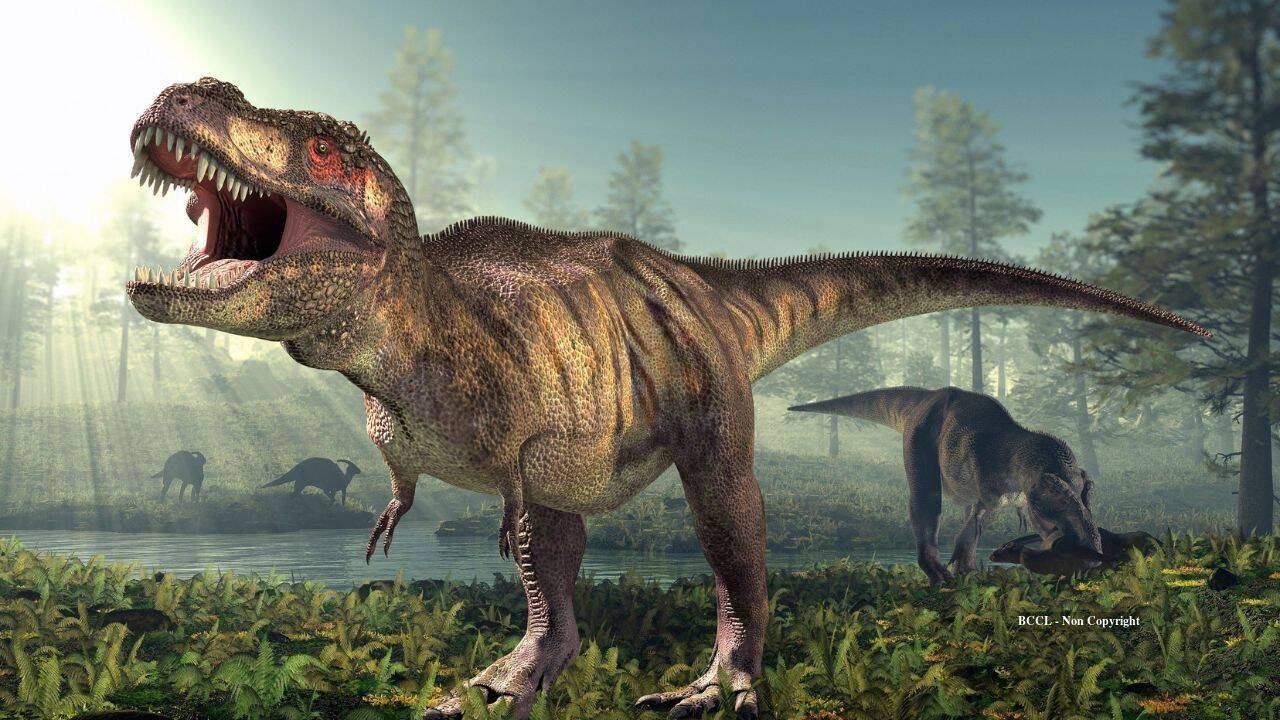
A recent study on T Rex footprints has shed new light on the giant dinosaur's movement patterns. According to the research, the Tyrannosaurus Rex, often depicted as a fierce and fast runner, actually walked at a moderate pace.
The study analyzed well-preserved T Rex footprints found in North America, which provided valuable insights into the dinosaur's locomotion. By examining the size, shape, and spacing of the footprints, scientists were able to estimate the T Rex's speed and gait.
The findings suggest that the T Rex moved at a walking pace, with estimates indicating that it covered around 5-7 kilometers per hour. This is significantly slower than the running speeds often attributed to the dinosaur in popular media.
The T Rex was a massive creature, measuring up to 12 meters in length and weighing over 9 tons. Its large size and weight would have made it difficult to achieve high speeds, and the study's findings support this theory.
The discovery has significant implications for our understanding of the T Rex's behavior and ecology. It suggests that the dinosaur may have been a more deliberate and calculated hunter, using its powerful sense of smell and exceptional eyesight to stalk its prey rather than relying on speed.
The study's findings also highlight the importance of fossil evidence in understanding the biology and behavior of extinct species. By analyzing the T Rex's footprints, scientists have been able to gain a more accurate understanding of the dinosaur's movement patterns and behavior.
In the past, the T Rex has been often portrayed as a fast and agile runner, but this new research challenges that image. The study's authors suggest that the T Rex's walking pace would have been more energy-efficient, allowing it to conserve energy for hunting and other activities.
The research has sparked a new debate about the T Rex's behavior and ecology, and scientists are eager to continue studying the dinosaur's fossil record to learn more about its biology and behavior.
The study's findings have significant implications for the field of paleontology, and will likely lead to a re-evaluation of our current understanding of the T Rex and its place in the ancient ecosystem.
In conclusion, the discovery that the T Rex walked, not ran, has provided new insights into the dinosaur's behavior and ecology. The study's findings highlight the importance of fossil evidence in understanding the biology and behavior of extinct species, and will likely lead to a greater understanding of the T Rex's place in the ancient world.
The T Rex's walking pace is a significant discovery that challenges our current understanding of the dinosaur's behavior and ecology. As scientists continue to study the T Rex's fossil record, we can expect to learn more about this fascinating creature and its place in the ancient world.
The study's findings are a reminder that there is still much to be learned about the T Rex and its behavior, and that new discoveries can challenge our current understanding of the dinosaur's biology and ecology.
In the end, the discovery that the T Rex walked, not ran, is a significant contribution to the field of paleontology, and will likely lead to a greater understanding of the dinosaur's behavior and ecology.
Frequently asked questions
How fast did the T Rex walk?
The T Rex walked at a pace of around 5-7 kilometers per hour.
Why did the T Rex walk instead of run?
The T Rex's large size and weight would have made it difficult to achieve high speeds, making walking a more energy-efficient option.