Jagannath Rath Yatra Begins July 16
Lord Jagannath's journey starts, attracting lakhs of devotees. Rituals and significance explained.
'%3E%3Crect%20width%3D'96'%20height%3D'96'%20fill%3D'%23B3261E'%2F%3E%3Ccircle%20cx%3D'30'%20cy%3D'24'%20r%3D'44'%20fill%3D'%23fff'%20opacity%3D'.12'%2F%3E%3Ccircle%20cx%3D'60'%20cy%3D'74'%20r%3D'40'%20fill%3D'%23000'%20opacity%3D'.10'%2F%3E%3C%2Fg%3E%3Cg%20fill%3D'%23fff'%3E%3Crect%20x%3D'29'%20y%3D'49'%20width%3D'8'%20height%3D'19'%20rx%3D'1'%2F%3E%3Crect%20x%3D'39'%20y%3D'40'%20width%3D'9'%20height%3D'28'%20rx%3D'1'%2F%3E%3Crect%20x%3D'50'%20y%3D'45'%20width%3D'8'%20height%3D'23'%20rx%3D'1'%2F%3E%3Crect%20x%3D'60'%20y%3D'53'%20width%3D'7'%20height%3D'15'%20rx%3D'1'%2F%3E%3Crect%20x%3D'41'%20y%3D'34'%20width%3D'5'%20height%3D'6'%2F%3E%3C%2Fg%3E%3C%2Fsvg%3E)
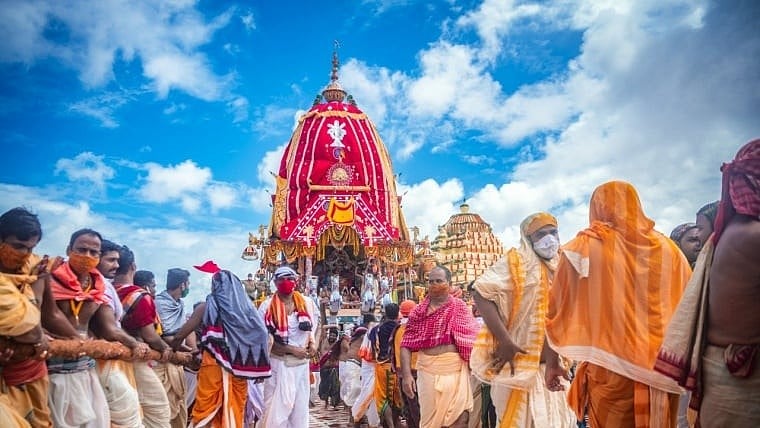
The Jagannath Rath Yatra, one of the most sacred Hindu observances, is set to begin on July 16 and will be celebrated until July 27, 2026, in Puri, Odisha. This festival is a significant part of the Char Dham of India and attracts devotees from around the world.
The festival begins with Pahandi Bije, followed by Chhera Pahanra, which includes the rituals of Snan Purnima, marking the beginning of the festival. The grand ceremonial procession involves the deities - Lord Jagannath, Lord Balabhadra, Devi Subhadra, and Sudarshan - stepping out of the temple to their respective chariots.
The deities are then bathed with 108 pitchers of water, and the Gajapati Maharaja of Puri performs the sacred Chhera Pahanra ritual. This symbolic act reflects humility and reminds devotees that everyone is equal before the Lord. The ritual of Chhera Pahanra will take place on July 16, 2026.
After Chhera Pahanra, the massive wooden chariots are pulled by thousands of devotees along the Grand Road to the Gundicha Temple, believed to be the garden house of Lord Jagannath's aunt. The deities remain there for several days, allowing devotees to seek their blessings. This phase of the festival will be observed from July 17 to July 19.
On the fifth day of the festival, Goddess Lakshmi visits the Gundicha Temple in search of Lord Jagannath, expressing her displeasure at being left behind, making Hera Panchami one of the most unique and symbolic rituals of the Yatra. This ritual will be observed on July 20.
The return journey of the deities from the Gundicha Temple to the Jagannath Temple is known as Bahuda Yatra. On the way back, the chariots halt at the Mausima Temple, where the deities are offered poda pitha, a sweet dish.
The Jagannath Rath Yatra is a significant festival in the Hindu calendar, and its rituals and traditions are steeped in history and culture. The festival is a celebration of the divine and the universal values of humility and equality.
The preparations for the Rath Yatra are in full swing, with decorative cloth and intricately crafted brass ornaments being fixed on the three chariots. The festival is expected to attract lakhs of devotees from around the world, who will gather to witness the grand procession and seek the blessings of Lord Jagannath.
In the context of Indian culture and traditions, the Jagannath Rath Yatra is an important event that showcases the country's rich heritage and diversity. The festival is a celebration of the universal values of humility, equality, and devotion, and its significance extends beyond the boundaries of Odisha and India.
In conclusion, the Jagannath Rath Yatra is a significant festival that attracts devotees from around the world. Its rituals and traditions are steeped in history and culture, and its significance extends beyond the boundaries of Odisha and India. The festival is a celebration of the divine and the universal values of humility and equality, and its importance will be felt by devotees and non-devotees alike.
The festival's impact on the local community is also significant, with thousands of devotees gathering to witness the grand procession and seek the blessings of Lord Jagannath. The festival is a major tourist attraction, and its economic impact on the local community is substantial.
Overall, the Jagannath Rath Yatra is a significant event in the Hindu calendar, and its importance will be felt by devotees and non-devotees alike. The festival's rituals and traditions are steeped in history and culture, and its significance extends beyond the boundaries of Odisha and India.