Scotland, Northern Ireland, Wales Sign Independence Pact
Leaders sign historic MoU, seek independence from UK, strengthen economic ties.
'%3E%3Crect%20width%3D'96'%20height%3D'96'%20fill%3D'%234A235A'%2F%3E%3Ccircle%20cx%3D'30'%20cy%3D'24'%20r%3D'44'%20fill%3D'%23fff'%20opacity%3D'.12'%2F%3E%3Ccircle%20cx%3D'60'%20cy%3D'74'%20r%3D'40'%20fill%3D'%23000'%20opacity%3D'.10'%2F%3E%3C%2Fg%3E%3Cg%20fill%3D'none'%20stroke%3D'%23fff'%20stroke-width%3D'3'%3E%3Ccircle%20cx%3D'48'%20cy%3D'48'%20r%3D'16'%2F%3E%3Cellipse%20cx%3D'48'%20cy%3D'48'%20rx%3D'6.5'%20ry%3D'16'%2F%3E%3Cline%20x1%3D'32'%20y1%3D'42'%20x2%3D'64'%20y2%3D'42'%2F%3E%3Cline%20x1%3D'32'%20y1%3D'54'%20x2%3D'64'%20y2%3D'54'%2F%3E%3C%2Fg%3E%3C%2Fsvg%3E)
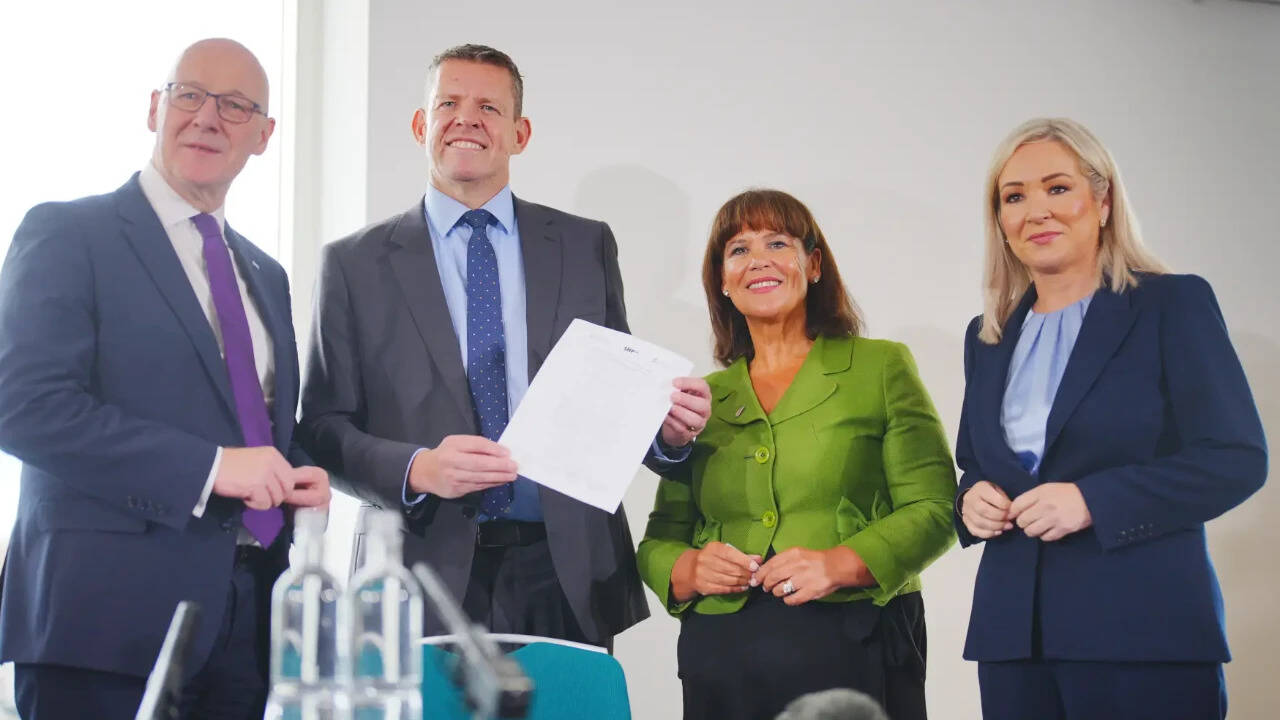
The leaders of Scotland, Northern Ireland, and Wales have signed a historic Memorandum of Understanding (MoU) that paves the way for their respective nations to break away from the United Kingdom. This significant development marks a shift away from Westminster's long-standing control over these regions.
The first ministers of Scotland, Northern Ireland, and Wales have committed to the principle of self-determination, allowing their nations to make their own decisions on key matters. The pact also aims to strengthen cooperation on economic and energy issues, which is expected to have a positive impact on the regions.
The signing of the MoU reflects a growing desire for constitutional change across Scotland, Northern Ireland, and Wales. There has been a increasing demand for greater autonomy and independence from the UK, with many citizens in these regions feeling that their interests are not being represented adequately at Westminster.
The move is seen as a significant challenge to the UK's traditional power structure, with many questioning what the future holds for the country. The UK has historically been a unitary state, with power concentrated in London, but this pact signals a desire for greater decentralization and regional autonomy.
The first ministers of Scotland, Northern Ireland, and Wales have stated that they will work together to achieve their goals, sharing best practices and expertise to strengthen their economies and improve the lives of their citizens. The pact is also expected to lead to greater cooperation on issues such as trade, investment, and energy security.
The implications of this pact are far-reaching, with potential consequences for the UK's economy, politics, and international relations. As the regions move towards greater independence, there will be a need for new arrangements to be put in place, including new trade agreements and international partnerships.
The signing of the MoU is a significant step towards a more federalized UK, with power being devolved to the regions. However, there are also concerns about the potential risks and challenges associated with this move, including the potential for economic instability and uncertainty.
In conclusion, the signing of the MoU by Scotland, Northern Ireland, and Wales marks a significant shift in the UK's constitutional landscape. As the regions move towards greater independence, there will be a need for careful planning and cooperation to ensure a smooth transition and to mitigate any potential risks.
The future of the UK remains uncertain, but one thing is clear: the desire for greater autonomy and independence in Scotland, Northern Ireland, and Wales is not going away. The UK government will need to respond to these demands and work towards a more federalized system, where power is devolved to the regions and citizens have a greater say in their own affairs.
The pact is a historic moment for Scotland, Northern Ireland, and Wales, and it will be interesting to see how the situation develops in the coming months and years.
Frequently asked questions
What is the significance of the MoU signed by Scotland, Northern Ireland, and Wales?
The MoU signals a shift away from Westminster's control and paves the way for the regions to break away from the UK.
What are the potential implications of this pact for the UK?
The pact could lead to a more federalized UK, with potential consequences for the economy, politics, and international relations.