Mumbai Reflects on Human Cost of Economics
As August ends, Mumbai considers the true cost of human progress. Economics is not just numbers, but human lives.
'%3E%3Crect%20width%3D'96'%20height%3D'96'%20fill%3D'%230B6E4F'%2F%3E%3Ccircle%20cx%3D'30'%20cy%3D'24'%20r%3D'44'%20fill%3D'%23fff'%20opacity%3D'.12'%2F%3E%3Ccircle%20cx%3D'60'%20cy%3D'74'%20r%3D'40'%20fill%3D'%23000'%20opacity%3D'.10'%2F%3E%3C%2Fg%3E%3Cg%20fill%3D'none'%20stroke%3D'%23fff'%20stroke-width%3D'3.2'%20stroke-linecap%3D'round'%20stroke-linejoin%3D'round'%3E%3Cpolyline%20points%3D'31%2C59%2041%2C49%2049%2C54%2063%2C37'%2F%3E%3Cpolyline%20points%3D'55%2C37%2063%2C37%2063%2C45'%2F%3E%3C%2Fg%3E%3C%2Fsvg%3E)
As the month of August comes to a close, Mumbai residents are reminded that time is a finite resource that cannot be replenished. With global life expectancy at birth being roughly 73 years, leaders and citizens alike are equal in the face of human mortality.
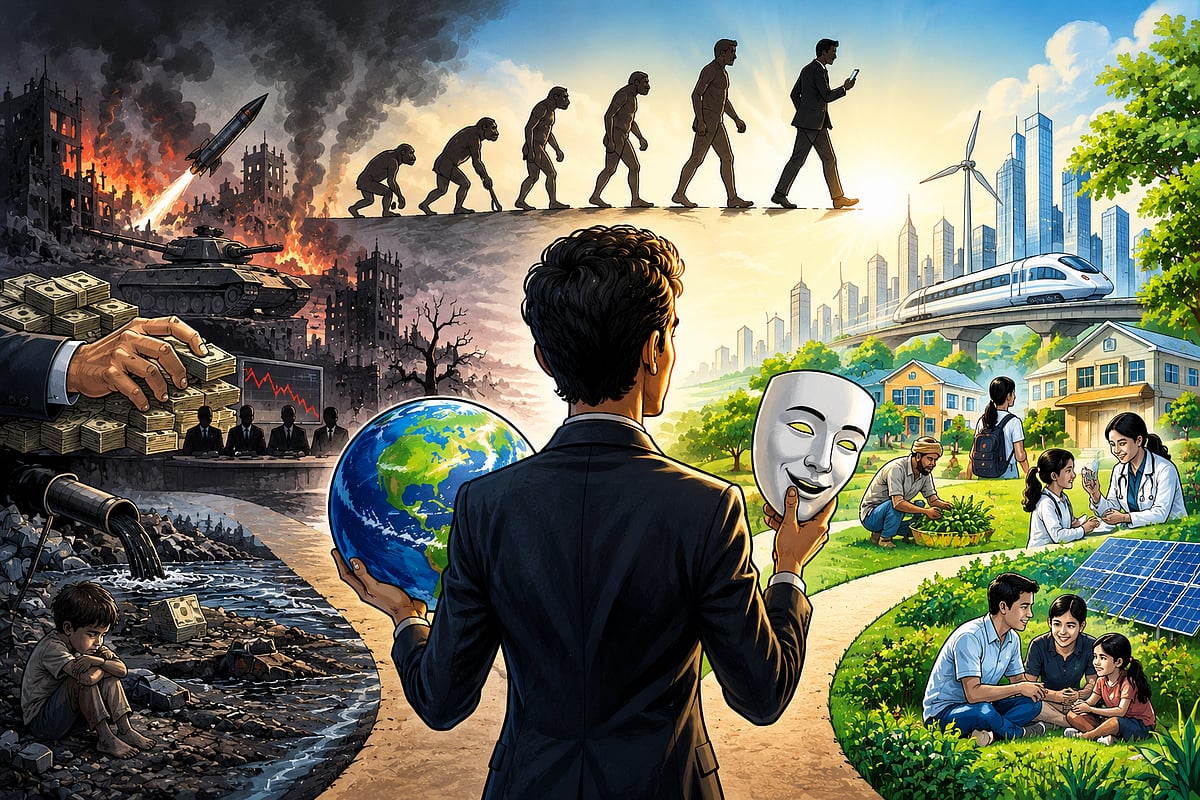
The concept of economics is deeply rooted in human history, dating back to the emergence of life on Earth around 3.5 billion years ago. From the development of chemistry to the evolution of Homo sapiens, human imagination and cooperation have played a crucial role in shaping our world. The creation of nations, laws, companies, and currencies is a testament to human ingenuity and the power of collective belief.
However, despite the many advancements humanity has made, we still grapple with issues like scarcity, greed, and war. The ongoing conflict between the US and Iran is a stark reminder of the human cost of war, with at least 7,900 people dead and a staggering $37.5 billion in war costs. The impact on the global economy is also significant, with Brent crude prices surging by 67% before easing to $88.58 a barrel.
In India, the pursuit of developed-economy status raises important questions about who benefits from economic growth. The Reserve Bank of India (RBI) must defend monetary credibility, while the Securities and Exchange Board of India (SEBI) must maintain market trust. Governments must simplify administration, and businesses must prioritize human dignity. Profit is essential for enterprise, but greed can suffocate its purpose.
As we look to the future, the rise of AI and robotics promises abundance, but also concentrates power. The question remains whether tomorrow's human will become wiser or merely more powerful. Economics teaches us about scarcity, but perhaps its rarest asset is life itself. No amount of wealth or power can buy back yesterday or print another decade.
In conclusion, as Mumbai reflects on the human cost of economics, it is clear that there is more to progress than just numbers. The true measure of success lies in the well-being of humanity and the planet we inhabit.
The unfinished experiment of Homo sapiens continues, and it is up to us to ensure that our pursuit of economic growth does not come at the expense of human dignity and the environment. As we move forward, we must prioritize simplicity, trust, and cooperation, and recognize that the rarest asset of all is life itself.
Ultimately, the story of human progress is a complex one, filled with contradictions and challenges. However, by acknowledging the human cost of economics and prioritizing human dignity, we can work towards creating a brighter future for all.
The next human, empowered by AI and robotics, must be wiser and more compassionate, recognizing the value of life and the importance of living in harmony with the planet. Only then can we truly say that we have made progress, not just in terms of economic growth, but in terms of human well-being and happiness.
As we close the chapter on August, we are reminded that time is a precious resource, and it is up to us to use it wisely. By prioritizing human dignity, simplicity, and cooperation, we can create a better future for ourselves and for generations to come.
In the end, it is not just about the numbers, but about the human cost of economics. It is about recognizing that life is the rarest asset of all, and that our pursuit of economic growth must be balanced with our pursuit of human well-being and happiness.
Frequently asked questions
What is the global life expectancy at birth?
The global life expectancy at birth is roughly 73 years.
What is the human cost of the US-Iran conflict?
The conflict has resulted in at least 7,900 deaths and $37.5 billion in war costs.