Bombay HC Rules Against NOC Requirement for Court Decrees
Bombay HC allows petition, rules that revenue authorities cannot insist on NOC for court-approved consent decrees. Petitioners Sanjay and Rachna Narang to register decree without society's permission.
'%3E%3Crect%20width%3D'96'%20height%3D'96'%20fill%3D'%23B3261E'%2F%3E%3Ccircle%20cx%3D'30'%20cy%3D'24'%20r%3D'44'%20fill%3D'%23fff'%20opacity%3D'.12'%2F%3E%3Ccircle%20cx%3D'60'%20cy%3D'74'%20r%3D'40'%20fill%3D'%23000'%20opacity%3D'.10'%2F%3E%3C%2Fg%3E%3Cg%20fill%3D'%23fff'%3E%3Crect%20x%3D'29'%20y%3D'49'%20width%3D'8'%20height%3D'19'%20rx%3D'1'%2F%3E%3Crect%20x%3D'39'%20y%3D'40'%20width%3D'9'%20height%3D'28'%20rx%3D'1'%2F%3E%3Crect%20x%3D'50'%20y%3D'45'%20width%3D'8'%20height%3D'23'%20rx%3D'1'%2F%3E%3Crect%20x%3D'60'%20y%3D'53'%20width%3D'7'%20height%3D'15'%20rx%3D'1'%2F%3E%3Crect%20x%3D'41'%20y%3D'34'%20width%3D'5'%20height%3D'6'%2F%3E%3C%2Fg%3E%3C%2Fsvg%3E)
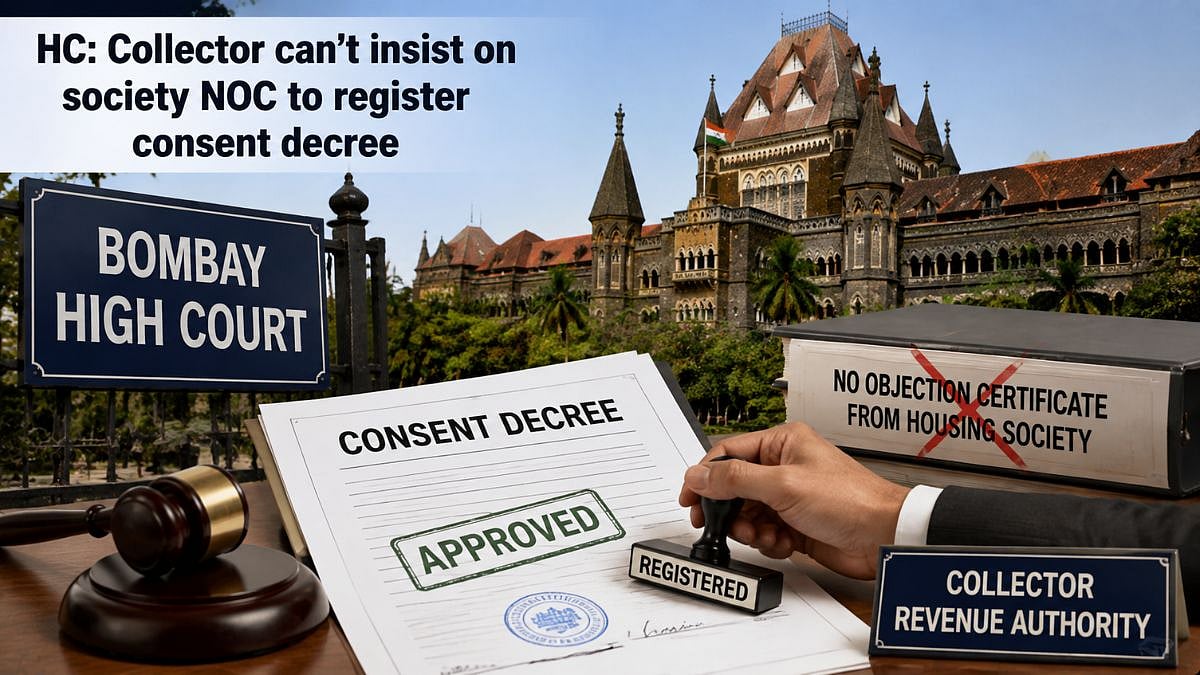
The Bombay High Court has passed an order stating that revenue authorities cannot insist on a housing society's 'No Objection Certificate' (NOC) as a pre-condition for registering a court-approved consent decree. This decision was made on August 17, 2026, by a bench of Justices Suman Shyam and Advait Sethna, while allowing a petition filed by Sanjay Narang and his sister Rachna Narang.
The petitioners had entered into an agreement concerning a commercial premises at Soona Mahal Cooperative Housing Society at Marine Drive in 2018. A dispute later reached the High Court and was settled through consent terms in December 2022. The court subsequently passed a consent decree stating that the terms would operate as a conveyance in favour of the petitioners.
The petitioners paid stamp duty of Rs 91.58 lakh on the decree and sought registration of the decree. However, the Sub-Registrar said that an NOC from the Collector was required, which in turn required an NOC from the housing society. The society objected to issuing the NOC, citing issues concerning the premises.
The petitioners challenged the requirement, arguing that the consent decree had already attained finality and that there was no legal requirement for the society's NOC. The State opposed the plea, relying on restrictions under Section 37A of the Maharashtra Land Revenue Code.
The High Court rejected the State's argument, stating that the revenue authorities should have acted in furtherance of the court decree instead of creating obstacles to its implementation. The court noted that the respondents could not point to any statutory provision, rule or notification requiring the society's NOC before registration.
The bench directed the Collector to decide the petitioners' August 2024 application without insisting on an NOC from the society and to facilitate registration of the consent decree. The court clarified that the society would not be held responsible by the Collector for the absence of an NOC.
This decision is significant as it clarifies the role of revenue authorities in implementing court decrees. The court's order ensures that the petitioners can register the consent decree without unnecessary obstacles. The decision also highlights the importance of following statutory provisions and rules in administrative decisions.
The Bombay High Court's order is a welcome move for individuals and businesses seeking to register court-approved consent decrees. It ensures that the legal process is followed, and unnecessary requirements are not imposed. The decision is also a reminder that revenue authorities must act in accordance with the law and court orders.
In conclusion, the Bombay High Court's decision is a significant development in the implementation of court decrees. It emphasizes the importance of following statutory provisions and rules, and ensures that revenue authorities do not create unnecessary obstacles. The decision is a positive step towards streamlining the legal process and promoting transparency and accountability in administrative decisions.
The implications of this decision are far-reaching, and it is likely to have a significant impact on the way revenue authorities handle court-approved consent decrees in the future. The decision is a reminder that the legal process must be followed, and that unnecessary requirements must not be imposed. It is a welcome move for individuals and businesses seeking to register court-approved consent decrees, and it promotes transparency and accountability in administrative decisions.
The Bombay High Court's decision is a significant contribution to the development of the law in this area. It provides clarity and guidance on the role of revenue authorities in implementing court decrees, and it ensures that the legal process is followed. The decision is a positive step towards promoting transparency and accountability in administrative decisions, and it is likely to have a significant impact on the way revenue authorities handle court-approved consent decrees in the future.
In the context of Mumbai's real estate market, this decision is particularly significant. It ensures that individuals and businesses can register court-approved consent decrees without unnecessary obstacles, and it promotes transparency and accountability in administrative decisions. The decision is a welcome move for those seeking to navigate the complex process of registering court-approved consent decrees, and it provides clarity and guidance on the role of revenue authorities in this process.
Overall, the Bombay High Court's decision is a significant development in the implementation of court decrees. It emphasizes the importance of following statutory provisions and rules, and ensures that revenue authorities do not create unnecessary obstacles. The decision is a positive step towards streamlining the legal process, and it promotes transparency and accountability in administrative decisions.
The decision is also a reminder that the legal process must be followed, and that unnecessary requirements must not be imposed. It is a welcome move for individuals and businesses seeking to register court-approved consent decrees, and it provides clarity and guidance on the role of revenue authorities in this process. The implications of this decision are far-reaching, and it is likely to have a significant impact on the way revenue authorities handle court-approved consent decrees in the future.
In conclusion, the Bombay High Court's decision is a significant contribution to the development of the law in this area. It provides clarity and guidance on the role of revenue authorities in implementing court decrees, and it ensures that the legal process is followed. The decision is a positive step towards promoting transparency and accountability in administrative decisions, and it is likely to have a significant impact on the way revenue authorities handle court-approved consent decrees in the future.
Frequently asked questions
What is the significance of the Bombay HC's decision?
The decision clarifies that revenue authorities cannot insist on a housing society's NOC for registering a court-approved consent decree, promoting transparency and accountability in administrative decisions.
What are the implications of this decision?
The decision is likely to have a significant impact on the way revenue authorities handle court-approved consent decrees in the future, ensuring that the legal process is followed and unnecessary obstacles are not created.