Shriram Wealth CEO on Balancing Growth and Protection
Vikas Satija discusses market-linked debentures and asset allocation. Learn how to protect market gains without giving up growth.
'%3E%3Crect%20width%3D'96'%20height%3D'96'%20fill%3D'%230B6E4F'%2F%3E%3Ccircle%20cx%3D'30'%20cy%3D'24'%20r%3D'44'%20fill%3D'%23fff'%20opacity%3D'.12'%2F%3E%3Ccircle%20cx%3D'60'%20cy%3D'74'%20r%3D'40'%20fill%3D'%23000'%20opacity%3D'.10'%2F%3E%3C%2Fg%3E%3Cg%20fill%3D'none'%20stroke%3D'%23fff'%20stroke-width%3D'3.2'%20stroke-linecap%3D'round'%20stroke-linejoin%3D'round'%3E%3Cpolyline%20points%3D'31%2C59%2041%2C49%2049%2C54%2063%2C37'%2F%3E%3Cpolyline%20points%3D'55%2C37%2063%2C37%2063%2C45'%2F%3E%3C%2Fg%3E%3C%2Fsvg%3E)
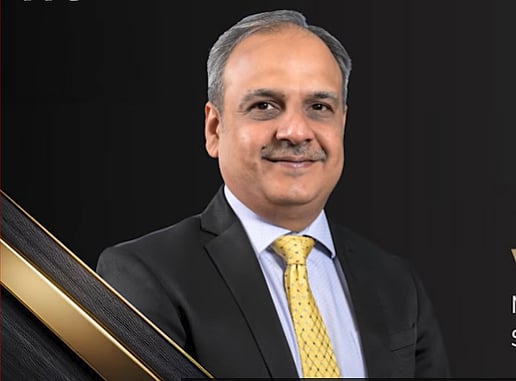
Vikas Satija, Managing Director and CEO of Shriram Wealth Ltd, recently spoke with Sheryll D'Souza about the importance of balancing wealth maximisation with capital protection.
Shriram Wealth, which entered the market about a year ago, aims to offer solutions rather than pushing products. The company brings together the 51-year legacy of the Shriram Group and the 107-year history of Sanlam, following an open-architecture model that covers five pillars: wealth creation, lending, protection, global investments, and legacy planning.
One key investment option discussed was market-linked debentures (MLDs). An MLD is a debt instrument whose return is linked to an underlying market asset, such as an equity index, individual stocks, gold, or commodities. The return on an MLD depends on the performance of the underlying asset and the terms specified in the structure.
Satija explained that some MLDs can protect an investor's capital while offering market participation. For example, an investment of ₹100 could be split, with ₹80 placed in a debt instrument designed to grow to ₹100 by maturity, and the remaining ₹20 used to gain exposure to the underlying derivatives. This structure can protect the principal at maturity while providing market upside, although the participation may be capped.
When asked about responding to geopolitical uncertainty and sharp market fluctuations, Satija emphasized the importance of asset allocation. Investors should determine the proportion of their investable surpluses to be allocated to equities, debt, gold, real estate, and other asset classes based on their risk profile. He advised against reacting impulsively to short-term developments and instead recommended patience, appropriate diversification, and periodic portfolio rebalancing.
Satija also highlighted the growing relevance of professionally managed family offices in India. He noted that India's wealth management industry is expanding rapidly and could grow at a compounded annual rate of 20-22% over the next two decades.
In conclusion, Satija's discussion with Sheryll D'Souza provided valuable insights into the importance of disciplined asset allocation, regular portfolio rebalancing, and long-term investing amid market volatility. By understanding the options available, such as market-linked debentures, investors can make informed decisions to balance their wealth maximisation goals with capital protection.
The Indian economy has shown resilience in the face of global uncertainty, with the Sensex and Nifty recently gaining on the back of lower oil prices and supportive RBI policy. As the economy continues to grow, investors must remain informed and adaptable to navigate the complexities of the market.
Ultimately, the key to successful investing lies in finding the right balance between growth and protection. By working with a reputable wealth management firm like Shriram Wealth and following a disciplined investment approach, investors can achieve their long-term financial goals and protect their wealth in uncertain times.
As India's wealth management industry continues to evolve, it is likely that we will see more innovative investment products and services emerge. For now, investors would do well to focus on the fundamentals of asset allocation, portfolio rebalancing, and long-term investing, while also staying informed about the latest developments in the market.
In the current market environment, it is more important than ever for investors to be aware of the options available to them and to make informed decisions about their investments. By doing so, they can protect their wealth and achieve their long-term financial goals.
The discussion with Vikas Satija highlights the importance of having a well-thought-out investment strategy in place. Investors should not react impulsively to market fluctuations but instead focus on their long-term goals and adjust their portfolios accordingly.
In terms of the Indian economy, the long-term growth story remains strong. Investors should be patient and focus on their long-term goals, rather than reacting to short-term market volatility. With the right investment strategy and a disciplined approach, investors can achieve their financial goals and protect their wealth in uncertain times.
The role of professionally managed family offices in India is also becoming increasingly important. These offices can provide investors with access to a wide range of investment products and services, as well as expert advice and guidance.
In conclusion, the discussion with Vikas Satija provides valuable insights into the importance of balancing wealth maximisation with capital protection. By understanding the options available and following a disciplined investment approach, investors can achieve their long-term financial goals and protect their wealth in uncertain times.
The Indian wealth management industry is expected to continue growing in the coming years, driven by the increasing demand for investment products and services. As the industry evolves, it is likely that we will see more innovative products and services emerge, providing investors with even more options to achieve their financial goals.
For now, investors should focus on the fundamentals of asset allocation, portfolio rebalancing, and long-term investing. By doing so, they can protect their wealth and achieve their long-term financial goals, even in uncertain times.
What it means for Mumbai and India is that investors need to be aware of the options available to them and make informed decisions about their investments. The growth of the wealth management industry in India is expected to have a positive impact on the economy, providing more opportunities for investors to achieve their financial goals.
Overall, the discussion with Vikas Satija highlights the importance of having a well-thought-out investment strategy in place and being aware of the options available to achieve long-term financial goals.
Frequently asked questions
What is a market-linked debenture?
A market-linked debenture is a debt instrument whose return is linked to an underlying market asset.
How can investors respond to market volatility?
Investors should focus on asset allocation, diversification, and periodic portfolio rebalancing, rather than reacting impulsively to short-term developments.