Supreme Court Upholds Government Power On Environmental Clearances
SC allows limited statutory amnesty for projects, prioritizes environment and public transparency.
'%3E%3Crect%20width%3D'96'%20height%3D'96'%20fill%3D'%231A5276'%2F%3E%3Ccircle%20cx%3D'30'%20cy%3D'24'%20r%3D'44'%20fill%3D'%23fff'%20opacity%3D'.12'%2F%3E%3Ccircle%20cx%3D'60'%20cy%3D'74'%20r%3D'40'%20fill%3D'%23000'%20opacity%3D'.10'%2F%3E%3C%2Fg%3E%3Cg%20fill%3D'%23fff'%3E%3Cpath%20d%3D'M31%2041%20L48%2031%20L65%2041%20Z'%2F%3E%3Crect%20x%3D'33'%20y%3D'43'%20width%3D'4'%20height%3D'17'%2F%3E%3Crect%20x%3D'41'%20y%3D'43'%20width%3D'4'%20height%3D'17'%2F%3E%3Crect%20x%3D'51'%20y%3D'43'%20width%3D'4'%20height%3D'17'%2F%3E%3Crect%20x%3D'59'%20y%3D'43'%20width%3D'4'%20height%3D'17'%2F%3E%3Crect%20x%3D'30'%20y%3D'62'%20width%3D'36'%20height%3D'4'%20rx%3D'1'%2F%3E%3C%2Fg%3E%3C%2Fsvg%3E)
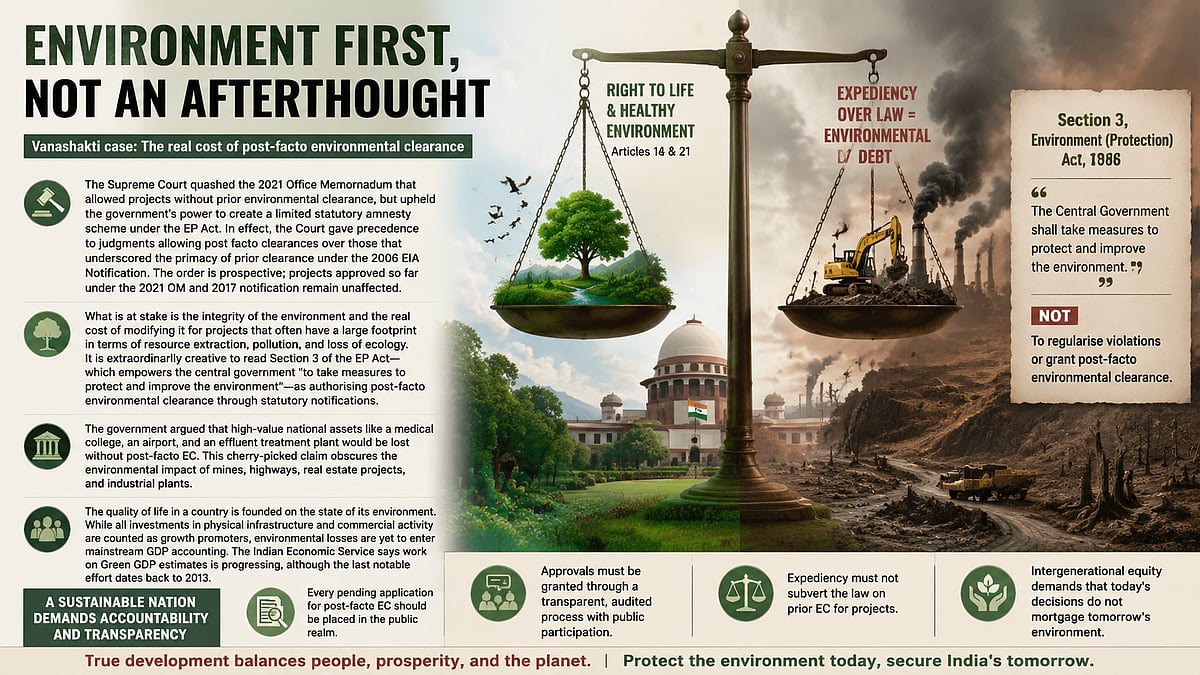
The Supreme Court of India has issued a significant order in the Vanashakti case, upholding the government's power to introduce a limited statutory amnesty scheme for projects without prior environmental clearance.
The three-judge Bench, led by Chief Justice of India Surya Kant, quashed the Office Memorandum issued by the union government in 2021, which permitted projects without prior clearance. However, the court maintained that the executive has the power to introduce such a scheme under the Environment (Protection) Act.
The Supreme Court's decision is based on a liberal interpretation of the Environment (Protection) Act, which prioritizes the government's authority to allow projects without prior environmental clearance. The court viewed certain precedent judgments as having greater significance, allowing post-facto clearances, while others took a strict view of requirements and underscored the primacy of prior clearance.
As a protective measure, the court made its order prospective, ensuring that projects approved under the 2021 office memo and an earlier 2017 notification remain unaffected. The integrity of the environment and the real cost of modifying it for projects are at stake, particularly those with a large footprint in terms of resource extraction, pollution, and loss of ecology.
The government had argued that a strict environmental clearance regime would result in the loss of high-value national assets, such as medical colleges, airports, and effluent treatment plants. However, this claim obscured the environmental impact of mines, highways, real estate projects, and industrial plants.
The quality of life in a country is founded on the state of its environment. While investments in physical infrastructure and commercial activity are counted as growth promoters, environmental losses are yet to enter mainstream GDP accounting. The Indian Economic Service is working on Green GDP estimates, although the last notable effort dates back to 2013.
As a country with the highest population and limited exploitable land resources, India must tread with great caution on altering its environment. National policy must prioritize a true estimate of costs and benefits, consistent with Articles 14 and 21 of the Constitution on the rights to equality and life and the principle of intergenerational equity.
Every pending application for post-facto environmental clearance should be placed in the public realm, and approvals should be given through a transparent, audited process. Expediency must not subvert the law, and the government must ensure that environmental concerns are addressed in decision-making.
The Supreme Court's order highlights the need for a balanced approach to environmental clearances, prioritizing both economic growth and environmental protection. The government must exercise caution and ensure that the integrity of the environment is maintained, while also promoting sustainable development and growth.
In conclusion, the Supreme Court's decision in the Vanashakti case has significant implications for environmental clearances in India. The government must prioritize transparency, accountability, and environmental protection in its decision-making, ensuring that the country's natural resources are preserved for future generations.
The importance of environmental protection cannot be overstated, and the government must take a proactive approach to addressing environmental concerns. By prioritizing transparency and accountability, the government can ensure that economic growth is achieved in a sustainable and environmentally responsible manner.
Ultimately, the Supreme Court's order serves as a reminder of the need for a balanced approach to environmental clearances, one that prioritizes both economic growth and environmental protection. The government must exercise caution and ensure that the integrity of the environment is maintained, while also promoting sustainable development and growth.
Frequently asked questions
What is the significance of the Supreme Court's order in the Vanashakti case?
The order upholds the government's power to introduce a limited statutory amnesty scheme for projects without prior environmental clearance, while prioritizing environment and public transparency.
What are the implications of the order for environmental clearances in India?
The order highlights the need for a balanced approach to environmental clearances, prioritizing both economic growth and environmental protection, and ensuring transparency and accountability in decision-making.