Kandivali BMC Hospital's ELISA Machine Defunct For 3 Months
Mumbai's Kandivali hospital faces ELISA machine breakdown, affecting disease testing.
'%3E%3Crect%20width%3D'96'%20height%3D'96'%20fill%3D'%23B3261E'%2F%3E%3Ccircle%20cx%3D'30'%20cy%3D'24'%20r%3D'44'%20fill%3D'%23fff'%20opacity%3D'.12'%2F%3E%3Ccircle%20cx%3D'60'%20cy%3D'74'%20r%3D'40'%20fill%3D'%23000'%20opacity%3D'.10'%2F%3E%3C%2Fg%3E%3Cg%20fill%3D'%23fff'%3E%3Crect%20x%3D'29'%20y%3D'49'%20width%3D'8'%20height%3D'19'%20rx%3D'1'%2F%3E%3Crect%20x%3D'39'%20y%3D'40'%20width%3D'9'%20height%3D'28'%20rx%3D'1'%2F%3E%3Crect%20x%3D'50'%20y%3D'45'%20width%3D'8'%20height%3D'23'%20rx%3D'1'%2F%3E%3Crect%20x%3D'60'%20y%3D'53'%20width%3D'7'%20height%3D'15'%20rx%3D'1'%2F%3E%3Crect%20x%3D'41'%20y%3D'34'%20width%3D'5'%20height%3D'6'%2F%3E%3C%2Fg%3E%3C%2Fsvg%3E)
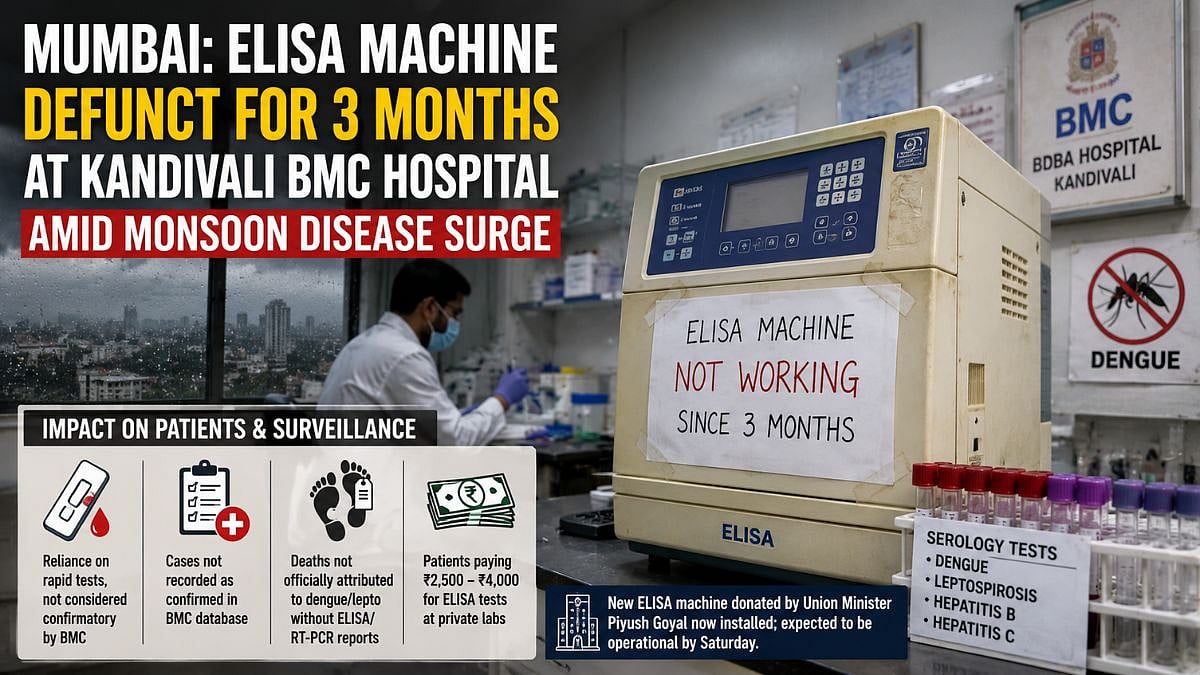
Mumbai's Bharat Ratna Dr Babasaheb Ambedkar Hospital in Kandivali has been without a functional ELISA machine for at least three months, hindering confirmatory testing for diseases like dengue, leptospirosis, Hepatitis B, and Hepatitis C. This breakdown comes at a critical time, as Mumbai is experiencing a surge in vector- and water-borne diseases during the peak monsoon season.
According to hospital sources, suspected cases of dengue and leptospirosis are being diagnosed using rapid diagnostic tests, as the ELISA machine is not available. However, the Brihanmumbai Municipal Corporation (BMC) only considers ELISA or RT-PCR tests as confirmatory for official disease surveillance. As a result, these cases are not being recorded as confirmed in the civic health department's database.
The hospital sources further claimed that patient deaths due to dengue or leptospirosis are not being officially attributed to these diseases unless supported by confirmatory laboratory reports. At least seven to eight patients have recently tested positive for dengue through rapid tests. Some patients have been referred to private laboratories for ELISA testing, incurring costs between Rs 2,500 and Rs 4,000 per test.
Ironically, a new ELISA machine donated by Union Minister Piyush Goyal around three months ago has remained non-operational despite being available at the hospital. Dr Ajay Gupta, Medical Superintendent of BDBA Hospital, confirmed that the hospital's ELISA machine had been non-functional. However, he maintained that patient treatment had not been affected, as treatment is initiated immediately if a rapid test is positive.
The line of treatment remains the same even after ELISA confirmation, according to Dr Gupta. He added that the donated ELISA machine has now been installed and is expected to become operational soon, restoring in-house confirmatory testing. Hospital sources, however, alleged that the prolonged breakdown has affected disease surveillance and reporting during the peak monsoon season.
The situation has been aggravated by manpower shortages, with laboratory technicians unable to travel to other civic hospitals for ELISA testing due to increased workload. The hospital's inability to perform confirmatory tests has significant implications for disease surveillance and reporting in Mumbai.
The BMC's reliance on ELISA or RT-PCR tests for confirmatory diagnosis means that cases diagnosed through rapid tests are not being officially recorded. This could lead to an underreporting of disease cases, making it challenging for authorities to track the spread of diseases and implement effective control measures.
In conclusion, the breakdown of the ELISA machine at Kandivali's BMC hospital has significant implications for disease surveillance and patient care in Mumbai. The hospital's efforts to restore the machine's functionality are crucial in ensuring that patients receive timely and accurate diagnoses, and that authorities can effectively track and control the spread of diseases.
The situation highlights the need for adequate resources and infrastructure in public healthcare facilities, particularly during peak disease seasons. The BMC and hospital authorities must work together to address the manpower shortages and ensure that all necessary equipment is functional and readily available.
As the monsoon season continues, it is essential that the hospital and authorities take prompt action to restore the ELISA machine's functionality and address the manpower shortages. This will help ensure that patients receive the best possible care, and that disease surveillance and reporting are accurate and effective.
The hospital's efforts to initiate treatment immediately, regardless of the diagnosis method, are commendable. However, the need for confirmatory testing cannot be overstated, and the hospital must prioritize restoring the ELISA machine's functionality to ensure that patients receive accurate diagnoses and timely treatment.
In the meantime, patients and their families must be aware of the situation and take necessary precautions to prevent the spread of diseases. The hospital and authorities must also work together to educate the public about the importance of disease surveillance and reporting, and the measures being taken to address the ELISA machine breakdown.
Ultimately, the breakdown of the ELISA machine at Kandivali's BMC hospital serves as a reminder of the challenges faced by public healthcare facilities in Mumbai. It highlights the need for adequate resources, infrastructure, and manpower to ensure that patients receive the best possible care, and that disease surveillance and reporting are accurate and effective.
Frequently asked questions
What is the status of the ELISA machine at Kandivali BMC Hospital?
The ELISA machine at Kandivali BMC Hospital has been non-functional for at least three months.
How are suspected dengue and leptospirosis cases being diagnosed?
Suspected cases are being diagnosed using rapid diagnostic tests, as the ELISA machine is not available.