DeepSeek AI Faces Global Trust Issues
DeepSeek AI model sparks trust concerns, China's censorship and info controls to blame.
'%3E%3Crect%20width%3D'96'%20height%3D'96'%20fill%3D'%234A235A'%2F%3E%3Ccircle%20cx%3D'30'%20cy%3D'24'%20r%3D'44'%20fill%3D'%23fff'%20opacity%3D'.12'%2F%3E%3Ccircle%20cx%3D'60'%20cy%3D'74'%20r%3D'40'%20fill%3D'%23000'%20opacity%3D'.10'%2F%3E%3C%2Fg%3E%3Cg%20fill%3D'none'%20stroke%3D'%23fff'%20stroke-width%3D'3'%3E%3Ccircle%20cx%3D'48'%20cy%3D'48'%20r%3D'16'%2F%3E%3Cellipse%20cx%3D'48'%20cy%3D'48'%20rx%3D'6.5'%20ry%3D'16'%2F%3E%3Cline%20x1%3D'32'%20y1%3D'42'%20x2%3D'64'%20y2%3D'42'%2F%3E%3Cline%20x1%3D'32'%20y1%3D'54'%20x2%3D'64'%20y2%3D'54'%2F%3E%3C%2Fg%3E%3C%2Fsvg%3E)
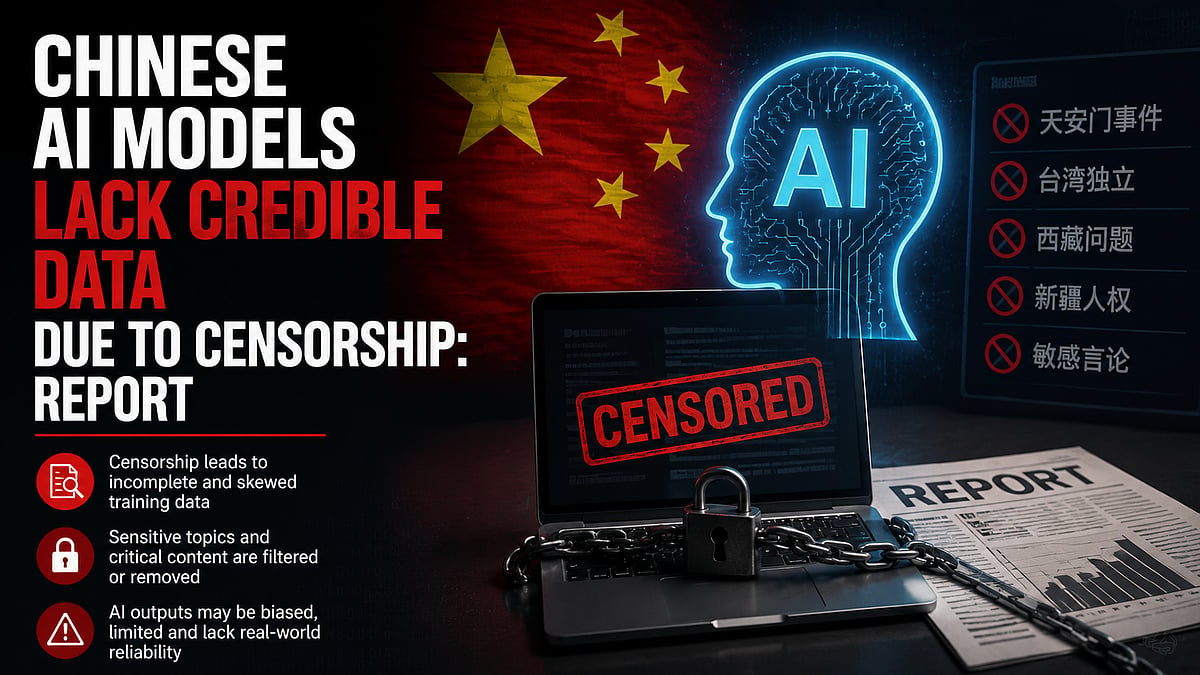
A recent report has highlighted the limitations of Chinese AI models, such as DeepSeek, due to the censorship on information in China. Despite being cheap and capable, these models are distrusted by many governments and users worldwide.
The DeepSeek 'R1' model, launched in January 2025, was seen as a significant leap in artificial intelligence for China. However, it was found to refuse or deflect roughly 85 per cent of prompts concerning politically sensitive topics in China. This has raised concerns about the model's ability to provide unbiased information.
The Chinese government's priority is to control the flow of information, considering it a political liability. The 2023 Interim Measures for the Management of Generative AI Services require any public-facing model to uphold 'core socialist values' and pass a state security review. This has resulted in a 'stability tax' - an unavoidable cost imposed on China's AI ambitions by the government's commitment to political control.
China has made significant advancements in technological products such as electric vehicles, batteries, and solar panels. However, generative AI is an inherently social technology that relies on open-ended language, which is exactly what the Chinese government wants to control.
Research has shown that foundation models originating from China have higher refusal rates, shorter responses, and less accurate answers to questions about Chinese politics than models built elsewhere. This is due to the censorship that persists even when DeepSeek's open-weight models are run privately.
The Chinese state control of the media also seeps into the training data on which all models depend, resulting in more favourable portrayals of states with tightly controlled media. Developers often adopt Chinese open-source models due to their lower cost, but most large enterprises contract directly with US providers or run their inference through major US cloud platforms.
Mainstream consumer audiences outside China continue to prefer US models, with DeepSeek's consumer app seeing a significant decline in downloads from 171 million in 2025 to 35 million in the first half of 2026. Australia, Taiwan, and Italy have also barred DeepSeek from use in government systems.
The report highlights the concerns surrounding Chinese AI models and their ability to provide unbiased information. The Chinese government's commitment to political control has resulted in a 'stability tax' that affects the country's AI ambitions.
The implications of this are significant, as it affects not only the development of AI in China but also its adoption globally. The report suggests that the limitations of Chinese AI models, such as DeepSeek, are a result of the censorship and information controls in China.
In conclusion, the concerns surrounding DeepSeek AI and other Chinese AI models are a result of the Chinese government's commitment to political control and censorship. This has resulted in a lack of trust in these models, affecting their adoption globally.
The future of AI development in China will depend on the government's ability to balance its commitment to political control with the need for open-ended language and unbiased information.
The report's findings have significant implications for the global AI community, highlighting the need for transparency and accountability in AI development.
As the AI landscape continues to evolve, it is essential to consider the implications of censorship and information controls on the development and adoption of AI models.
The report's conclusions are a reminder that the development of AI is not just a technical issue but also a social and political one.
The need for open-ended language and unbiased information is essential for the development of trustworthy AI models.
The Chinese government's commitment to political control has resulted in a 'stability tax' that affects not only the development of AI in China but also its adoption globally.
In the end, the future of AI development in China will depend on the government's ability to balance its commitment to political control with the need for transparency and accountability in AI development.
Frequently asked questions
What is the main concern surrounding DeepSeek AI model?
The main concern is the model's ability to provide unbiased information due to China's censorship and information controls.
How has the global adoption of DeepSeek AI model been affected?
The model's adoption has been affected, with many governments and users distrusting it, and some countries barring it from use in government systems.