Small Towns Lead India's Rooftop Solar Boom
Small towns surpass big cities in rooftop solar adoption, driven by government scheme.
'%3E%3Crect%20width%3D'96'%20height%3D'96'%20fill%3D'%23B3261E'%2F%3E%3Ccircle%20cx%3D'30'%20cy%3D'24'%20r%3D'44'%20fill%3D'%23fff'%20opacity%3D'.12'%2F%3E%3Ccircle%20cx%3D'60'%20cy%3D'74'%20r%3D'40'%20fill%3D'%23000'%20opacity%3D'.10'%2F%3E%3C%2Fg%3E%3Cg%20fill%3D'%23fff'%3E%3Crect%20x%3D'29'%20y%3D'49'%20width%3D'8'%20height%3D'19'%20rx%3D'1'%2F%3E%3Crect%20x%3D'39'%20y%3D'40'%20width%3D'9'%20height%3D'28'%20rx%3D'1'%2F%3E%3Crect%20x%3D'50'%20y%3D'45'%20width%3D'8'%20height%3D'23'%20rx%3D'1'%2F%3E%3Crect%20x%3D'60'%20y%3D'53'%20width%3D'7'%20height%3D'15'%20rx%3D'1'%2F%3E%3Crect%20x%3D'41'%20y%3D'34'%20width%3D'5'%20height%3D'6'%2F%3E%3C%2Fg%3E%3C%2Fsvg%3E)
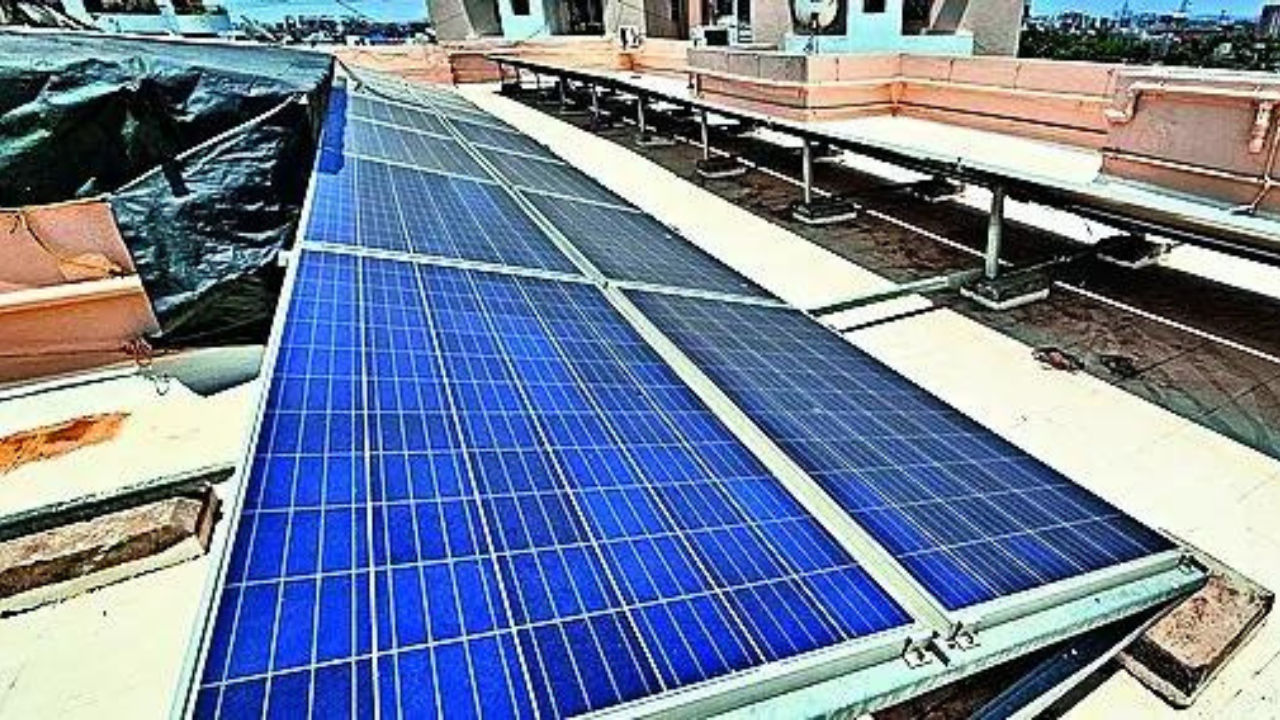
India's smaller urban centers are taking the lead in adopting rooftop solar installations, outpacing major metropolitan areas. This shift is largely driven by the Pradhan Mantri Surya Ghar Muft Bijli Yojana, a government scheme aimed at promoting rooftop solar for households.
The scheme has seen significant progress, with over 36 lakh rooftop solar systems already installed across the country. The initiative aims to benefit a large number of households, providing them with a sustainable and cost-effective source of energy.
According to the scheme's objectives, efforts are now focused on expanding the reach of rooftop solar installations to more urban areas and assisting low-income households in adopting this technology. This move is expected to not only reduce the country's reliance on non-renewable energy sources but also provide economic benefits to households.
The Pradhan Mantri Surya Ghar Muft Bijli Yojana is part of India's larger efforts to increase its renewable energy capacity and reduce carbon emissions. The scheme's success in smaller urban centers can be attributed to the relatively lower costs of installation and maintenance, as well as the growing awareness of the benefits of renewable energy.
As the country continues to push for greater adoption of rooftop solar, it is likely that more households will take advantage of the scheme. The government's efforts to expand the reach of the scheme to more urban areas and low-income households are expected to play a crucial role in achieving this goal.
The adoption of rooftop solar installations in smaller urban centers has also created new opportunities for local businesses and entrepreneurs. The growth of the rooftop solar industry is expected to create new jobs and stimulate local economies, contributing to the overall development of these areas.
In the context of India's energy landscape, the shift towards rooftop solar is significant. The country has set ambitious targets for increasing its renewable energy capacity, and the adoption of rooftop solar is expected to play a key role in achieving these targets.
The success of the Pradhan Mantri Surya Ghar Muft Bijli Yojana in smaller urban centers is a positive indication of the potential for rooftop solar adoption in India. As the scheme continues to expand and more households take advantage of its benefits, it is likely that India will make significant progress in achieving its renewable energy goals.
In conclusion, the lead taken by smaller urban centers in adopting rooftop solar installations is a significant development in India's energy landscape. The government's efforts to promote rooftop solar through the Pradhan Mantri Surya Ghar Muft Bijli Yojana have shown promising results, and it is likely that this trend will continue in the coming years.
The implications of this trend are far-reaching, with potential benefits for the environment, the economy, and households across the country. As India continues to push for greater adoption of renewable energy, the success of the Pradhan Mantri Surya Ghar Muft Bijli Yojana in smaller urban centers will serve as a model for other areas to follow.