
Frankie & Kathi Roll Joints in Mumbai
A local's guide to Mumbai rolls: Tibb's frankie, Colaba baida roti, Kolkata kathi rolls & chicken shawarma, with areas, ₹ price bands and ordering tips.
'%3E%3Crect%20width%3D'96'%20height%3D'96'%20fill%3D'%23E65100'%2F%3E%3Ccircle%20cx%3D'30'%20cy%3D'24'%20r%3D'44'%20fill%3D'%23fff'%20opacity%3D'.12'%2F%3E%3Ccircle%20cx%3D'60'%20cy%3D'74'%20r%3D'40'%20fill%3D'%23000'%20opacity%3D'.10'%2F%3E%3C%2Fg%3E%3Cg%3E%3Ccircle%20cx%3D'48'%20cy%3D'48'%20r%3D'15'%20fill%3D'none'%20stroke%3D'%23fff'%20stroke-width%3D'3'%2F%3E%3Cpath%20fill%3D'%23fff'%20d%3D'M48%2037%20l3.5%2011%20-3.5%2011%20-3.5%20-11%20z'%2F%3E%3Ccircle%20cx%3D'48'%20cy%3D'48'%20r%3D'2.2'%20fill%3D'%23fff'%2F%3E%3C%2Fg%3E%3C%2Fsvg%3E)
The Top 10
- 01
Tibb's Frankie
Multiple outlets (flagship on Linking Road, Bandra West) ₹120–250 a frankie (approx.)Go for: The original Bombay frankie (since 1969) — chicken/mutton wrapped in an egg-coated roti with the signature Tibb's masala
Ask for extra Tibb's masala; the chicken chilli-cheese frankie is the crowd favourite.
- 02
Bademiya
Tulloch Road, Colaba (behind the Taj) ₹600–1,000 for two (approx.)Go for: Late-night legend since 1946 — chicken/mutton seekh rolls and baida roti off the coal grill
Go after 8pm, expect a crowd, and eat standing or in your car like the regulars.
- 03
Ayub's
Forbes Street, Kala Ghoda, Fort ₹300–500 for two (approx.)Go for: Cult chicken tikka and reshmi kebab rolls with a punchy fresh green chutney
Opens around 4:30pm; weekend waits get long, so visit on a weeknight.
- 04
Sarvi
Nagpada, South Mumbai ₹500–800 for two (approx.)Go for: 90-year-old Irani institution — smooth kainchi seekh kebabs you roll into fresh tandoori roti
The facade has no signboard; look for the corner opposite Nagpada police station.
- 05
Cafe Noorani
Haji Ali Circle, Tardeo ₹800–1,200 for two (approx.)Go for: Decades-old Mughlai spot for chicken/mutton kebab rolls alongside its famous biryani
A rare sit-down option here — good for groups; pair a roll with the seekh kebabs.
- 06
Hangla's
Powai, Bandra, Andheri & Malad ₹400–600 for two (approx.)Go for: Mumbai's go-to for Kolkata-style kathi rolls — charcoal-grilled chicken/mutton with paratha, onion and lime
Order the double-egg double-chicken kathi and ask for extra green chilli and lime.
- 07
Rolls Mania
18+ outlets (Powai, Lower Parel, Bandra, Andheri and more) ₹400–500 for two (approx.)Go for: Homegrown QSR chain built around 'a whole meal in a roll', with a big veg and non-veg range
Reliable takeaway near stations; the peri-peri and schezwan rolls are the picks.
- 08
Rollacosta
Andheri West & Versova (plus other outlets) ₹300–500 for two (approx.)Go for: Rolls-and-shawarma chain doing lighter, nutritionist-designed wraps
Go for a shawarma-style rolla if you want something less oily than a classic frankie.
- 09
Kathi Junction
Mira Road, Virar and other suburban outlets ₹250–450 for two (approx.)Go for: Large kathi-roll franchise — affordable chicken/paneer kathi rolls and shawarmas
A quick, budget-friendly suburban bite; good for a fast solo meal.
- 10
Faasos
Delivery-first, kitchens across Mumbai ₹300–500 for two (approx.)Go for: The brand that popularised the modern wrap/roll — chicken tikka and paneer tikka wraps
Order through the app; it's built for convenient delivery rather than dine-in.
Ranked by our Mumbai desk · prices are approximate — confirm before you go.
The short version: Mumbai’s roll scene runs from the homegrown Tibb’s frankie — a spiced roti wrap that was actually invented in this city — to Colaba’s late-night baida roti and chicken kathi rolls, and on to the garlicky chicken shawarma wraps that fuel the college and after-work crowd. It’s the best portable meal in the city: hot, hand-held, and rarely more than a couple of hundred rupees. Learn four formats well and you can eat brilliantly anywhere from a Fort office lane to a Bandra promenade.
Some cities eat rolls as a fad. Mumbai eats them because the city moves too fast for a plate and fork. A roll is a whole meal you can hold in one hand while the other clutches a train pole, and it survives a rickshaw ride, a platform dash and a fifteen-minute queue outside a cinema. This guide walks you through the formats that actually matter — the frankie, the kathi roll, the baida roti and the shawarma — where each one is done well, roughly what you’ll pay, and how to order like you’ve done it a hundred times.
Mumbai’s rolls at a glance
Use this as a compass, not a contract — prices shift by outlet, by filling and with the going rate for mutton. Everything below is a per-roll ballpark for the standard chicken version unless noted.
| Roll | Where it shines | Rough price | Best for |
|---|---|---|---|
| Tibb’s frankie | Kiosks & mall counters citywide | ₹90–₹220 | First-timers, a movie or train grab |
| Baida roti | Colaba lanes behind the Taj | ₹250 upward | Late night, a big appetite |
| Kolkata-style kathi roll | Bandra, Mohammed Ali Road, kebab counters | ₹120–₹280 | The “proper” roll experience |
| Chicken shawarma | Mohammed Ali Road, Carter Road, college hubs | ₹120–₹250 | Cheap, fast, eaten on the move |
| Paneer frankie / paneer tikka roll | Widely available, veg counters | ₹90–₹200 | Vegetarians who want the real thing |
The anatomy of a good roll
Before the where, understand the what. Once you can read a roll, you can walk up to any counter in the city and judge it in ten seconds.
The wrap
Everything hangs on the bread. A frankie uses a thin, soft roti brushed with beaten egg on the griddle, so it’s pliable and holds a lot of filling without cracking. A Kolkata-style kathi roll uses a flaky, layered paratha shallow-fried until it blisters — greasier, sturdier, more indulgent. Shawarma comes in a soft flatbread or rumali-style wrap that’s meant to be folded tight and toasted on the press. If the bread is cold, stiff or reheated from a stack, the whole thing suffers; you want it coming off the heat as it’s assembled.
The filling
Good filling tastes cooked to order, not scooped from a tray that’s been sitting since lunch. For chicken and mutton, you’re looking for pieces with some char and colour — tikka, seekh, bhuna, reshmi — rather than pale, boiled-looking meat drowned in gravy. Paneer should be pan-seared with a bit of a crust. The egg layer, where there is one, should be a thin fried sheet bonded to the roti, not a wet omelette folded in as an afterthought.
The finish
The last thirty seconds are where a ₹120 roll becomes worth ₹200. The classic trio is sliced raw onion, a squeeze of lime and a spoon of green chutney, with chilli or a masala dust for heat. Shawarma leans on garlic sauce and a little pickle. A common misstep at busier counters is drowning everything in mayonnaise or a sweet red sauce — ask for it light if you want the meat to lead. And always ask them to seal and toast the roll on the griddle before it’s wrapped; it holds together far better on the walk.
The Tibb’s frankie: Mumbai’s own invention
Before anything else, know this: the frankie was born in Bombay. The story goes back to the late 1960s, when Amarjit Singh Tibb, inspired by a stuffed-bread snack he’d tried abroad, created a spiced, masala-fried filling rolled inside a soft egg-coated roti and sold it as a fast, hot, hand-held snack. He named it the “frankie,” and the format caught on across cinema halls, stations and markets until it became shorthand for the whole city’s idea of a roll.
What you’re actually getting
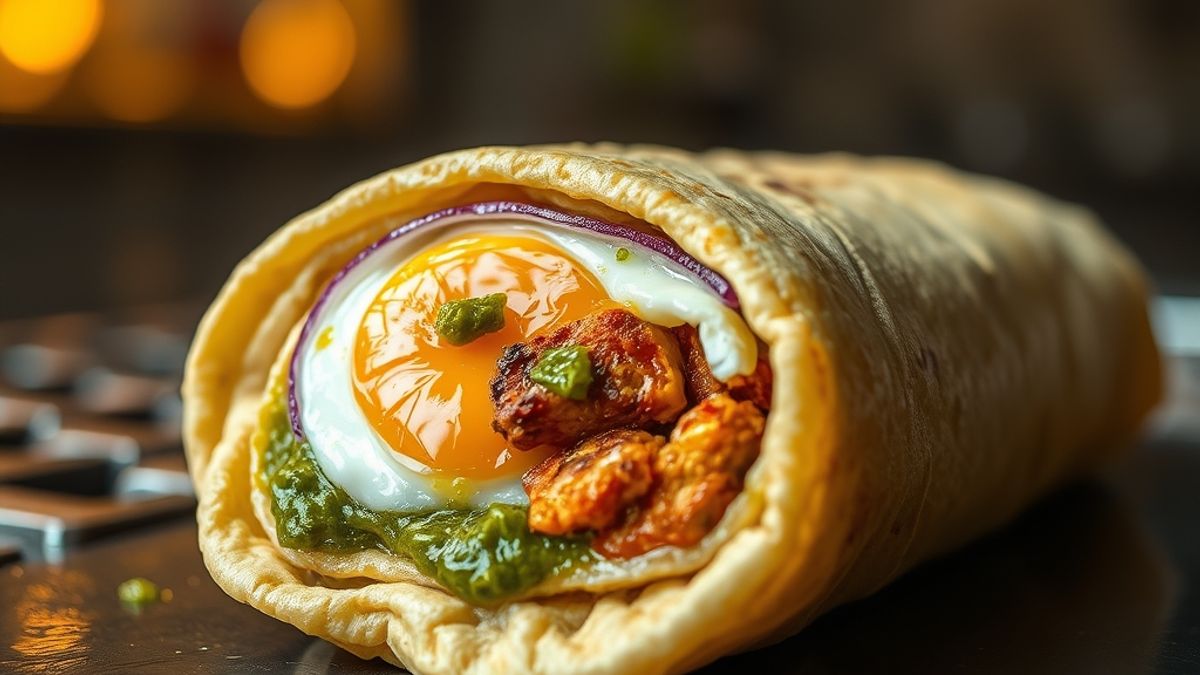
Today Tibb’s Frankie is a familiar chain with kiosks and small outlets scattered across the city and inside many malls. What you’re getting is consistent and comforting rather than gourmet: a thin roti wrapped around a beaten-egg layer and a filling — classic options run to chicken, mutton, paneer and the very Mumbai schezwan variants — finished with a tangy masala and raw onion. The appeal is reliability. A frankie from a mall counter in Andheri tastes much like one from a kiosk near a station in the suburbs, which is exactly why it’s the safe first move.
How to order it
- Rough price: roughly ₹90–₹220 depending on the filling and outlet, with veg noticeably cheaper than non-veg.
- Order this: the chicken frankie if it’s your first, or a schezwan chicken frankie if you want that Indo-Chinese kick that Mumbai does so well.
- Good to know: it travels well, so it’s a genuinely good grab on the way into a movie or a long local-train ride. Ask for the masala on the side if you’re heat-shy — the schezwan and “extra masala” versions can bite.
Colaba after dark: baida roti and kathi rolls
If you want the theatrical, smoke-and-sizzle end of the roll world, head to the lanes behind the Taj in Colaba. This is where the city’s roll culture is at its most alive, especially once the dinner crowd thins and the real regulars appear.
Bademiya and the baida roti
Bademiya is the institution here — a decades-old spot that grew from handcarts into a Colaba landmark, famous for late-night kebabs and rolls. You’ll see cooks flipping and folding baida roti (a fried, egg-washed roti stuffed with spiced minced chicken, mutton or egg) while a line of hungry regulars and the occasional fancy car waits alongside. The baida roti is the thing to understand here: it’s less a rolled wrap than a stuffed, shallow-fried parcel, crisp at the edges and rich in the middle, best eaten straight off the griddle before the base goes soft.
- Rough price: rolls and baida roti here typically run from around ₹250 upward.
- Order this: a chicken or mutton baida roti, plus a seekh or tikka roll to compare the two textures side by side.
- Timing: this is late-night territory, open into the small hours — ideal after a night out around Fort and Colaba. Carry cash and be ready to eat standing; there’s rarely anywhere to sit.
Ayub’s in Kala Ghoda
A short walk away in the Kala Ghoda area, Ayub’s is the tucked-away favourite for kathi kebabs and rolls — chicken tikka, reshmi, bhuna and mutton seekh folded into roti. It’s small, unpretentious and beloved by the late crowd, the kind of place people send friends to precisely because it doesn’t look like much. If you’re already exploring the Fort and Kala Ghoda art precinct, it’s an easy detour, and it pairs well with an evening spent wandering the galleries and stone facades. For a fuller after-hours plan around here, the same lanes feed into Mumbai’s wider late-night food map.
The Kolkata-style kathi roll
The kathi roll as most people picture it — a paratha wrapped around skewer-grilled kebab, egg, sliced onion and a squeeze of lime with green chutney — is a Kolkata export that Mumbai has thoroughly adopted. It’s arguably the most satisfying roll in the city when it’s done right, and the most disappointing when it isn’t.
How to spot a good one
The tell-tale signs are a flaky, slightly greasy paratha, a proper egg coating (the “double egg” upgrade is genuinely worth it), and kebab that tastes grilled rather than boiled. A great kathi roll has a little chew from the paratha, a little char from the meat, and a fresh crunch of raw onion — three textures in one bite. If the paratha is limp and the meat is grey, walk on.
Where to find it
Look for dedicated Kolkata-roll counters and kebab joints across the western suburbs and the Muslim food streets. In Bandra, Hangla’s near Linking Road is a well-known name for the Kolkata-style double-egg chicken roll, handy when you’re already down that way to shop or eat. Around Mohammed Ali Road — especially electric during Ramzan — the kebab-and-roll stalls are as authentic as it gets; that whole quarter deserves its own evening, mapped out in our Mohammed Ali Road food trail.
- Rough price: roughly ₹120–₹280, with double-egg and double-chicken versions at the top of that band.
- Order this: a double-egg chicken roll for the full experience; a mutton seekh roll if you want it richer and smokier.
- Pro tip: ask them to grill the paratha a little crisper and to toast the finished roll seam-side down — it holds together far better on the walk and won’t spill onion at the first bite.
Shawarma: the Middle-Eastern wrap Mumbai made its own
Somewhere along the way the chicken shawarma became a genuine Mumbai street staple — thin slices shaved off a vertical rotisserie, folded into a soft wrap with garlic sauce, tangy vegetables and sometimes a smear of chilli. It’s cheap, fast and everywhere, and it has quietly become the default late-evening snack for a whole generation of college-goers.
Where it’s reliable
Reliable pockets: Mohammed Ali Road, where some of the oldest and most affordable shawarma counters have been feeding crowds for years; Carter Road in Bandra, a classic promenade spot for a grilled-chicken wrap with the sea breeze; and the many outlets around college and nightlife hubs where the after-hours queue tells you everything you need to know. A short line moving fast, meat carved to order and a warm press for the wrap are the three green flags.
- Rough price: roughly ₹120–₹250 for a chicken shawarma roll, more for cheese or “special” versions.
- Order this: a chicken shawarma roll with extra garlic sauce; skip the mayo overload if you want the meat to shine.
- Good to know: shawarma is the one roll where freshness of the carved meat matters most — a rotisserie that’s been turning steadily beats one where slices are sitting pre-cut on a tray.
Vegetarian and lighter rolls
Mumbai is a serious vegetarian city, and the roll counters know it. You are not stuck with a plain veg frankie of cabbage and sauce unless you settle for one.
The two rolls worth seeking out are the paneer frankie — pan-seared paneer with masala and onion in the egg-brushed roti — and the paneer tikka kathi roll, where marinated cubes get a proper grill before they’re wrapped in paratha. Both are widely available and genuinely good, not afterthoughts. Aloo (potato) and mixed-veg frankies sit at the cheaper end and make a decent quick bite, and many counters will happily do a “no egg” version of any roll if you ask. Expect roughly ₹90–₹200, veg running cheaper than the chicken equivalents.
If you’re vegetarian and building a longer food outing, rolls slot neatly alongside the rest of the city’s meatless street canon — this fits into the broader Mumbai street-food crawl rather than replacing it.
What to order, by mood
- First-timer, keep it simple: a Tibb’s chicken frankie or a Kolkata-style double-egg chicken roll.
- Big appetite, late night: a baida roti plus a seekh roll from Colaba, eaten standing on the pavement like a local.
- Light and quick: a single chicken shawarma wrap, garlic sauce, no mayo.
- Vegetarian: a paneer frankie, or a paneer tikka kathi roll — both are widely available and honestly satisfying.
- Something to compare: order a frankie and a Kolkata roll side by side once, and you’ll immediately understand why Mumbai keeps both.
Neighbourhood notes
Rolls turn up everywhere, but a few areas reward you more than others, and knowing which is which saves you a wasted trip.
- Colaba and Fort: the heartland of the late-night, sit-nowhere, eat-standing roll — baida roti and seekh rolls after dark, best after a wander through the Fort and Kala Ghoda precinct.
- Mohammed Ali Road and Bhendi Bazaar: the most authentic kebab-and-roll cooking in the city, and unmissable during Ramzan.
- Bandra: Linking Road for Kolkata-style rolls, Carter Road for a shawarma with a sea view — an easy combine with a longer eating loop.
- The suburbs and malls: where the Tibb’s-style frankie lives, consistent and convenient near stations and cinemas from Andheri outward.
Tips, timing and getting there
- Best time: evenings after 7pm, when turnover is highest and everything is fresh off the griddle. Colaba’s roll scene peaks late, well past the point where most kitchens elsewhere have shut.
- Freshness rule: order where the queue is longest and the filling is being cooked to order, not scooped from a tray that’s been sitting. A busy counter is a fresh counter.
- Monsoon note: in the June-to-September rains, favour covered counters and places with brisk turnover — you want food that isn’t sitting exposed, and a roll you can eat under an awning between downpours. A hot, freshly griddled roll is one of the great monsoon comfort foods when the streets are wet.
- Carry cash and napkins: many of the best stalls are cash-first, and rolls are gloriously messy — garlic sauce and lime don’t care about your shirt.
- Getting around: Colaba is a short taxi ride from Churchgate (Western line) or CSMT (Central/Harbour line). Mohammed Ali Road sits between Marine Lines and Sandhurst Road. Bandra’s Carter and Linking Road spots are a rickshaw hop from Bandra station. If the local train is your lifeline for all this, it helps to know how the Mumbai locals work before you set out.
- Pair it up: rolls fold neatly into a wider street-food crawl — grab a vada pav to start and a roll to finish, and you’ve eaten the city in two bites.
A simple one-evening roll crawl
If you want a plan rather than a list, this is the low-effort, high-reward version. Start early evening in Bandra with a Kolkata-style double-egg chicken roll near Linking Road, then drift to Carter Road for a chicken shawarma and the sea breeze. Later, if the night has legs, taxi down to Colaba and finish behind the Taj with a baida roti and a seekh roll once the crowd thins after 11pm. Three neighbourhoods, four rolls, one very good evening — and you’ll have tasted the full arc of how Mumbai eats on the move, from a Kolkata import to a Middle-Eastern wrap to the city’s own homegrown invention.
Frequently Asked Questions
What is the difference between a frankie and a kathi roll?
A frankie is Mumbai's homegrown version, invented by Amarjit Singh Tibb in the late 1960s: a thin, soft roti brushed with a beaten-egg layer, wrapped around a masala-fried filling and finished with raw onion and a tangy masala. A kathi roll is the Kolkata-style wrap Mumbai adopted, built on a flaky, shallow-fried paratha around skewer-grilled kebab, egg and sliced onion with green chutney and lime. In short, the frankie is softer and more uniform, while the kathi roll is flakier, greasier and more indulgent.
Where can I get rolls late at night in Mumbai?
The Colaba lanes behind the Taj are the go-to after dark. Bademiya is the landmark for late-night baida roti and kebab rolls, and Ayub's in nearby Kala Ghoda is a small, well-loved spot for kathi rolls into the small hours. Mohammed Ali Road also runs late, especially during Ramzan, when the whole quarter stays open past midnight.
How much does a chicken roll cost in Mumbai?
As a rough guide, expect roughly ₹90–₹220 for a Tibb's-style chicken frankie, ₹120–₹280 for a Kolkata-style kathi roll (double-egg and double-chicken versions cost more), and around ₹250 upward for baida roti at a Colaba institution. A chicken shawarma typically runs ₹120–₹250. Prices vary by outlet and are best treated as approximate rather than fixed.
What is baida roti?
Baida roti is a fried, egg-washed roti stuffed with spiced minced chicken, mutton or egg, then shallow-fried until the edges are crisp. It's less a rolled wrap than a flat, stuffed parcel, rich in the middle and best eaten straight off the griddle before the base softens. Colaba's Bademiya is the classic place to try it.
Are there good vegetarian rolls in Mumbai?
Yes, and they're not afterthoughts. The paneer frankie (pan-seared paneer with masala and onion) and the paneer tikka kathi roll (marinated, grilled paneer in a paratha) are both widely available and genuinely satisfying, usually around ₹90–₹200. Aloo and mixed-veg frankies sit at the cheaper end, and most counters will make a no-egg version of any roll if you ask.
Which area of Mumbai is best for rolls?
It depends on the roll. Colaba and Fort are best for late-night baida roti and seekh rolls, Mohammed Ali Road and Bhendi Bazaar for the most authentic kebab-and-roll cooking (especially during Ramzan), and Bandra's Linking Road and Carter Road for Kolkata-style rolls and shawarma. For a reliable Tibb's-style frankie, head to the kiosks and mall counters spread across the suburbs.