
Ghatkopar Food Trail: Gujarati Snacks & Khau Galli
Ghatkopar khau galli food guide: cheese pav bhaji, dabeli, khichu, dhokla, cheese dosa and golas in Mumbai's Gujarati snack belt — prices, timings, tips.
'%3E%3Crect%20width%3D'96'%20height%3D'96'%20fill%3D'%23E65100'%2F%3E%3Ccircle%20cx%3D'30'%20cy%3D'24'%20r%3D'44'%20fill%3D'%23fff'%20opacity%3D'.12'%2F%3E%3Ccircle%20cx%3D'60'%20cy%3D'74'%20r%3D'40'%20fill%3D'%23000'%20opacity%3D'.10'%2F%3E%3C%2Fg%3E%3Cg%3E%3Ccircle%20cx%3D'48'%20cy%3D'48'%20r%3D'15'%20fill%3D'none'%20stroke%3D'%23fff'%20stroke-width%3D'3'%2F%3E%3Cpath%20fill%3D'%23fff'%20d%3D'M48%2037%20l3.5%2011%20-3.5%2011%20-3.5%20-11%20z'%2F%3E%3Ccircle%20cx%3D'48'%20cy%3D'48'%20r%3D'2.2'%20fill%3D'%23fff'%2F%3E%3C%2Fg%3E%3C%2Fsvg%3E)
The Top 11
- 01
Pure Milk Centre
Ghatkopar East (Vikrant Circle) ₹300–500 for two (approx)Go for: Ghatkopar's dosa institution — 100+ wild varieties, headlined by the cheese burst dosa (also Maggi, pasta and ice-cream dosas).
Go on a weekday evening; weekend queues are long. Mostly cash, though there's now a small AC section.
- 02
Achija
Ghatkopar East (Tilak Road Naka, near Vikrant Circle) ₹300–500 for two (approx)Go for: Legendary all-veg pav bhaji joint — order the cheese pav bhaji and the buttery grilled/cheese sandwich.
Open till around 1 AM, so it's the go-to late-night stop; expect a crowd after 9 PM. Jain options available.
- 03
Ghatkopar Khau Galli
Ghatkopar East (off the station, towards Vikrant Circle) ₹150–300 for two (approx)Go for: The street-food heart of the trail — Jini dosa, multi-flavour pani puri, dabeli, frankies, pizza shots and crepes across dozens of stalls.
Opens around 4 PM and peaks after dark. Carry cash, come hungry, and graze small across several carts.
- 04
Rajdhani Thali
Ghatkopar West (R City Mall) ₹1,000–1,200 for two (approx)Go for: Unlimited Gujarati-Rajasthani thali with 25+ items and a menu that rotates daily.
Time your visit for the discounted Tuesday thali, and arrive genuinely hungry — refills keep coming.
- 05
Sai Swad Dosa
Ghatkopar East (Khau Galli) ₹150–300 for two (approx)Go for: A well-loved dosa cart famous for its Jini dosa — a chopped, buttery masala-dosa scramble.
It's a street stall, so head there after 6 PM when it fires up; cash only.
- 06
Family Tree
Ghatkopar East ₹800–1,200 for two (approx)Go for: All-vegetarian multi-cuisine sit-down spot (Indian, Italian, Mexican, Chinese) known for its dum biryani.
Book ahead on weekends and ask for the Jain menu if you need it.
- 07
Mahavir Sweets & Farsan
Ghatkopar West (LBS Marg) ₹200–400 for two (approx)Go for: Classic Gujarati farsan-and-mithai counter — kachori, samosa, fafda-jalebi, kandvi and barfis.
Come in the morning for hot, fresh fafda-jalebi; office-goer queues build early.
- 08
Shuruwat
Ghatkopar West ₹600–900 for two (approx)Go for: Contemporary all-veg cafe — try the multigrain feta-chilli dosa and the Latino pani puri.
Good for a relaxed sit-down brunch rather than a quick grab-and-go.
- 09
Chaap Ki Chhap
Ghatkopar East ₹500–800 for two (approx)Go for: Soya-chaap specialist doing veg mock-meat done as grills, tikkas and rich gravies.
Order the malai/afghani chaap — a satisfying vegetarian stand-in for kebabs.
- 10
HOG - House of Good Food
Ghatkopar West ₹700–1,000 for two (approx)Go for: Casual comfort-food restaurant known for cheese fondues and loaded exotic pizzas.
The fondue is best shared, so go with a group.
- 11
Trupti Snacks
Ghatkopar East ₹150–300 for two (approx)Go for: Neighbourhood farsan-and-sweets shop with fresh khakhra, chevda, fafda plus barfi and rasmalai.
Best in the morning when the farsan is freshest; great for takeaway snacks.
Ranked by our Mumbai desk · prices are approximate — confirm before you go.
The short version: Ghatkopar East’s khau galli is one of Mumbai’s great eastern-suburb food streets — a dense Gujarati-Kutchi snack belt where cheese-loaded pav bhaji, dabeli, khichu and dhokla share the lane with fusion chaat, cheese dosa and dry-fruit golas. It wakes up around 4pm, runs late into the night, leans overwhelmingly vegetarian, and rarely costs more than a couple of hundred rupees to eat very well. Come hungry, come in company, and plan to split everything.
Most food-crawl guides never cross the harbour into the eastern suburbs. That is their loss. Ghatkopar — a prosperous, tightly packed, heavily Gujarati-Kutchi pocket on the Central line — has quietly become one of the best snacking destinations in the city. It is the kind of place where three generations of one family run a single dabeli stall, where a woman who has made the same four things for two decades will still out-sell the flashier counter next door, and where “cheese” has been cheerfully welded onto every classic you can name. This is a trail built for grazing rather than feasting: small plates, quick bites, and the discipline to keep some room. Below is how to walk it well.
Quick reference: what to eat, what it costs
Treat every price here as an approximate 2026 street-side band, not a fixed menu. Portions, toppings and how much cheese and butter you sign up for will swing the number, and rates drift upward each year. This is the shape of the trail, not a receipt.
| Dish | Where to find it | Rough price (₹) | Best for |
|---|---|---|---|
| Butter / cheese pav bhaji | Achija and similar big counters | 120–250 a plate | The signature; share as a meal |
| Dabeli (and dabeli cone) | Kutchi snack stalls, Shreeji Corner | 30–70 | A cheap, perfect first bite |
| Khichu | Small Gujarati counters | 40–90 | Soft, hot, comforting graze |
| Dhokla / farsan | Radhe Dhokla (sit-down), stalls | 40–120 | A light palate-cleanser |
| Cheese dosa & fusion chaat | Dosa and chaat tawas | 80–200 | Splitting; street theatre |
| Malai / dry-fruit gola, kulfi-falooda | Gola and dessert stalls | 40–150 | The cold, sweet finish |
If you only remember one rule from the table, make it this: one savoury, one fusion, one sweet, then repeat. Nobody does the khau galli in a single dish.
When to go and how the lane works
The heart of it is the khau galli just off the station in Ghatkopar East — a narrow lane that fills up through the evening with office-goers heading home, college students, and families working their way stall to stall. It is not a sit-down destination. It is a standing, walking, sharing kind of street, and the sooner you accept that the more you will enjoy it.
Timing
The lane is really an evening affair. Most counters get going around 4pm and run late into the night, with the crowd thickening sharply after 7pm once the after-work rush arrives off the Central line trains. If you want the food at its freshest with room to actually move, aim for that early window between roughly 5 and 6.30pm — the tawas are hot, the queues are short, and you can taste widely before the crush. Turn up at 8.30 on a Saturday and you will still eat brilliantly, but you will do it shoulder-to-shoulder, which is either the charm or the chaos depending on your mood.
How it works
You eat on your feet, you order across several stalls, and you pay each one separately. That is the rhythm of every Mumbai khau galli and Ghatkopar is no exception. Carry cash — many of the smaller counters still prefer notes and coins, though a good number now take UPI too, so keep both options open. Grab a paper plate, eat standing to one side so you are not blocking the flow, and do not expect seating; the handful of stalls with a stool or two are the exception.
Strategy
Go with at least one other person and split every plate. The entire appeal here is variety, and a single large portion to yourself defeats the purpose — you will be full after two stalls and will have missed the other twenty. Order small, taste, move on, come back to whatever won. Think of it as a tasting menu you assemble yourself, on foot, for a few hundred rupees.
Cheese pav bhaji, the Ghatkopar way
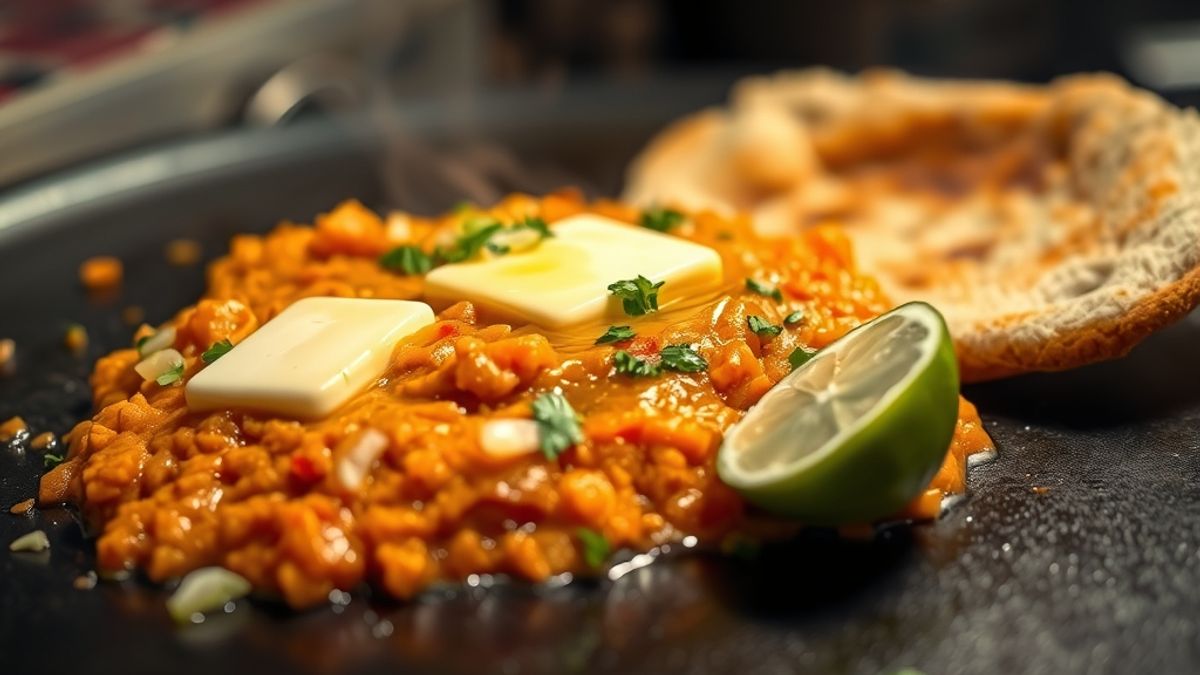
If Ghatkopar has a signature, it is pav bhaji taken to gleeful excess. The well-known name here is Achija, a local institution popular enough to run more than one outlet in the area — so if one is heaving, there may be another nearby. The house style is generous to the point of theatre: a mound of finely mashed bhaji worked on a screaming-hot tawa, a slab of butter melting into a golden puddle at the edge, soft pav toasted in that same butter until the cut faces are lacquered and crisp, with raw chopped onion and a wedge of lime on the side.
Start with the classic butter pav bhaji to understand the base — it should be smooth, deep red-brown, buttery without being greasy, and hot enough to steam. Then, if you are feeling reckless, order the cheese pav bhaji, where grated cheese is folded through the bhaji until it turns rich and stringy and pulls in threads off the spoon. It is unapologetic and it is the reason people travel across the city for this street.
One honest caveat: this is a full meal, not a snack. A plate of cheese pav bhaji will comfortably feed two, and if you eat a whole one solo early in the crawl, your evening is effectively over. Share one plate between two, keep the pav count down, and you will still have appetite for the dabeli and dosa waiting further down the lane.
The Gujarati-Kutchi snack belt: khichu, dabeli, dhokla
This is where Ghatkopar shows its roots, and where the trail rewards you for looking past the flashy counters. Tucked between the big tawas are tiny Gujarati snack stalls — the sort run by one family, sometimes by a single woman who has been making the same handful of things for years and needs no signboard to draw a queue. Shreeji Corner is one such small, well-loved spot, known for homely Gujarati bites: khichu, wati dal na dhokla, dabeli and pav patties, all made the way a Kutchi household would make them.
Here is the shortlist to hunt for across this belt:
- Dabeli — the Kutchi classic and, rupee for rupee, perhaps the best thing you will eat all evening. A spiced, faintly sweet potato filling is packed into a buttered pav with tangy chutney, pomegranate seeds, roasted peanuts and a shower of fine sev. Watch for the dabeli cone variant some stalls now do, with the masala and toppings stacked into a crisp cone so you get everything in one crunchy handful. At ₹30–₹70 it is the ideal opener while you decide what else to eat.
- Khichu — a soft, hot, steamed rice-flour dough, faintly chilli-spiked, eaten with a slick of oil and a spoon of sharp green chutney. It is deeply comforting, the kind of thing regulars order on autopilot, and it works beautifully as a warm counterpoint to all the cheese elsewhere on the trail.
- Dhokla — steamed, spongy, mildly sweet-sour and tempered with mustard seeds and curry leaves. It is the reliable palate-cleanser of the belt: light, fresh, and the thing to reach for when your mouth needs a break between two heavier bites.
If you would rather sit down and eat this repertoire off a plate at a table, Radhe Dhokla has a presence in Ghatkopar East and is a dependable stop for freshly steamed dhokla, khichu and Gujarati farsan. It is a gentler, less frantic way to taste the same tradition, and a good move if you are with older family members or simply want ten minutes off your feet. If this corner of the food interests you, it pairs naturally with a full Gujarati thali elsewhere in the city, where the same flavours arrive as a proper sit-down meal rather than a standing snack.
Fusion chaat and cheese dosa
Ghatkopar’s other personality is unapologetically inventive, and this is where the street stops being reverent about tradition and starts having fun. The dosa counters here are a spectacle in their own right — batter spread thin and lacy across the tawa, loaded with fillings, chopped into bite-sized pieces with the edge of the spatula, then buried under a snowdrift of grated cheese and served with coconut chutney and sambar. It is not the purist’s Udupi dosa, and that is entirely the point. This is dosa as street theatre, and you should order it in exactly that spirit.
You will also find the wider Mumbai fusion-chaat universe well represented and in full cheese-forward mood: schezwan crossovers, “Chinese bhel”, cheese-and-corn layered onto familiar chaats, and a general willingness to top anything with anything. Some of it is brilliant, some of it is chaos, and the only way to know is to split a plate and find out. Treat it as the city’s street food scene at its most experimental — the opposite of the disciplined single-dish stalls, and a fair chunk of why people keep coming back to this particular lane rather than a hundred others.
Order a cheese dosa to split, plus one fusion chaat you would never find in a South Indian tiffin house, and you have captured this stretch of the trail. Loaded dosas and fusion chaats mostly land in the ₹80–₹200 band, climbing with every extra topping, so keep an eye on how fast the “just add cheese” additions stack up.
Finish sweet: gola, kulfi and mithai
No Ghatkopar crawl ends without something cold and sweet, and the lane obliges generously. The gola (shaved-ice) stalls here go well beyond the basic syrup-over-ice of childhood — the ones to look for pile a dry-fruit malai gola high with strands of mawa, chopped nuts and thick cream until it is closer to a dessert than a drink. On a humid Mumbai evening, after all that butter and cheese, it is exactly the reset your palate is begging for.
Beyond the golas, the surrounding market spills kulfi, falooda and mithai counters onto the edges of the food street, so the sweet finish can be as light or as serious as you like. A malai or dry-fruit gola at ₹40–₹150 is the quick cool-down; a kulfi-falooda is the move if you want something more substantial to walk home with. For more in this vein across the city, Mumbai’s desserts and mithai scene runs deep, and Ghatkopar is a fine place to develop the habit.
A first-timer’s crawl, in order
If you have never done this street and want a plan rather than a wander, walk it roughly like this. Begin light with a dabeli while you get your bearings and scout the queues. Follow it with a khichu or a plate of dhokla from a Gujarati counter to warm up properly. Then commit to the main event — a shared cheese pav bhaji at Achija, split strictly between two. Swing into the inventive stretch for a cheese dosa and one fusion chaat you have never seen before. Close it out with a dry-fruit malai gola. That is five or six stops, comfortably under a few hundred rupees a head, and a complete picture of what this belt does best — without leaving you too full to enjoy the last bite.
Tips for eating well here
- Go on an empty stomach and share everything. The whole appeal is variety; large solo portions are the single most common mistake first-timers make.
- Follow the queues. On a busy street, the longest line usually means the freshest, fastest-turnover food — trust the crowd over the signage.
- Bring cash, keep UPI ready. Acceptance is uneven; the smallest and often best stalls still run on notes and coins, so do not rely on a phone alone.
- Lean into the vegetarian thing. This belt is overwhelmingly veg by tradition, and much of it is genuinely satisfying even for committed meat-eaters. Come expecting it rather than hunting for exceptions.
- Mind the monsoon. Between roughly June and September, an open-air standing street is at the mercy of the rain; carry an umbrella, favour the covered and busiest stalls, and pick a dry evening if you can. Winter and the cooler months are the most pleasant time to linger.
- Time it right. Weeknights are calmer; weekends and evenings after 8pm get shoulder-to-shoulder. Earlier is easier if you actually want to taste widely.
Getting there
Ghatkopar is one of the best-connected points in the eastern suburbs, which is a large part of why the food street thrives. It sits on the Central line, and it is also the eastern terminus of Metro Line 1 (the Blue Line) running in from Versova — making it a genuine east-west interchange, with the two stations linked by a foot overbridge. That combination is the practical magic here: the whole city can reach a single lane in Ghatkopar East without much fuss, and it shows in the crowds every evening.
The khau galli is a short walk from the Ghatkopar East exit; ask for the khau galli or the main market and any local will point you the right way. If you are coming from the western suburbs, skip the harbour-line detour and take the metro straight across from Andheri — it is the painless way in, drops you within walking distance, and lets you arrive hungry rather than frazzled. Time your visit for early evening, walk the lane once end to end before committing, and then eat your way back down it slowly.
Frequently Asked Questions
What is Ghatkopar khau galli famous for?
It is best known as a Gujarati-Kutchi snack street in Ghatkopar East, where cheese-loaded pav bhaji, dabeli, khichu and dhokla sit alongside fusion chaats and cheese dosa. You eat standing, moving stall to stall along a narrow lane, splitting small plates rather than sitting down to a single meal. The dessert end runs to dry-fruit malai golas, kulfi and falooda from the surrounding market.
What time does Ghatkopar khau galli open and when is best to go?
It is an evening scene: most counters get going around 4pm and run late into the night. The busiest, freshest hours are after 7pm once the after-work crowd arrives off the Central line. For the food at its best with room to actually move, aim for the earlier window between roughly 5 and 6.30pm, and favour weeknights over weekends if you want to taste widely without the crush.
How much does it cost to eat at Ghatkopar khau galli?
You can eat very well for a couple of hundred rupees a head if you share. As rough 2026 bands, dabeli runs about ₹30–₹70, khichu and dhokla ₹40–₹120, cheese or butter pav bhaji ₹120–₹250 a plate, loaded dosas and fusion chaats ₹80–₹200, and golas or kulfi-falooda ₹40–₹150. Treat these as approximate and rising, and carry cash since many small stalls still prefer notes, though UPI is increasingly accepted.
Is Ghatkopar khau galli vegetarian?
Largely yes. The area's Gujarati-Kutchi character means the food is overwhelmingly vegetarian, from the dabeli, khichu and dhokla counters to the cheese pav bhaji and dosa stalls. It is genuinely satisfying even for committed meat-eaters, so it is best approached expecting a veg feast rather than hunting for exceptions.
How do I get to Ghatkopar khau galli by metro or train?
Ghatkopar sits on the Central line and is also the eastern terminus of Metro Line 1 (the Blue Line) from Versova, with the two stations joined by a foot overbridge. From the western suburbs, the easiest route is the metro straight across from Andheri, which drops you within walking distance. The lane itself is a short walk from the Ghatkopar East exit — ask any local for the khau galli or the main market.
What should a first-timer order at Ghatkopar khau galli?
Start light with a dabeli while you scout the queues, then a khichu or plate of dhokla from a Gujarati counter. Make the shared cheese pav bhaji at a big name like Achija your main event, strictly split between two, then move to the inventive stretch for a cheese dosa and one fusion chaat you have never seen. Finish with a dry-fruit malai gola to cool down — that is five or six stops and a complete picture of the street for under a few hundred rupees a head.