
Hyderabadi Biryani & Dum Cooking in Mumbai
Real Hyderabadi kachchi dum biryani in Mumbai: where to eat it, mirchi ka salan, Ramzan haleem, ₹ price bands and how to tell it from generic biryani.
'%3E%3Crect%20width%3D'96'%20height%3D'96'%20fill%3D'%23E65100'%2F%3E%3Ccircle%20cx%3D'30'%20cy%3D'24'%20r%3D'44'%20fill%3D'%23fff'%20opacity%3D'.12'%2F%3E%3Ccircle%20cx%3D'60'%20cy%3D'74'%20r%3D'40'%20fill%3D'%23000'%20opacity%3D'.10'%2F%3E%3C%2Fg%3E%3Cg%3E%3Ccircle%20cx%3D'48'%20cy%3D'48'%20r%3D'15'%20fill%3D'none'%20stroke%3D'%23fff'%20stroke-width%3D'3'%2F%3E%3Cpath%20fill%3D'%23fff'%20d%3D'M48%2037%20l3.5%2011%20-3.5%2011%20-3.5%20-11%20z'%2F%3E%3Ccircle%20cx%3D'48'%20cy%3D'48'%20r%3D'2.2'%20fill%3D'%23fff'%2F%3E%3C%2Fg%3E%3C%2Fsvg%3E)
The Top 10
- 01
Paradise Biryani
Andheri East (Marol); also Mira Road & Navi Mumbai ~₹500–800 for two (approx.)Go for: The original Hyderabad chain, now in Mumbai — chicken and mutton dum biryani, best with mirchi ka salan and double ka meetha.
Mostly takeaway/delivery-led; order ahead on weekends as biryani sells out fast.
- 02
Nizam's Heritage
Byculla (inside Comfort Inn Heritage) ~₹800–1,200 for two (approx.)Go for: Proper sit-down Hyderabadi kachi dum biryani plus patthar ka gosht and mirchi ka salan — among the closest to Hyderabad in the city.
Best for a full Hyderabadi spread; go for dinner and add haleem during Ramzan.
- 03
Biryani By Kilo (BBK)
City-wide outlets — Andheri, Powai, Chembur, Khar, BKC, Lower Parel, Malad, Thane ~₹500–700 for two (approx.)Go for: Cooked-to-order Hyderabadi dum biryani sealed and served in a clay handi, in chicken, mutton, paneer and veg.
Delivery/takeaway only — order a handi for two rather than single portions for better value.
- 04
Jaffer Bhai's Delhi Darbar
Grant Road (original); also Colaba & Mahim ~₹500–800 for two (approx.)Go for: Long-running Mumbai biryani house celebrated for its rich, aromatic mutton biryani and kebabs.
The Grant Road original is the one to visit; go early evening to beat the dinner crowd.
- 05
Cafe Noorani
Haji Ali (Tardeo) ~₹500–800 for two (approx.)Go for: Decades-old café near Haji Ali known for its chicken and mutton biryani with seekh kebabs.
Handy before or after the Haji Ali dargah; a half-plate biryani makes a good light meal.
- 06
Persian Darbar
Byculla (original); also Bandra (Linking Road) & Andheri ~₹700–1,000 for two (approx.)Go for: Grand portions and richly spiced biryani; the mutton and raan biryani are the pull.
Portions are large — one biryani easily feeds two; the Bandra outlet is the most convenient.
- 07
Behrouz Biryani
Delivery-only, kitchens across Mumbai, Navi Mumbai & Thane ₹₹₹ — ~₹800–1,200 for two (approx.)Go for: Premium royal-style dum biryani delivered hot in a sealed handi, with a Hyderabadi option among the regional styles.
Priced on the higher side — order the family handi and look for combo deals to soften the cost.
- 08
Lucky Restaurant
Bandra West (Hill Road) ~₹400–700 for two (approx.)Go for: Vintage Bandra institution loved for comforting, well-spiced mutton biryani.
Always busy and cash-friendly — an easy stop after a Hill Road/Linking Road walk.
- 09
Noor Mohammadi Hotel
Bhendi Bazaar (South Mumbai) ~₹300–500 for two (approx.)Go for: Old-Bombay eatery running since the 1920s, known for hearty mutton biryani and its signature chicken 'Sanju Baba'.
No-frills, cash-preferred; great for an old-city lunch, especially during Ramzan.
- 10
Shalimar Restaurant
Bhendi Bazaar / Mohammed Ali Road ~₹500–800 for two (approx.)Go for: Long-standing Mughlai spot on the Mohammed Ali Road food trail with robust mutton biryani and kebabs.
Best visited hungry with a group so you can share the grills alongside the biryani.
Ranked by our Mumbai desk · prices are approximate — confirm before you go.
Hyderabadi food in Mumbai is a world of its own — kachchi dum biryani sealed with dough and slow-cooked over raw marinated mutton, a ladle of tangy mirchi ka salan alongside, Ramzan-season haleem pounded for hours, and a bowl of double ka meetha to close. This guide is about knowing what you are actually eating, where the real thing lives, and how to order so you never mistake it for a generic plate of rice and meat.
Most of us grow up in Mumbai on a loose, generous idea of “biryani” — long-grain rice, a big piece of mutton, maybe a boiled egg riding on top. Hyderabadi cuisine is a more specific animal, and once you learn to read it, you cannot un-see the difference. What follows is a been-there, eaten-there guide to finding it across the city: which pockets to trust, what has to arrive on the table alongside the rice, and the small tells that separate a specialist kitchen from a place that simply prints “biryani” on the board. Treat every rupee figure here as a compass, not a contract — prices are per person, they shift with the season and the cut of meat, and they climb the moment you sit down inside a hotel dining room rather than a lane-side counter.
Start here: the one-glance cheat sheet
If you remember nothing else, remember what to order, roughly what it costs, and when it is at its best. Everything below expands on this table.
| Dish | What it actually is | Rough spend (per person) | Where it shines | Best time |
|---|---|---|---|---|
| Mutton kachchi dum biryani | Raw marinated mutton sealed under rice, slow-cooked on dum | ₹300–₹550 at specialists; more at hotels | Bhendi Bazaar, Nagpada, Powai/Andheri specialists | Lunch onwards; go early before it sells out |
| Chicken dum biryani | Lighter, quicker, more forgiving version | ₹200–₹400 | Anywhere reliable; a safe first order | All day |
| Mirchi ka salan | Nutty-tangy long-chilli gravy that cuts the rice | Usually included; ₹40–₹90 if charged extra | Any true Hyderabadi kitchen | With every biryani |
| Haleem | Wheat, lentils and pounded meat cooked to a paste | ₹150–₹350 a bowl | Mohammed Ali Road iftar stalls | Ramzan only, after sunset |
| Double ka meetha / qubani ka meetha | Saffron-milk bread pudding / stewed apricots | ₹100–₹250 | Specialist kitchens, Ramzan sweet stalls | Year-round at specialists; peaks in Ramzan |
Kachchi vs pakki: know what you are ordering
The single most useful thing to understand is the difference between the two dum methods, because it quietly decides everything about the dish on your plate.
Kachchi (kacchi) biryani is the harder, riskier, more prized method. Raw marinated meat is layered underneath partially cooked rice, the pot is sealed shut with a rope of dough, and the whole thing is left to cook together on slow dum — gentle, trapped heat. The meat’s juices rise as steam and perfume the rice from within, and the timing has to be exact: too long and the rice turns to paste, too little and the meat stays raw. This is the method a serious Hyderabadi kitchen builds its reputation on.
Pakki biryani cooks the meat first, then layers it with rice and finishes it on dum. It is faster, far more forgiving, and still genuinely good — but it is a different texture and a different intention. A busy kitchen turning out volume will usually lean pakki without saying so.
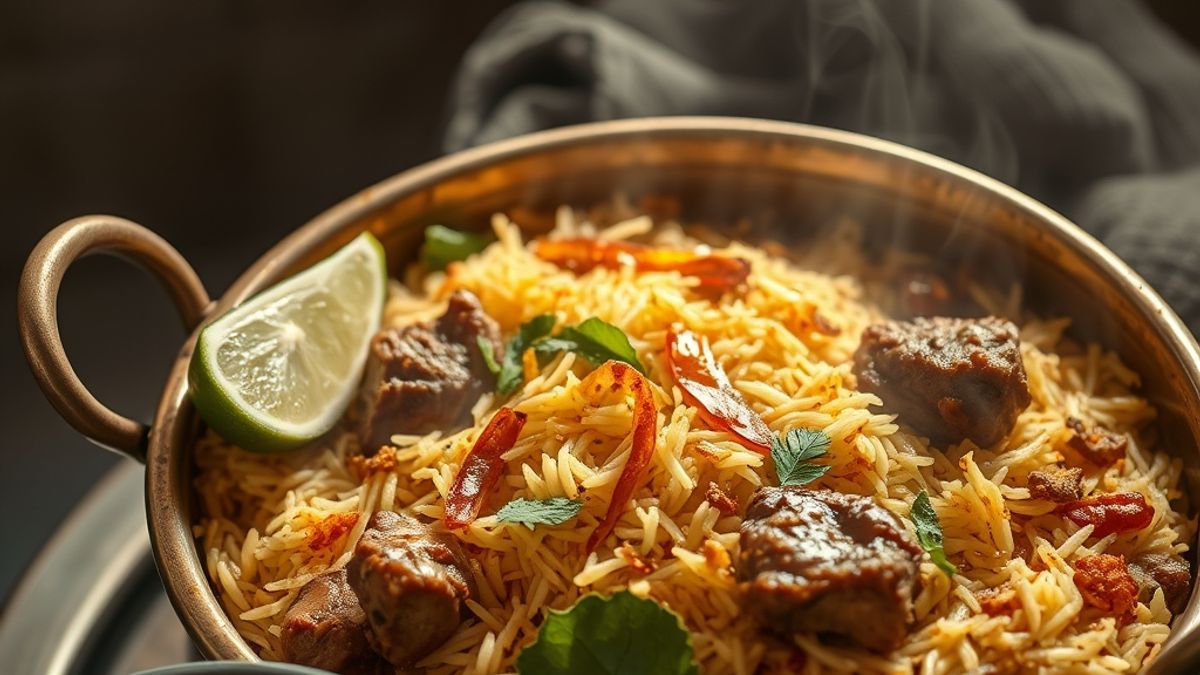
Beyond method, real Hyderabadi biryani has a recognisable signature: saffron-streaked rice rather than one uniform colour, a generous scatter of fried onions (birista), fresh mint, and a spice profile that runs sharper and more sour-hot than the ghee-heavy Mumbai-Mughlai style you meet on Mohammed Ali Road. If your plate arrives evenly dyed, mint-free and with no salan in sight, you are eating something else — possibly delicious, but not this. For the richer, ghee-forward Mumbai tradition and how it differs, our Mughlai and kebab guide is the companion read.
The two things that must arrive alongside it
Hyderabadi biryani is a thali idea, not a solo act. Two accompaniments are non-negotiable, and a kitchen that treats them as optional is telling you something about how seriously it takes the cuisine.
Mirchi ka salan
This is the make-or-break side: a thick, glossy, nutty-tangy gravy of long green chillies simmered down with peanuts, sesame, coconut and tamarind. It is not fiery so much as deep and sour, and its whole job is to cut through the richness of the rice, spoonful by spoonful. Skipping it genuinely is skipping the point. At a proper Hyderabadi kitchen it comes with the biryani as a matter of course; at a general restaurant you may have to ask, and if the answer is a blank look, adjust your expectations of the biryani too.
Dahi ki chutney and raita
The cooling counterweight — a thin, lightly spiced yoghurt, sometimes loosened almost to a drinking consistency, that resets your palate between mouthfuls. Between the salan doing the sour-hot work and the raita doing the cooling, the biryani sits in the middle where it belongs. Order the biryani without confirming these are on the way and you have under-ordered; ask, and a real kitchen will not blink.
Where to eat: think in pockets, not addresses
Mumbai has no single “Hyderabad lane,” so the honest way to hunt is by neighbourhood character rather than by chasing one famous doorway. Three pockets do most of the work.
Bhendi Bazaar and Mohammed Ali Road
The historic Muslim food quarter near Crawford Market is the surest bet for slow-cooked meat done with intent. It is dense, old-school and busiest after dark, and it is where our Mohammed Ali Road food trail walks you street by street. The wider Mumbai street food guide is worth a look too, because the best evenings here are grazing evenings — a plate of biryani, a few kebabs, something sweet, all within a few hundred metres. Plan a crossover with the Mughlai guide above and you have a full night mapped.
Byculla and Nagpada
Just north of the old quarter sit the long-standing, sit-down biryani institutions that Mumbaikars have quietly trusted for generations. This is the pocket to choose when the street itself feels overwhelming — you get a table, a fan, a menu and often a more consistent kachchi than the crush of the lanes allows. It is also friendlier for a first-timer who wants to taste the cuisine without navigating a standing-room crowd.
Powai, Andheri and the western suburbs
This is where dedicated, explicitly “Hyderabadi” kitchens — the “Hyderabad House” and “Hyderabad Xpress”-style names — have opened to feed the tech-corridor crowd, and they are often the most upfront about the kachchi-dum method on their menus. They lean modern and delivery-friendly, take cards, and are the easiest option if you live in the suburbs and do not want to make an expedition to town. A useful filter across all three pockets: look for places that put “Hyderabadi” in the name and list mirchi ka salan on the menu. A kitchen that specialises is far likelier to run the kachchi method than a general Mughlai restaurant that also happens to sell biryani on the side.
What to order, and the rough spend
Once you are in the right kind of place, the ordering itself is simple. Portions run generous, so resist the urge to over-order on the first round.
- Mutton kachchi dum biryani is the flagship. If a kitchen does one thing well, this is usually it, and it is the plate that tells you whether the place is the real thing. Reckon on roughly ₹300–₹550 for a solid portion at a specialist, and noticeably more at a hotel restaurant. One plate, with salan and raita, comfortably feeds one hungry person or splits between two lighter eaters.
- Chicken dum biryani is the lighter, quicker, safer order — the sensible first move at a place you do not know yet. Roughly ₹200–₹400, and a good way to read a kitchen before committing to the mutton on a return visit.
- Haleem, in season, is worth a dedicated trip rather than a side order (more below).
- Double ka meetha or qubani ka meetha to finish, if the kitchen carries them — and whether it does is itself a signal of how deep the Hyderabadi roots go.
A small tactical note: biryani is often cooked in batches through the day, and the mutton is the first thing to run out. If your heart is set on it, treat the meal as a lunch-to-early-evening plan rather than a late-night one. For genuinely late cravings, the city’s after-hours options are a different map — our late-night food guide covers where the kitchens are still lit past midnight.
Haleem: the Ramzan headliner
Haleem is one of the great Hyderabadi contributions to Mumbai’s food calendar, and it is tied almost entirely to a single month. Wheat, lentils and meat are slow-pounded together for hours into a rich, smooth, savoury paste, then finished with fried onions, fresh mint, a squeeze of lime and a slick of ghee. Eaten hot from a communal vessel, it is as much ritual as dish.
During Ramzan, the lanes of Bhendi Bazaar and Mohammed Ali Road transform after sunset: iftar stalls throw open, communal tables fill, and haleem is ladled out of enormous cauldrons to crowds breaking their fast. The established restaurants along Mohammed Ali Road are the classic hunting ground, and a growing number of suburban kitchens now run dedicated Ramzan haleem menus too, so you no longer have to travel to town for a decent bowl. The catch is seasonality — outside the fasting month, honest haleem is genuinely hard to find, so the rule is simple: if you spot it in season, order it, and do not assume it will still be there next week.
The sweet finish: double ka meetha and qubani ka meetha
Two desserts define the end of a Hyderabadi meal, and both reward seeking out.
Double ka meetha is fried bread soaked in saffron-and-cardamom milk and strewn with nuts — cousin to bread pudding and shahi tukda, but with its own richer, milkier character. Qubani ka meetha goes the other way: stewed dried apricots, tart and dark and jammy, served with a swirl of fresh cream or a scoop of vanilla ice cream to balance the sourness. One is comfort, the other is contrast, and a good table finds room for a shared portion of at least one.
Neither turns up at every biryani counter. They live at Hyderabadi-specialist restaurants and at Ramzan-season sweet stalls, so if you see either printed on a menu, take it as a quiet endorsement of the whole kitchen. For a broader tour of the city’s sugar — from Mughlai sweets to Maharashtrian classics — our Mumbai desserts and mithai guide is the natural next stop.
How to spot the real thing
You do not need an insider to tell a serious Hyderabadi kitchen from a hopeful one. A handful of tells do most of the work, and they are all visible from your seat.
- The rice is streaked, not uniform. Patches of white, saffron-yellow and browned grain mean the biryani was layered and dum-cooked, not stirred together in one pot.
- There is mint, and there is birista. Fresh mint leaves and a tangle of crisp fried onions are Hyderabadi fingerprints; their absence is a red flag.
- The salan shows up unasked. A kitchen that plates mirchi ka salan without being reminded knows exactly what it is serving.
- The menu names its method. Boards that say “kachchi” or “dum” specifically — rather than just “special biryani” — tend to mean it.
- The mutton runs out early. Slightly annoying, genuinely reassuring: it usually means the biryani is cooked fresh in limited batches rather than held all day.
None of these is a guarantee on its own, but three or four together and you are almost certainly in the right place. If Hyderabadi’s tang and heat leave you curious about the neighbouring southern traditions, the Andhra meals guide is a good bridge — same broad region, very different plate.
Timing, transport and a few practical notes
When to go. Hyderabadi kitchens are lunch-and-dinner operations, and because the good biryani is batch-cooked, the mutton can be gone by late evening. Go earlier rather than later if you are set on it. Ramzan is the undisputed peak for both haleem and sheer street energy — arrive hungry, pace yourself across stalls rather than committing to one plate too soon, and expect crowds.
Getting to the old quarter. For Bhendi Bazaar and Mohammed Ali Road, the nearest suburban rail stops are Sandhurst Road on the Harbour Line and Marine Lines or Charni Road on the Western Line; from any of them a short cab or auto to Crawford Market drops you at the mouth of the lanes. If the train network is new to you, the local train guide explains the lines and which side to alight. Carry cash and small change — many of the best stalls are not set up for cards — and wear closed shoes, because the streets get slick and busy after dark.
Out in the suburbs. For the Powai and Andheri specialists, the Metro and the Western Line make the western suburbs painless, and most sit-down kitchens there take cards and run on the delivery apps, so a home order is a genuine option on a night you cannot face the commute.
The whole game, in the end, is patience and a bit of insistence: come with an appetite, order the salan without being asked twice, and do not rush the dum. That is where the flavour actually lives.
Frequently Asked Questions
What's the difference between Hyderabadi biryani and regular Mumbai biryani?
Hyderabadi biryani is usually kachchi-style — raw marinated meat sealed under partly cooked rice and slow-cooked together on dum — with saffron-streaked rice, fried onions, mint and a sharper, more sour-hot spice profile. It almost always arrives with mirchi ka salan on the side. Mumbai-Mughlai biryani, by contrast, is generally milder, ghee-rich and cooked meat-first, and rarely comes with salan.
What is kachchi dum biryani?
Kachchi ("raw") dum biryani layers raw marinated meat underneath partially cooked rice, seals the pot with a rope of dough, and cooks the whole thing slowly over gentle trapped heat, or dum. The meat's own juices steam up and flavour the rice from within, which is why the timing has to be exact. It is harder and riskier than the pakki method, where the meat is cooked first, and that is precisely why serious Hyderabadi kitchens take pride in it.
Where can I find good haleem in Mumbai?
Haleem is largely a Ramzan-season dish, and the classic hunting ground is the iftar street food around Bhendi Bazaar and Mohammed Ali Road after sunset. Established restaurants there and a growing number of suburban kitchens now run special Ramzan haleem menus. Outside the fasting month it is genuinely hard to find, so the safe rule is to order it whenever you spot it in season.
What should you order alongside Hyderabadi biryani?
Two accompaniments are essential. The first is mirchi ka salan, a thick, tangy gravy of long green chillies with peanuts, sesame, coconut and tamarind that cuts the richness of the rice. The second is a thin spiced raita or dahi ki chutney to cool the palate. A proper Hyderabadi kitchen serves the salan without being asked; if it doesn't appear, request it, and treat its absence as a sign about the kitchen.
How much does a plate of Hyderabadi mutton biryani cost in Mumbai?
At a specialist kitchen, a solid plate of mutton kachchi dum biryani runs roughly ₹300–₹550, with hotel restaurants charging more. Chicken dum biryani is lighter and cheaper at about ₹200–₹400. Portions are generous, so one mutton plate with salan and raita comfortably feeds one hungry person or splits between two lighter eaters. Treat these as seasonal ranges rather than fixed prices.
Is Hyderabadi biryani very spicy?
The biryani itself is more aromatic than fiery — most of the heat and tang come from the mirchi ka salan and green chillies served alongside. It is bolder and more sour-hot than typical Mumbai-Mughlai food, but the cooling raita on the table is designed to balance it. If you prefer things milder, you can ask the kitchen to go easier on the salan.