

Starring
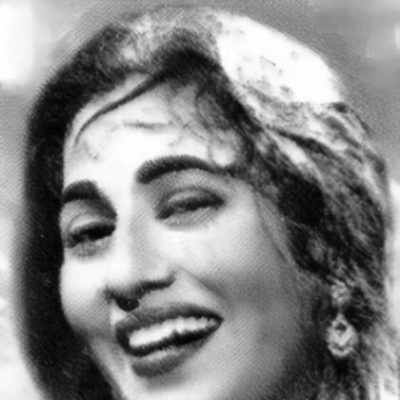
About the film
Barsaat Ki Raat (transl. A Rainy Night) is a 1960 Indian Hindi-language romantic musical film directed by P. L. Santoshi and produced by R. Chandra. Starring Madhubala, Bharat Bhushan and Shyama, the film is considered a defining example of romantic musical film genre.
The film's art direction is by Ganesh Basak. A Muslim-social set amongst the erudite and cultured urban Muslims of independent India, Barsaat Ki Raat revolves around two lovers Shabnam (Madhubala) and Amaan (Bhushan), who strive to be together but the society does not approve of them. Upon its release, the film became a blockbuster success, the second highest earner of 1960, the twenty-first highest earner of the 1960s at the Indian box office, and one of the top hundred highest-grossers of all time (when adjusted for inflation).
Plot
Amaan Hyderabadi is a talented and struggling Urdu poet and lyricist trying to make a mark in the world of music. Shabnam, who has not seen him yet, loves his songs and poetry. For his job, he travels to his friend Inspector Shekhar's house to perform his own songs live on All India Radio. One rainy night, he seeks shelter and also meets Shabnam – whom he can't get out of his mind. Through Shekhar, he meets the family of police commissioner Khan Bahadur and encounters the eldest daughter, none other than Shabnam. Luck comes his way as he is appointed as a tutor for Shabnam's little sister Razia.
During lessons, Aman and Shabnam grow closer. Khan Bahadur overhears their conversations, not being much impressed due to Amaan's poverty. He insults and expels Amaan from their house and forbids any contact. Shabnam sees elopement with Amaan as her only hope. Their escape plan is discovered and her father swiftly fixes a devastated Shabnam's marriage with Aftab Ahmed of Lucknow against her wish. Khan Bahadur sets off for Lucknow with his family. Amaan also arrives in Lucknow in search of his fortune. Coincidentally, Amaan discovers that Aftab, the friend in whose house he is staying, is actually the future husband of his lady love Shabnam.
Amaan leaves Aftab's house without informing him. Meanwhile, Amaan's old friends Shabab and Shama arrive in Lucknow to participate in a qawwali competition, in which they keep losing. Shama is in love with Amaan, but he does not know this. Amaan begins to compose shayaris for the competition and very quickly he carves a niche for himself in the musical world. However, submerged in the painful memory of his lost love Shabnam, Amaan does not realise Shama's love for him. Soon, he becomes the heart and soul of Shama's musical troupe. With Amaan's beautiful voice and shayaris, Shama's group attains popularity and wins the competition.
Themes
The story features a number of innovative themes while maintaining the basic form of a love story. It has particularly strong female characters who are independent-minded and choose their own loves and destiny. Conflicts are not so much between the wishes of the parents and children about whom the children will marry, as is a common theme in Indian movies, but among the main characters and the duplicitous signals men and women send each other. The movie glorifies the lives of "nautch girls" not often regarded highly in Indian society. Although it features Muslim characters, the movie seamlessly shows the universality of sensual love.
Soundtrack
The soundtrack of Barsaat Ki Raat was composed by Roshan, and lyrics were penned by Sahir Ludhianavi. It was the second best-selling soundtrack of 1960 after Mughal-e-Azam. The song "Zindagi Bhar Nahin Bhoolegi" was a chartbuster, and was on the top in the Binaca Geetmala's annual list of 1960.
The popular qawwalis “Na To Karavan Ki Talash Hai” and “Yeh Ishq Ishq Hai” were both inspired by the classic 1950s Sufi qawwali “Na To Butkade Ki Talab Mujhe”. This original piece was written by Ameer Bakhsh Sabri and composed and performed by the Pakistani qawwali duo Ustad Fateh Ali Khan and Ustad Mubarak Ali Khan (Nusrat Fateh Ali Khan’s father and uncle, respectively). While Sahir Ludhianvi wrote many new lyrics for the film versions, some lines were adapted or taken verbatim from the original kalam. Similarly, the film’s other notable qawwali, “Nigah-e-Naaz Ke Maaron Ka Haal Kya Hoga” (often shortened to “Nigah-e-Naaz Ke”), drew its melodic inspiration and central hook from Fateh Ali Khan and Mubarak Ali Khan's qawwali “Sahar Qareeb Hai Taaron Ka Haal Kya Hoga” (written by Sehba Akhtar), particularly adapting the line “Teri nigah ke maaron ka haal kya hoga.” Producer R. Chandra, elder brother of the film’s lead actor Bharat Bhushan, had personally obtained permission from Fateh Ali Khan and Mubarak Ali Khan before adapting their qawwalis for the soundtrack, although the original artists never received any formal credit. Reportedly, R. Chandra had first approached composer Khayyam for the project. However, Khayyam declined because he refused to adapt or recreate someone else’s existing qawwali compositions, preferring to create entirely original music. Roshan then took over…
Rediff.com, calling the film's music its lifeline, placed "Na To Karavan Ki Talash Hai" at the second place in the "Bollywood's Top 10 qawwalis."
Key details
| Release year | 1960 |
|---|---|
| Language | Hindi |
| Director | P. L. Santoshi |
| Starring | Madhubala, Bharat Bhushan |
Frequently Asked Questions
When was Barsaat Ki Raat released?
Barsaat Ki Raat is a Hindi-language film released in 1960, directed by P. L. Santoshi.
Who directed Barsaat Ki Raat?
Barsaat Ki Raat was directed by P. L. Santoshi.
Who stars in Barsaat Ki Raat?
Barsaat Ki Raat stars Madhubala, Bharat Bhushan.
What is Barsaat Ki Raat about?
Barsaat Ki Raat (transl. A Rainy Night) is a 1960 Indian Hindi-language romantic musical film directed by P.
Where can I watch Barsaat Ki Raat?
Barsaat Ki Raat may be available on major streaming platforms or for digital rental — check current OTT listings for availability in your region.
Reference: Wikipedia
← Back to the Bollywood Hub