Government Struggles with Education Crisis Amid Student Protests
Student protests spark education overhaul demands. Rural schools in shambles.
'%3E%3Crect%20width%3D'96'%20height%3D'96'%20fill%3D'%231A5276'%2F%3E%3Ccircle%20cx%3D'30'%20cy%3D'24'%20r%3D'44'%20fill%3D'%23fff'%20opacity%3D'.12'%2F%3E%3Ccircle%20cx%3D'60'%20cy%3D'74'%20r%3D'40'%20fill%3D'%23000'%20opacity%3D'.10'%2F%3E%3C%2Fg%3E%3Cg%20fill%3D'%23fff'%3E%3Cpath%20d%3D'M31%2041%20L48%2031%20L65%2041%20Z'%2F%3E%3Crect%20x%3D'33'%20y%3D'43'%20width%3D'4'%20height%3D'17'%2F%3E%3Crect%20x%3D'41'%20y%3D'43'%20width%3D'4'%20height%3D'17'%2F%3E%3Crect%20x%3D'51'%20y%3D'43'%20width%3D'4'%20height%3D'17'%2F%3E%3Crect%20x%3D'59'%20y%3D'43'%20width%3D'4'%20height%3D'17'%2F%3E%3Crect%20x%3D'30'%20y%3D'62'%20width%3D'36'%20height%3D'4'%20rx%3D'1'%2F%3E%3C%2Fg%3E%3C%2Fsvg%3E)
The government is facing a daunting challenge in addressing the education crisis in India, particularly in rural areas, after last month's student protests led by the Cockroach Janata Party (CJP). The protests, which demanded a drastic overhaul of the entire educational infrastructure, have put the government on the backfoot.
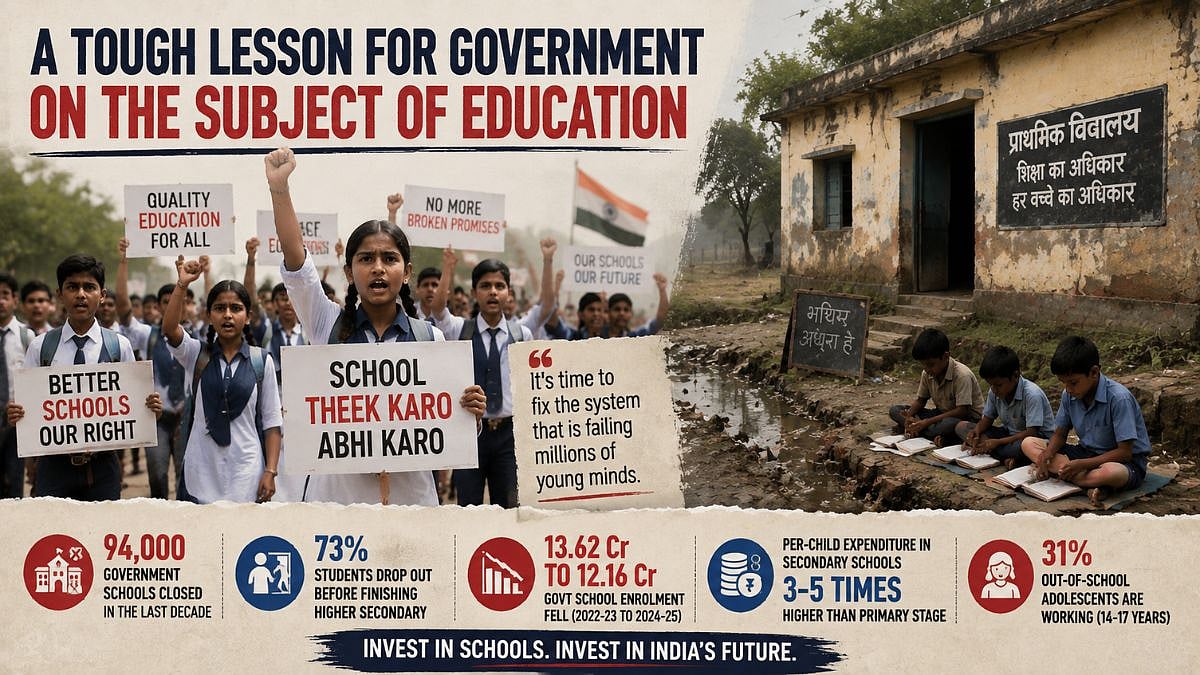
The CJP's School Theek Karo campaign, launched on the 80th anniversary of Independence, has gained significant momentum, with both Gen Alpha and Gen Z joining the movement. The campaign's focus on rural schools has exposed the government's inability to address the crisis in this sector. According to a recent survey by Niti Ayog, 94,000 government schools have closed over the past decade, with 26,000 closures in Uttar Pradesh alone.
The statistics are alarming, with a parliamentary panel noting a 'drastic decline' in the number of schools and students as the education level rises. Nearly 73% of students drop out before finishing higher secondary. The government's own data reveals that government school enrolment dropped from 13.62 crore to 12.16 crore between 2022-23 and 2024-25, while enrolment in private schools increased.
The survey also highlighted the economic pressures faced by students, particularly those from rural and low-income backgrounds. The per-child expenditure in government secondary schools is three to five times higher than at the primary stage, making it difficult for families to afford education. As a result, many adolescents are forced to drop out of school and enter the workforce or take on domestic responsibilities.
The Periodic Labour Force Survey (PLFS) 2020-21 estimates that 31% of out-of-school adolescents (14-17 years) are working, while another 25% cited household duties. For girls, this often translates into early withdrawal from school to take on unpaid care work, deepening existing gender inequities.
The government's inability to address the education crisis has led to a quiet but persistent pattern of dropout, shaped by affordability and economic choices. The CJP's campaign has brought attention to the issue, and the government will need to take concrete steps to address the crisis and prevent further decline.
The education crisis in rural areas is a complex issue, with deep-rooted problems that require a comprehensive solution. The government will need to work with stakeholders, including educators, policymakers, and community leaders, to develop a plan that addresses the root causes of the crisis.
The consequences of inaction will be severe, with long-term effects on the country's economic growth, social mobility, and human development. The government must take the CJP's demands seriously and work towards creating a more equitable and accessible education system.
In conclusion, the government's struggles with the education crisis are a wake-up call for the need for urgent reform. The CJP's campaign has highlighted the need for a drastic overhaul of the entire educational infrastructure, and the government must take concrete steps to address the crisis and prevent further decline.
The education crisis in India is a pressing issue that requires immediate attention. The government must work towards creating a more equitable and accessible education system, particularly in rural areas, to ensure that all students have access to quality education and can reach their full potential.
The future of India's education system depends on the government's ability to address the crisis and create a more sustainable and equitable system. The CJP's campaign has brought attention to the issue, and it is now up to the government to take action and create a better future for India's students.
The government's response to the education crisis will have a significant impact on the country's development and growth. It is essential that the government takes the CJP's demands seriously and works towards creating a more equitable and accessible education system.
The education crisis in India is a complex issue that requires a comprehensive solution. The government must work with stakeholders to develop a plan that addresses the root causes of the crisis and creates a more sustainable and equitable system.
In the end, the government's ability to address the education crisis will determine the future of India's students and the country's development. It is essential that the government takes immediate action to address the crisis and create a more equitable and accessible education system.
Frequently asked questions
What is the current state of education in rural India?
The education system in rural India is in shambles, with 94,000 government schools closed in the past decade and a drastic decline in the number of schools and students as the education level rises.
What are the main reasons for the education crisis in rural India?
The main reasons for the education crisis in rural India are economic pressures, lack of accessibility, and affordability, which force many adolescents to drop out of school and enter the workforce or take on domestic responsibilities.