AI Tool Helps Save Gwalior Cop's Life After Snake Bites
Gwalior cop bitten twice by venomous snake, AI tool aids in treatment
'%3E%3Crect%20width%3D'96'%20height%3D'96'%20fill%3D'%23B3261E'%2F%3E%3Ccircle%20cx%3D'30'%20cy%3D'24'%20r%3D'44'%20fill%3D'%23fff'%20opacity%3D'.12'%2F%3E%3Ccircle%20cx%3D'60'%20cy%3D'74'%20r%3D'40'%20fill%3D'%23000'%20opacity%3D'.10'%2F%3E%3C%2Fg%3E%3Cg%20fill%3D'%23fff'%3E%3Crect%20x%3D'29'%20y%3D'49'%20width%3D'8'%20height%3D'19'%20rx%3D'1'%2F%3E%3Crect%20x%3D'39'%20y%3D'40'%20width%3D'9'%20height%3D'28'%20rx%3D'1'%2F%3E%3Crect%20x%3D'50'%20y%3D'45'%20width%3D'8'%20height%3D'23'%20rx%3D'1'%2F%3E%3Crect%20x%3D'60'%20y%3D'53'%20width%3D'7'%20height%3D'15'%20rx%3D'1'%2F%3E%3Crect%20x%3D'41'%20y%3D'34'%20width%3D'5'%20height%3D'6'%2F%3E%3C%2Fg%3E%3C%2Fsvg%3E)
A police head constable in Gwalior, Madhya Pradesh, is recovering after being bitten twice by a venomous snake inside his government quarters. The incident occurred on August 13-14, when Head Constable Pooran Sikarwar was resting after duty and a snake entered his room, biting him twice on the hand.
According to reports, Sikarwar raised an alarm after feeling severe pain, and his colleagues, including Station In-charge Saurabh Srivastava, rushed to his room to find the snake still inside. Sikarwar's condition began deteriorating, prompting the officers to arrange medical assistance immediately.
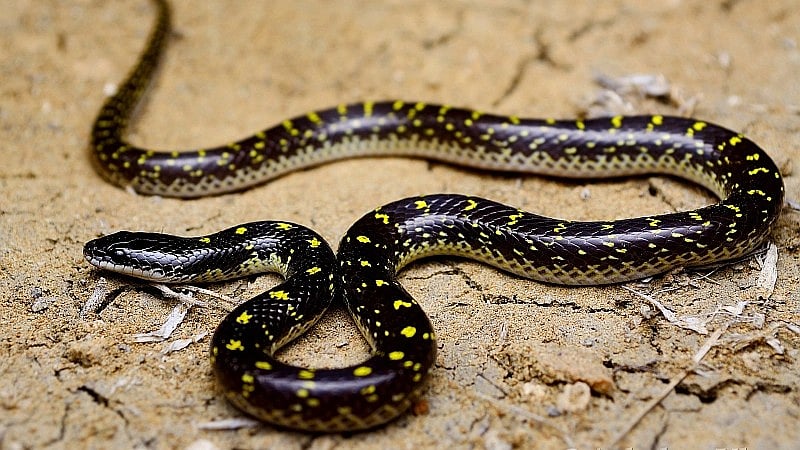
The species of the snake is reportedly disputed, with some identifying it as a black cobra and others as a common krait, both of which are venomous and can cause serious neurotoxic effects. To identify the species and understand the potential effects of its venom, Srivastava photographed the snake and uploaded the image to an AI tool.
The AI-generated information was shared with doctors before Sikarwar reached the hospital, providing medical personnel with additional information to assess the appropriate treatment. Sikarwar was initially rushed to Jai Arogya Hospital, where doctors began treatment, and was later shifted to Apollo Hospital for further medical care.
Doctors administered anti-venom and other treatment, and Sikarwar's condition, which was initially reported to be serious, subsequently improved and stabilised. The incident highlights the increased risk of snake encounters during the monsoon season, when reptiles often enter homes and buildings seeking dry shelter.
In such situations, it is advised to keep the affected limb as still as possible and seek emergency medical treatment immediately. Traditional methods such as cutting or sucking the wound should be avoided, and if it can be done safely, a photograph of the snake may help medical professionals identify the species.
The Gwalior incident demonstrates how rapidly available technology, when used alongside professional medical care, can provide potentially useful information in emergency situations. The snake was later safely caught by police, bringing the immediate danger under control.
The incident has also drawn attention to the importance of being aware of the risks of snake encounters during the monsoon season and taking necessary precautions to prevent such incidents. Gwalior SSP Dharmveer Singh Yadav visited the hospital to check on the injured head constable, and Sikarwar is currently recovering from the incident.
The use of AI tools in such situations can be a game-changer, providing critical information that can aid in treatment and save lives. The incident is a testament to the power of technology and medical care coming together to provide effective treatment in emergency situations.
In conclusion, the incident in Gwalior highlights the importance of being aware of the risks of snake encounters during the monsoon season and the potential benefits of using AI tools in emergency situations. It also underscores the need for prompt medical attention and the importance of avoiding traditional methods of treatment that can do more harm than good.
The recovery of Head Constable Pooran Sikarwar is a relief, and the incident serves as a reminder of the importance of being prepared for emergency situations and the potential benefits of using technology to aid in treatment.
Frequently asked questions
What should I do if I am bitten by a suspected venomous snake?
Keep the affected limb as still as possible and seek emergency medical treatment immediately. Avoid traditional methods such as cutting or sucking the wound.
Can a photograph of the snake help in treatment?
Yes, if it can be done safely without approaching the snake, a photograph may help medical professionals identify the species and provide appropriate treatment.