Bhopal Municipal Corporation Forms Team To Implement Slaughterhouse Order
Bhopal Municipal Corporation forms joint team, High Court directs implementation of order on slaughterhouse, Inspection to be video-recorded
'%3E%3Crect%20width%3D'96'%20height%3D'96'%20fill%3D'%23B3261E'%2F%3E%3Ccircle%20cx%3D'30'%20cy%3D'24'%20r%3D'44'%20fill%3D'%23fff'%20opacity%3D'.12'%2F%3E%3Ccircle%20cx%3D'60'%20cy%3D'74'%20r%3D'40'%20fill%3D'%23000'%20opacity%3D'.10'%2F%3E%3C%2Fg%3E%3Cg%20fill%3D'%23fff'%3E%3Crect%20x%3D'29'%20y%3D'49'%20width%3D'8'%20height%3D'19'%20rx%3D'1'%2F%3E%3Crect%20x%3D'39'%20y%3D'40'%20width%3D'9'%20height%3D'28'%20rx%3D'1'%2F%3E%3Crect%20x%3D'50'%20y%3D'45'%20width%3D'8'%20height%3D'23'%20rx%3D'1'%2F%3E%3Crect%20x%3D'60'%20y%3D'53'%20width%3D'7'%20height%3D'15'%20rx%3D'1'%2F%3E%3Crect%20x%3D'41'%20y%3D'34'%20width%3D'5'%20height%3D'6'%2F%3E%3C%2Fg%3E%3C%2Fsvg%3E)
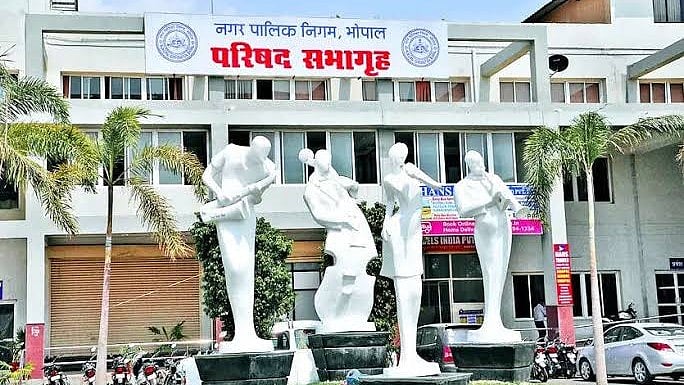
The Bhopal Municipal Corporation has formed a joint team to implement the Jabalpur High Court's order on the modern slaughterhouse at Maida Mill Road, Jinsi. The team, comprising officials from the revenue, veterinary, and animal disease investigation departments, was constituted at a meeting held on August 27.
The team will inspect the slaughterhouse premises, examine the articles stored there, and assess the condition and quality of animal products. The proposed panel includes an SDM/tehsildar, a senior veterinary doctor, and three specialists from the State Animal Disease Investigation Laboratory.
The inspection and related proceedings will be video-recorded to maintain transparency. Articles found to have deteriorated will be destroyed, while those considered fit for use will be dealt with in accordance with the directions of the state authorities and the civic body.
The High Court has also directed authorities to stop the ammonia plant after the articles are removed from the premises. This order comes after the court's August 25 directive in the case of M/s Livestock Food Processors Pvt Ltd vs State of Madhya Pradesh and others.
Meanwhile, the Madhya Pradesh High Court has dismissed a Public Interest Litigation (PIL) seeking the permanent closure of the modern slaughterhouse. A division bench comprising Acting Chief Justice Vivek Rusia and Justice Pradeep Mittal dismissed the petition on September 1, observing that the facility had already been constructed and made operational.
The petitioners had raised environmental and public health concerns, citing alleged pollution from the earlier Jinsi Road slaughterhouse. They also questioned the location of the new facility. However, the court noted that nearly Rs 29 crore had already been spent on the project and that the petition was filed after a delay of around three years.
The court found no grounds for interference and dismissed the PIL. The BMC commissioner, Sanskriti Jain, confirmed that officials were directed to submit the names and designations of nominated officers at the earliest so that the team can begin the process of implementing the court's order.
The formation of the joint team and the implementation of the High Court's order are significant developments in the case. The slaughterhouse has been a point of contention, with concerns raised about environmental and public health impacts.
The High Court's decision to dismiss the PIL seeking closure of the slaughterhouse is also noteworthy. The court's observation that the facility had already been constructed and made operational, and that the Madhya Pradesh Pollution Control Board had inspected it and granted the necessary permissions, suggests that the slaughterhouse has met the required regulatory standards.
The implementation of the High Court's order will be closely watched, and it remains to be seen how the joint team will carry out the inspection and assessment of the slaughterhouse premises. The video recording of the inspection and related proceedings will help maintain transparency and ensure that the process is fair and impartial.
In conclusion, the formation of the joint team and the implementation of the High Court's order are important steps in addressing the concerns surrounding the modern slaughterhouse in Bhopal. The developments in this case will have significant implications for the city and its residents, and it is essential to ensure that the process is carried out in a fair, transparent, and environmentally responsible manner.
The Bhopal Municipal Corporation's actions in this case demonstrate its commitment to implementing the High Court's order and addressing the concerns raised by the petitioners. The corporation's efforts to maintain transparency and ensure that the process is fair and impartial are commendable, and it is essential to continue monitoring the situation to ensure that the slaughterhouse operates in a responsible and environmentally sustainable manner.
The dismissal of the PIL seeking closure of the slaughterhouse is also a significant development, as it suggests that the facility has met the required regulatory standards. However, it is essential to continue monitoring the situation to ensure that the slaughterhouse operates in a responsible and environmentally sustainable manner.
The implementation of the High Court's order will have significant implications for the city and its residents, and it is essential to ensure that the process is carried out in a fair, transparent, and environmentally responsible manner. The Bhopal Municipal Corporation's actions in this case demonstrate its commitment to addressing the concerns surrounding the modern slaughterhouse, and it is essential to continue monitoring the situation to ensure that the slaughterhouse operates in a responsible and environmentally sustainable manner.
Frequently asked questions
What is the purpose of the joint team formed by the Bhopal Municipal Corporation?
The joint team will inspect the slaughterhouse premises, examine the articles stored there, and assess the condition and quality of animal products.
Why was the PIL seeking closure of the slaughterhouse dismissed?
The PIL was dismissed because the facility had already been constructed and made operational, and the Madhya Pradesh Pollution Control Board had inspected it and granted the necessary permissions.