OpenAI Claims to Solve Navier-Stokes Problem
OpenAI says it solved a $1 million math problem. Mathematicians are skeptical.
'%3E%3Crect%20width%3D'96'%20height%3D'96'%20fill%3D'%23B3261E'%2F%3E%3Ccircle%20cx%3D'30'%20cy%3D'24'%20r%3D'44'%20fill%3D'%23fff'%20opacity%3D'.12'%2F%3E%3Ccircle%20cx%3D'60'%20cy%3D'74'%20r%3D'40'%20fill%3D'%23000'%20opacity%3D'.10'%2F%3E%3C%2Fg%3E%3Cg%20fill%3D'%23fff'%3E%3Crect%20x%3D'29'%20y%3D'49'%20width%3D'8'%20height%3D'19'%20rx%3D'1'%2F%3E%3Crect%20x%3D'39'%20y%3D'40'%20width%3D'9'%20height%3D'28'%20rx%3D'1'%2F%3E%3Crect%20x%3D'50'%20y%3D'45'%20width%3D'8'%20height%3D'23'%20rx%3D'1'%2F%3E%3Crect%20x%3D'60'%20y%3D'53'%20width%3D'7'%20height%3D'15'%20rx%3D'1'%2F%3E%3Crect%20x%3D'41'%20y%3D'34'%20width%3D'5'%20height%3D'6'%2F%3E%3C%2Fg%3E%3C%2Fsvg%3E)
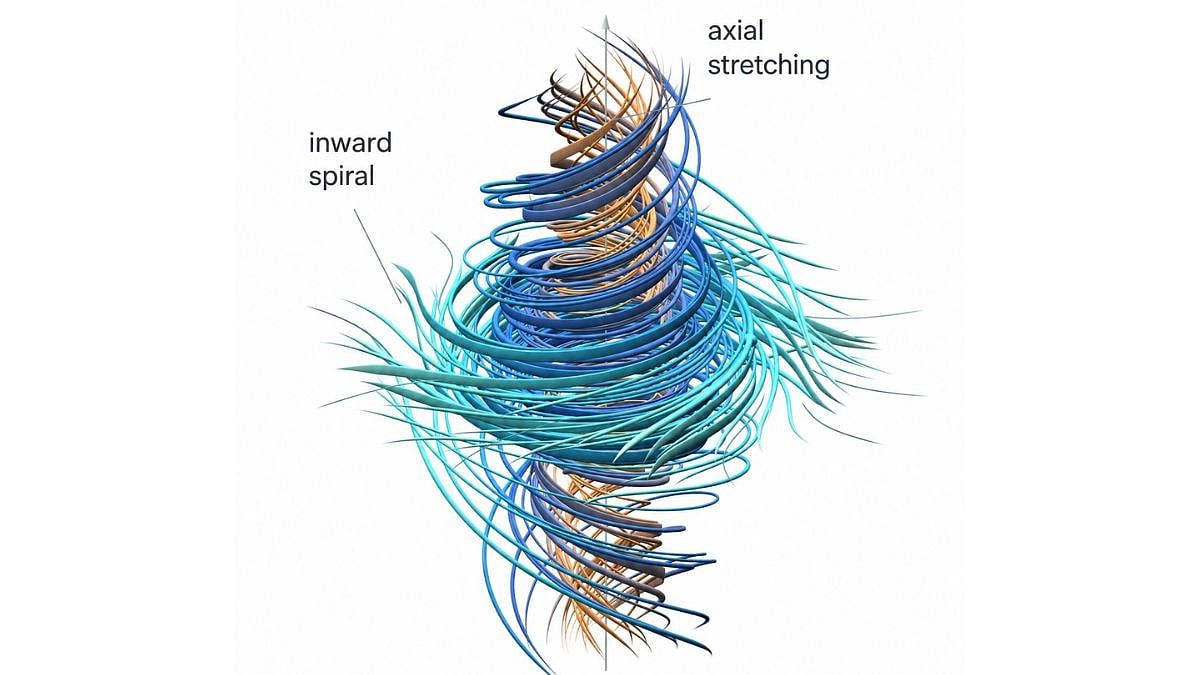
The Navier-Stokes equations are a fundamental concept in mathematics that describe the movement of fluids like water, air, and blood. They are crucial in various fields, including aircraft design, ocean modeling, and meteorology. However, one question about these equations has remained unresolved for nearly a century: can a perfectly smooth flow spontaneously develop an infinite, uncontrolled spike, also known as a 'blow-up,' in a finite amount of time?
The Navier-Stokes problem was formalized in the early 2000s by the Clay Mathematics Institute as one of seven 'Millennium Prize Problems,' each carrying a $1 million reward. Only one of the seven, the Poincare Conjecture, has been solved so far. The Navier-Stokes problem has resisted every attempt for so long due to the chaotic and non-linear nature of fluid behavior, making it difficult to prove that a solution stays smooth forever or to construct an example where it doesn't.
Recently, OpenAI announced that it has solved the equation using an unreleased internal model. According to the company, roughly 10,000 AI agents worked in parallel on the problem, at a cost running into the millions of dollars. The resulting proof was formally checked using the verification language Lean. However, the proof applies to the 'forced' version of the equations, which includes an external forcing term, not the exact 'unforced' version specified by the Clay Institute's prize.
The implications of OpenAI's claim are significant, as it suggests a shift in how mathematical research gets done. If AI systems can meaningfully contribute to problems this difficult, it could potentially compress years of human effort into weeks. This has real implications for fields reliant on fluid dynamics, from climate modeling to aerospace engineering, where better theoretical guarantees can translate into more reliable predictions and designs.
However, not all mathematicians are convinced by OpenAI's claim. Some have raised concerns about credit, accusing OpenAI of building on ideas from their unpublished work. Mathematician Terence Tao has also warned that treating landmark open problems purely as benchmarks for AI capability risks discouraging mathematicians from sharing early-stage ideas.
The Navier-Stokes problem is a complex and challenging issue that has puzzled mathematicians for nearly a century. While OpenAI's claim may be a significant breakthrough, it is essential to approach it with caution and skepticism. The mathematical community will need to carefully review and verify the proof before it can be accepted as a solution to the problem.
The resolution of the Navier-Stokes problem could have far-reaching implications for various fields, including science, engineering, and mathematics. It could lead to better understanding and prediction of complex phenomena, such as weather patterns and ocean currents. However, it is crucial to ensure that the solution is accurate and reliable, and that it is not based on unverified or unproven assumptions.
In conclusion, the Navier-Stokes problem is a significant challenge in mathematics that has remained unresolved for nearly a century. OpenAI's claim to have solved the problem is a notable development, but it requires careful review and verification. The implications of the solution are substantial, and it could potentially lead to significant advances in various fields. However, it is essential to approach the claim with caution and skepticism, and to ensure that the solution is accurate and reliable.
The potential impact of OpenAI's claim on the mathematical community and the broader scientific landscape is substantial. It could lead to a shift in how mathematical research is conducted, with AI systems playing a more significant role in solving complex problems. However, it is crucial to ensure that the use of AI systems is transparent, accountable, and responsible, and that it does not discourage mathematicians from sharing their ideas and collaborating with others.
Ultimately, the resolution of the Navier-Stokes problem is a significant achievement that could have far-reaching implications for various fields. While OpenAI's claim is a notable development, it is essential to approach it with caution and skepticism, and to ensure that the solution is accurate and reliable. The mathematical community will need to carefully review and verify the proof before it can be accepted as a solution to the problem.
The Navier-Stokes problem is a complex and challenging issue that requires careful consideration and analysis. The potential implications of the solution are substantial, and it could lead to significant advances in various fields. However, it is crucial to ensure that the solution is accurate and reliable, and that it is not based on unverified or unproven assumptions. The mathematical community will need to carefully review and verify the proof before it can be accepted as a solution to the problem.
In the end, the resolution of the Navier-Stokes problem is a significant achievement that could have far-reaching implications for various fields. The potential impact of OpenAI's claim on the mathematical community and the broader scientific landscape is substantial, and it could lead to a shift in how mathematical research is conducted. However, it is essential to approach the claim with caution and skepticism, and to ensure that the solution is accurate and reliable.
The significance of the Navier-Stokes problem lies in its potential to improve our understanding of complex phenomena, such as weather patterns and ocean currents. The solution to the problem could lead to better predictions and designs in various fields, including science, engineering, and mathematics. However, it is crucial to ensure that the solution is accurate and reliable, and that it is not based on unverified or unproven assumptions.
The Navier-Stokes problem is a challenging issue that requires careful consideration and analysis. The potential implications of the solution are substantial, and it could lead to significant advances in various fields. However, it is essential to approach the claim with caution and skepticism, and to ensure that the solution is accurate and reliable. The mathematical community will need to carefully review and verify the proof before it can be accepted as a solution to the problem.
The resolution of the Navier-Stokes problem could have far-reaching implications for various fields, including science, engineering, and mathematics. The potential impact of OpenAI's claim on the mathematical community and the broader scientific landscape is substantial, and it could lead to a shift in how mathematical research is conducted. However, it is essential to approach the claim with caution and skepticism, and to ensure that the solution is accurate and reliable.
In conclusion, the Navier-Stokes problem is a significant challenge in mathematics that has remained unresolved for nearly a century. OpenAI's claim to have solved the problem is a notable development, but it requires careful review and verification. The implications of the solution are substantial, and it could potentially lead to significant advances in various fields. However, it is essential to approach the claim with caution and skepticism, and to ensure that the solution is accurate and reliable.
What it means for Mumbai or India is that the resolution of the Navier-Stokes problem could lead to better understanding and prediction of complex phenomena, such as weather patterns and ocean currents. This could have significant implications for various fields, including science, engineering, and mathematics, and could lead to better designs and predictions in these fields.
Frequently asked questions
What is the Navier-Stokes problem?
The Navier-Stokes problem is a mathematical challenge that describes the movement of fluids like water, air, and blood.
Why is the Navier-Stokes problem significant?
The resolution of the Navier-Stokes problem could lead to better understanding and prediction of complex phenomena, such as weather patterns and ocean currents.