West Asia Crisis Raises Edible Oil Prices in India
Edible oil prices rise due to West Asia crisis, but availability remains adequate.
'%3E%3Crect%20width%3D'96'%20height%3D'96'%20fill%3D'%231A5276'%2F%3E%3Ccircle%20cx%3D'30'%20cy%3D'24'%20r%3D'44'%20fill%3D'%23fff'%20opacity%3D'.12'%2F%3E%3Ccircle%20cx%3D'60'%20cy%3D'74'%20r%3D'40'%20fill%3D'%23000'%20opacity%3D'.10'%2F%3E%3C%2Fg%3E%3Cg%20fill%3D'%23fff'%3E%3Cpath%20d%3D'M31%2041%20L48%2031%20L65%2041%20Z'%2F%3E%3Crect%20x%3D'33'%20y%3D'43'%20width%3D'4'%20height%3D'17'%2F%3E%3Crect%20x%3D'41'%20y%3D'43'%20width%3D'4'%20height%3D'17'%2F%3E%3Crect%20x%3D'51'%20y%3D'43'%20width%3D'4'%20height%3D'17'%2F%3E%3Crect%20x%3D'59'%20y%3D'43'%20width%3D'4'%20height%3D'17'%2F%3E%3Crect%20x%3D'30'%20y%3D'62'%20width%3D'36'%20height%3D'4'%20rx%3D'1'%2F%3E%3C%2Fg%3E%3C%2Fsvg%3E)
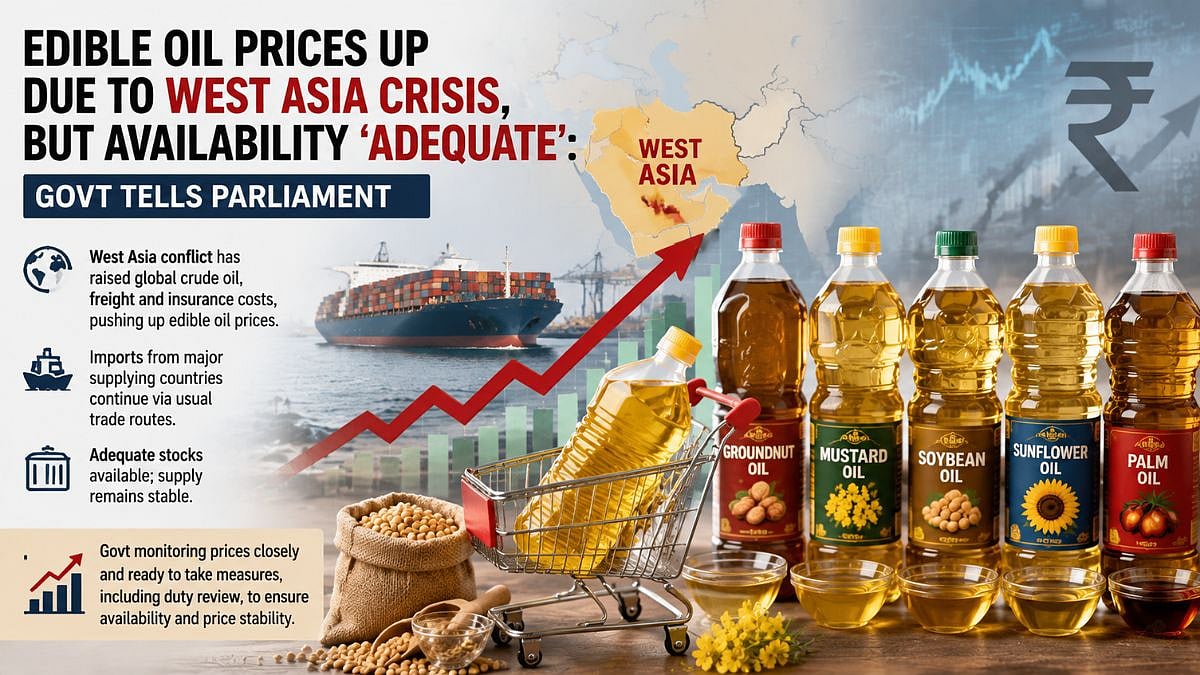
The ongoing crisis in West Asia has led to an increase in global and domestic edible oil prices in India. According to the Minister of State for Food and Consumer Affairs, Nimuben Jayantibhai Bambhaniya, the country's reliance on imports to meet its domestic edible oil requirement has made it vulnerable to international market trends.
The recent geopolitical conflict in West Asia has resulted in higher global crude oil prices, freight, and marine insurance costs, ultimately leading to increased international edible oil prices. Additionally, the higher crude oil prices have diverted more palm and soybean oil towards biofuel production, reducing export availability and pushing up both global and domestic edible oil prices.
Despite the price increase, the availability of edible oils in the country remains adequate, with imports from major supplying countries continuing through the usual trade routes. The government has reported that adequate stocks are available, and imports from major supplier countries continue without significant disruption.
The average retail price of various edible oils has increased over the past six months. Groundnut oil prices have risen to Rs 206 per kg from Rs 190 per kg, while mustard oil prices have increased to Rs 196 per kg from Rs 186 per kg. Soybean oil prices have gone up to Rs 164 per kg from Rs 151 per kg, sunflower oil prices have risen to Rs 189 per kg from Rs 169 per kg, and palm oil prices have increased to Rs 148 per kg from Rs 133 per kg.
The government is closely monitoring the prices and availability of edible oils in the domestic market and remains prepared to undertake appropriate market intervention measures, including a review of import duty and other trade-related measures, as and when required. This is to ensure adequate availability and stabilize prices in the interest of consumers.
The Indian government's efforts to monitor and regulate the edible oil market are crucial in maintaining price stability and ensuring adequate availability for consumers. The situation is being closely watched, and the government is prepared to take necessary steps to mitigate the impact of the West Asia crisis on the domestic edible oil market.
In conclusion, while the West Asia crisis has led to an increase in edible oil prices in India, the government's efforts to monitor and regulate the market have helped maintain adequate availability. The situation remains under close watch, and the government is prepared to take necessary steps to stabilize prices and ensure consumer interests are protected.
The impact of the West Asia crisis on India's edible oil market is a significant concern, and the government's response will be crucial in maintaining price stability and ensuring adequate availability for consumers. As the situation continues to evolve, the government's preparedness to undertake market intervention measures will be essential in mitigating the effects of the crisis on the domestic market.
Overall, the government's efforts to monitor and regulate the edible oil market, combined with its preparedness to undertake market intervention measures, will help maintain price stability and ensure adequate availability for consumers in India.
Frequently asked questions
Why have edible oil prices increased in India?
Edible oil prices have increased due to the West Asia crisis, which has led to higher global crude oil prices, freight, and marine insurance costs.
Is the availability of edible oils adequate in India?
Yes, the availability of edible oils in India remains adequate, with imports from major supplying countries continuing through the usual trade routes.