Lok Sabha Panel Flags Preparation Gaps For 3rd Language Rollout
Parliamentary panel highlights lack of preparation for third language introduction in Class 6.
'%3E%3Crect%20width%3D'96'%20height%3D'96'%20fill%3D'%231A5276'%2F%3E%3Ccircle%20cx%3D'30'%20cy%3D'24'%20r%3D'44'%20fill%3D'%23fff'%20opacity%3D'.12'%2F%3E%3Ccircle%20cx%3D'60'%20cy%3D'74'%20r%3D'40'%20fill%3D'%23000'%20opacity%3D'.10'%2F%3E%3C%2Fg%3E%3Cg%20fill%3D'%23fff'%3E%3Cpath%20d%3D'M31%2041%20L48%2031%20L65%2041%20Z'%2F%3E%3Crect%20x%3D'33'%20y%3D'43'%20width%3D'4'%20height%3D'17'%2F%3E%3Crect%20x%3D'41'%20y%3D'43'%20width%3D'4'%20height%3D'17'%2F%3E%3Crect%20x%3D'51'%20y%3D'43'%20width%3D'4'%20height%3D'17'%2F%3E%3Crect%20x%3D'59'%20y%3D'43'%20width%3D'4'%20height%3D'17'%2F%3E%3Crect%20x%3D'30'%20y%3D'62'%20width%3D'36'%20height%3D'4'%20rx%3D'1'%2F%3E%3C%2Fg%3E%3C%2Fsvg%3E)
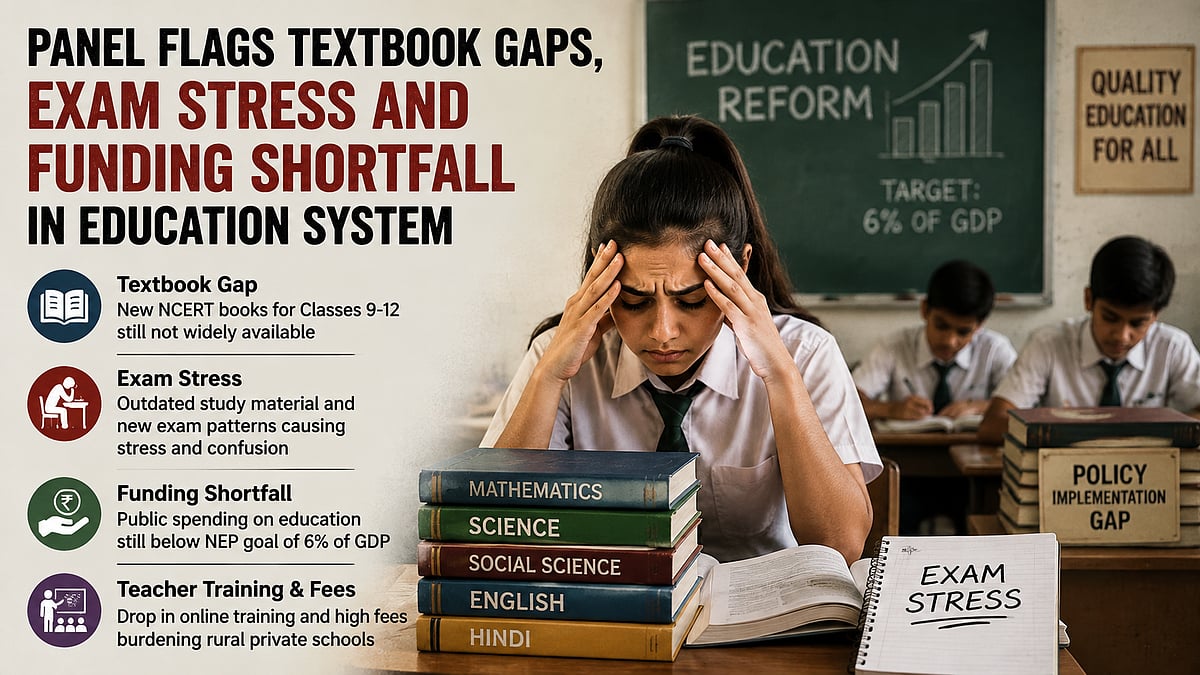
A parliamentary panel has pointed out that schools have not been provided enough time to prepare for the introduction of a third language from Class 6 onwards under the National Education Policy (NEP) 2020. The panel noted that the recruitment of language staff, availability of study material, and clarity on language selection have led to stress for students, teachers, parents, and school authorities.
The observations are part of the Tenth Report of the Committee on Estimates (2026-27) on the budget and policy aspects for providing affordable and quality education in the country. The report was presented to the Lok Sabha on Wednesday.
The Union Ministry of Education has taken extensive steps under NEP 2020 to promote mother tongue-based instruction and multilingualism in early school grades. The ministry has collaborated with states and specialized bodies to establish structural changes like the flexible three-language formula and the new language framework.
The ministry has achieved notable progress by translating core discipline textbooks into all 22 scheduled languages and creating bridge courses and e-contents for smooth curriculum transitions. Innovative resources have been deployed, including play-based learning kits in 22 languages and a nationwide language exposure program.
However, despite these strong resource frameworks, the committee noted that the requirement of study materials, teacher training, and language teaching staff has not been foreseen by the ministry. The panel recommended that the ministry expedite the development of textbooks, textual materials, and handbooks and their translation into regional languages.
The committee also recommended that the ministry take necessary measures to assist state and UT education boards in recruiting teachers to provide instruction in the third language. The panel's observations highlight the need for better preparation and planning to ensure a smooth rollout of the third language from Class 6 onwards.
The introduction of a third language from Class 6 onwards is a significant change under NEP 2020, and it is essential that schools are provided with adequate time and resources to prepare for this change. The panel's recommendations are aimed at addressing the gaps in preparation and ensuring that students, teachers, and parents are not unduly stressed.
The National Education Policy 2020 aims to promote multilingualism and mother tongue-based instruction in schools. The policy has introduced a flexible three-language formula, which allows students to choose any three languages from a list of scheduled languages. The policy also emphasizes the importance of regional languages and promotes their use in education.
The parliamentary panel's report highlights the need for better planning and preparation to ensure that the goals of NEP 2020 are achieved. The report's recommendations are aimed at addressing the gaps in preparation and ensuring that students, teachers, and parents are not unduly stressed.
In conclusion, the parliamentary panel's report highlights the need for better preparation and planning to ensure a smooth rollout of the third language from Class 6 onwards. The report's recommendations are aimed at addressing the gaps in preparation and ensuring that students, teachers, and parents are not unduly stressed. The introduction of a third language from Class 6 onwards is a significant change under NEP 2020, and it is essential that schools are provided with adequate time and resources to prepare for this change.
The report's findings have significant implications for the education sector, and it is essential that the ministry takes the panel's recommendations seriously. The ministry must expedite the development of textbooks, textual materials, and handbooks and their translation into regional languages. The ministry must also take necessary measures to assist state and UT education boards in recruiting teachers to provide instruction in the third language.
Overall, the parliamentary panel's report highlights the need for better planning and preparation to ensure that the goals of NEP 2020 are achieved. The report's recommendations are aimed at addressing the gaps in preparation and ensuring that students, teachers, and parents are not unduly stressed. The introduction of a third language from Class 6 onwards is a significant change under NEP 2020, and it is essential that schools are provided with adequate time and resources to prepare for this change.
The significance of the report's findings cannot be overstated. The introduction of a third language from Class 6 onwards has the potential to promote multilingualism and mother tongue-based instruction in schools. However, it is essential that schools are provided with adequate time and resources to prepare for this change. The report's recommendations are aimed at addressing the gaps in preparation and ensuring that students, teachers, and parents are not unduly stressed.
In the end, the parliamentary panel's report highlights the need for better planning and preparation to ensure a smooth rollout of the third language from Class 6 onwards. The report's recommendations are aimed at addressing the gaps in preparation and ensuring that students, teachers, and parents are not unduly stressed. The introduction of a third language from Class 6 onwards is a significant change under NEP 2020, and it is essential that schools are provided with adequate time and resources to prepare for this change.
Frequently asked questions
What is the issue with the introduction of a third language from Class 6 onwards?
The issue is that schools have not been provided enough time to prepare for the introduction of a third language, leading to stress for students, teachers, parents, and school authorities.
What are the recommendations of the parliamentary panel?
The panel recommends that the ministry expedite the development of textbooks, textual materials, and handbooks and their translation into regional languages, and take necessary measures to assist state and UT education boards in recruiting teachers to provide instruction in the third language.