Taj Mahal's Future At Risk Amid Development Plans
Taj Mahal faces pollution threats, India's SC dilutes industry ban.
'%3E%3Crect%20width%3D'96'%20height%3D'96'%20fill%3D'%23B3261E'%2F%3E%3Ccircle%20cx%3D'30'%20cy%3D'24'%20r%3D'44'%20fill%3D'%23fff'%20opacity%3D'.12'%2F%3E%3Ccircle%20cx%3D'60'%20cy%3D'74'%20r%3D'40'%20fill%3D'%23000'%20opacity%3D'.10'%2F%3E%3C%2Fg%3E%3Cg%20fill%3D'%23fff'%3E%3Crect%20x%3D'29'%20y%3D'49'%20width%3D'8'%20height%3D'19'%20rx%3D'1'%2F%3E%3Crect%20x%3D'39'%20y%3D'40'%20width%3D'9'%20height%3D'28'%20rx%3D'1'%2F%3E%3Crect%20x%3D'50'%20y%3D'45'%20width%3D'8'%20height%3D'23'%20rx%3D'1'%2F%3E%3Crect%20x%3D'60'%20y%3D'53'%20width%3D'7'%20height%3D'15'%20rx%3D'1'%2F%3E%3Crect%20x%3D'41'%20y%3D'34'%20width%3D'5'%20height%3D'6'%2F%3E%3C%2Fg%3E%3C%2Fsvg%3E)
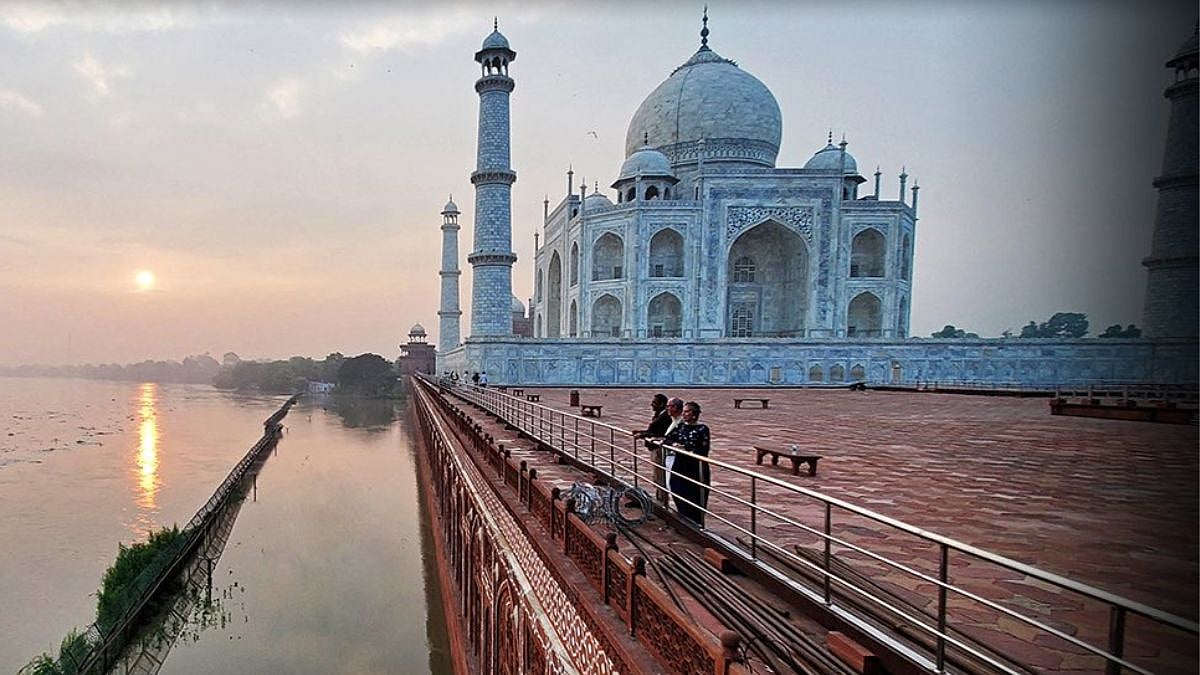
The Taj Mahal, India's most iconic ancient monument, attracts 6.5 million visitors annually and generates significant revenue. However, its preservation has been a longstanding concern due to pollution and industrial activities in the surrounding area.
The Supreme Court of India had issued directions to relocate polluting industries and curb air pollution in the Taj Trapezium Zone (TTZ) three decades ago. Recently, the court has diluted the ban on new industries in the TTZ, allowing 410 pending applications for micro, small, and medium industrial establishments to be considered.
A bench headed by Chief Justice of India Surya Kant has mandated the TTZ Authority to achieve a consensus on each application, with the participation of the Central Empowered Committee and the National Environmental Engineering Research Institute (NEERI). The amicus in the case has been given review powers to refer any matter to the court for a final decision. Public oversight is also incorporated, allowing objections to the decisions.
Despite these checks, the efficacy of the measures will depend on compliance by the executive. The fundamental issue of pollution in the region and the failure of authorities to comply with earlier directions for the TTZ remains a concern. The TTZ requires a vision document, a cumulative impact assessment study, and a final report on non-polluting industries.
The pressure to expand economic opportunity and tax revenues often leads to short-termism, resulting in negative effects on the environment. The clean-up effort to stop sewage and toxic chemical dumping into the Yamuna River has been slow, and the impact of the massive sewage treatment plant at Okhla on sulphurous emissions needs monitoring.
The preservation of the Taj Mahal is crucial, not only for its historical significance but also for its economic benefits. The monument has been fetching steady rewards for modern rulers, while concern for its upkeep has been underwhelming. The integrity of Shah Jahan's creation was left to a public interest petition to preserve.
India's rich archaeological heritage has largely failed to attract international tourists, with tiger tourism generating 13 times more revenue than the Archaeological Survey of India's ticket sales. The preservation of heritage for posterity is essential, and the Taj Mahal's future hinges on balancing development and preservation.
The Indian government must prioritize the preservation of the Taj Mahal and other historical monuments, ensuring that economic development does not come at the cost of environmental degradation and cultural heritage. The Supreme Court's decision to dilute the ban on new industries in the TTZ is a step towards finding a balance between development and preservation, but it is crucial to monitor the implementation of these measures and ensure that the Taj Mahal's integrity is protected.
In conclusion, the Taj Mahal's future is a pressing concern that requires immediate attention. The Indian government, judiciary, and civil society must work together to preserve this national archaeological treasure, ensuring that it continues to attract visitors and generate revenue while maintaining its historical and cultural significance.
The long-term preservation of the Taj Mahal is essential for India's cultural heritage and economic development. The monument's significance extends beyond its historical value, and its preservation is crucial for the country's reputation as a responsible custodian of its cultural heritage.
Ultimately, the Taj Mahal's future depends on the ability of the Indian government and judiciary to balance development and preservation, prioritizing the protection of this iconic monument for future generations.
Frequently asked questions
What is the current status of the Taj Mahal's preservation?
The Indian government and judiciary are working to preserve the Taj Mahal, with efforts to reduce pollution and protect the monument's integrity.
Why is the Taj Mahal important to India's economy?
The Taj Mahal generates significant revenue from tourism and is a crucial part of India's cultural heritage, attracting international visitors and promoting economic development.