MSRTC Plans Conductorless Bus Services
MSRTC to cut costs with conductorless buses, but passenger safety a concern. Long routes pose challenges.
'%3E%3Crect%20width%3D'96'%20height%3D'96'%20fill%3D'%23B3261E'%2F%3E%3Ccircle%20cx%3D'30'%20cy%3D'24'%20r%3D'44'%20fill%3D'%23fff'%20opacity%3D'.12'%2F%3E%3Ccircle%20cx%3D'60'%20cy%3D'74'%20r%3D'40'%20fill%3D'%23000'%20opacity%3D'.10'%2F%3E%3C%2Fg%3E%3Cg%20fill%3D'%23fff'%3E%3Crect%20x%3D'29'%20y%3D'49'%20width%3D'8'%20height%3D'19'%20rx%3D'1'%2F%3E%3Crect%20x%3D'39'%20y%3D'40'%20width%3D'9'%20height%3D'28'%20rx%3D'1'%2F%3E%3Crect%20x%3D'50'%20y%3D'45'%20width%3D'8'%20height%3D'23'%20rx%3D'1'%2F%3E%3Crect%20x%3D'60'%20y%3D'53'%20width%3D'7'%20height%3D'15'%20rx%3D'1'%2F%3E%3Crect%20x%3D'41'%20y%3D'34'%20width%3D'5'%20height%3D'6'%2F%3E%3C%2Fg%3E%3C%2Fsvg%3E)
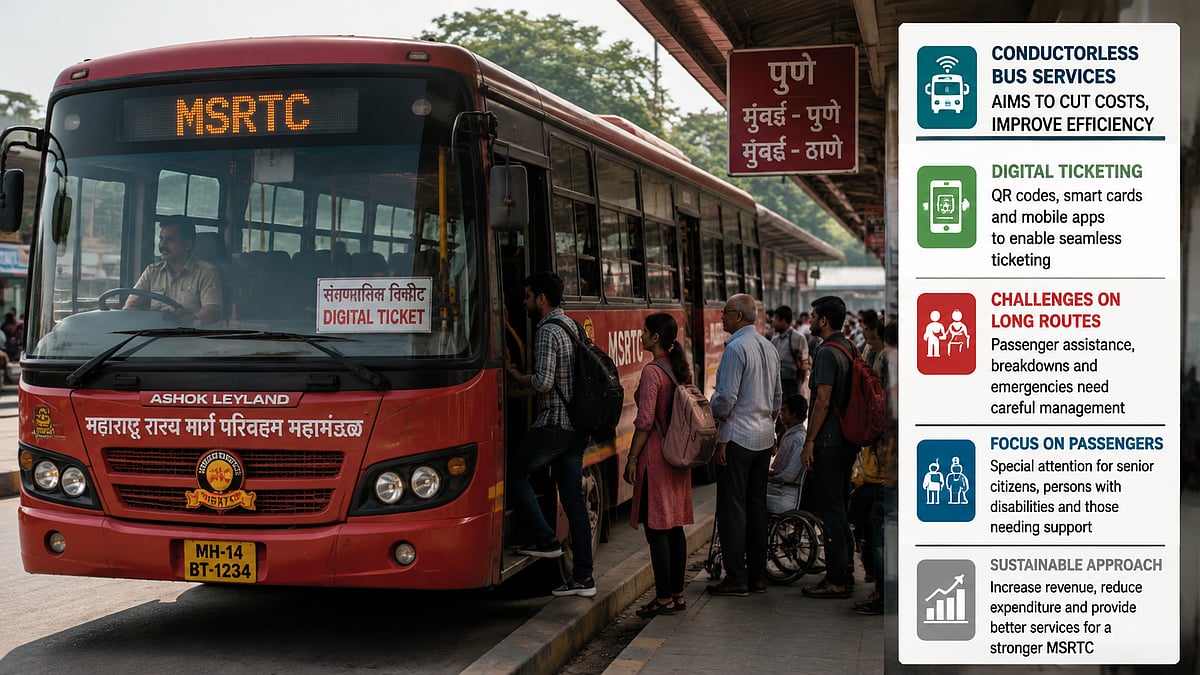
The Maharashtra State Road Transport Corporation (MSRTC) is planning to introduce conductorless bus services to reduce manpower costs and improve its financial position.
Transport Minister Pratap Sarnaik has asked the undertaking to prioritize this model on suitable routes.
The conductorless model is already being tested on shorter routes such as Mumbai-Pune and Mumbai-Thane, where digital ticketing and smart cards can reduce the need for a conductor.
However, extending this model to long-distance services could pose practical challenges, particularly in handling passengers during breakdowns and emergencies.
In the event of a breakdown, a conductor can help coordinate passenger movement and assist with luggage.
The absence of a conductor could also create difficulties for senior citizens, persons with disabilities, and other passengers requiring assistance.
Sarnaik stressed that passenger needs must remain central to the corporation's plans, and that MSRTC is not merely a public transport system but an integral part of the daily lives of people across Maharashtra.
The conductorless model could offer MSRTC a way to cut costs, but its expansion will require careful route selection, reliable digital ticketing, and clear arrangements for passenger assistance.
The move is part of a wider push to increase revenue, curb avoidable expenditure, and make better use of existing resources.
MSRTC is looking to improve its financial position, and the conductorless model is seen as a way to achieve this goal.
The corporation will have to assess whether the conductorless model can work on longer routes, where passengers may require assistance during the journey.
The Transport Minister emphasized that merely increasing ticket fares cannot improve MSRTC's financial condition, and that increasing revenue while reducing expenditure and providing better services is the sustainable way forward.
The introduction of conductorless bus services is a significant development for MSRTC, and its success will depend on careful planning and implementation.
The conductorless model has the potential to reduce costs and improve efficiency, but it must be balanced with the need to ensure passenger safety and convenience.
As MSRTC moves forward with this plan, it will be important to monitor its progress and make adjustments as needed to ensure that the needs of passengers are being met.
Frequently asked questions
What is the purpose of introducing conductorless bus services?
The purpose is to reduce manpower costs and improve MSRTC's financial position.
What are the potential challenges of extending the conductorless model to long-distance services?
The challenges include handling passengers during breakdowns and emergencies, and providing assistance to senior citizens and persons with disabilities.