Maulana Claims Lord Krishna Offered Namaz Daily
Maulana Jargees Ansari sparks row with claim, video goes viral online
'%3E%3Crect%20width%3D'96'%20height%3D'96'%20fill%3D'%231A5276'%2F%3E%3Ccircle%20cx%3D'30'%20cy%3D'24'%20r%3D'44'%20fill%3D'%23fff'%20opacity%3D'.12'%2F%3E%3Ccircle%20cx%3D'60'%20cy%3D'74'%20r%3D'40'%20fill%3D'%23000'%20opacity%3D'.10'%2F%3E%3C%2Fg%3E%3Cg%20fill%3D'%23fff'%3E%3Cpath%20d%3D'M31%2041%20L48%2031%20L65%2041%20Z'%2F%3E%3Crect%20x%3D'33'%20y%3D'43'%20width%3D'4'%20height%3D'17'%2F%3E%3Crect%20x%3D'41'%20y%3D'43'%20width%3D'4'%20height%3D'17'%2F%3E%3Crect%20x%3D'51'%20y%3D'43'%20width%3D'4'%20height%3D'17'%2F%3E%3Crect%20x%3D'59'%20y%3D'43'%20width%3D'4'%20height%3D'17'%2F%3E%3Crect%20x%3D'30'%20y%3D'62'%20width%3D'36'%20height%3D'4'%20rx%3D'1'%2F%3E%3C%2Fg%3E%3C%2Fsvg%3E)
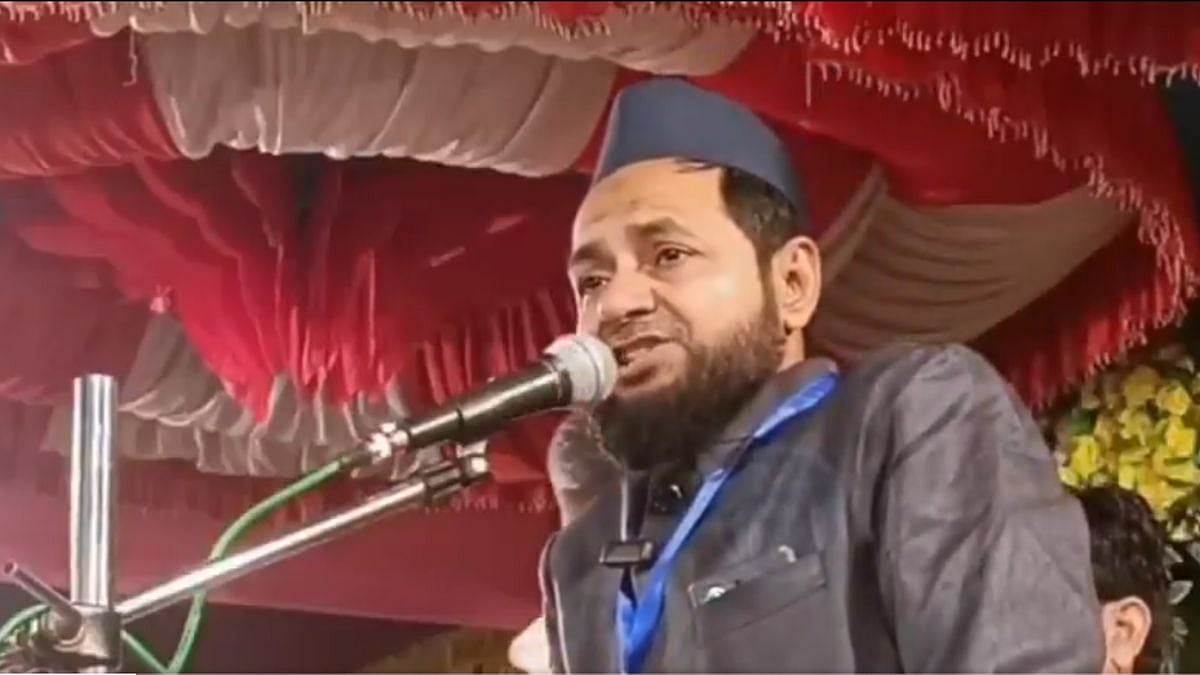
A video of Maulana Jargees Ansari has gone viral on social media, sparking a heated debate over his claim that Lord Krishna offered namaz five times a day. The remarks were made in a clip where Ansari references the Shrimad Bhagavad Gita, specifically Chapter 6, Verse 10.
Maulana Ansari says that Lord Krishna used to offer namaz five times a day, and invites those who do not believe him to look at the aforementioned verse in the Bhagavad Gita. He then recites the verse in Sanskrit and offers his interpretation of its meaning, stating that it describes Lord Krishna instructing Arjuna to worship God with the entire body.
According to Ansari, the verse advocates for full-body devotion during worship, which he contrasts with the common practice among many Hindus today of demonstrating a folded-hands namaste gesture. He claims that such worship does not involve complete bodily participation, and goes on to say that the light of Islam is the same Deen that was presented by Lord Ram and Lord Krishna during their time on Earth.
The video has triggered widespread discussion and debate online, with many users expressing differing views over Ansari's interpretation of Hindu scriptures. As of now, there has been no official response from major Hindu religious bodies or from Maulana Ansari addressing the criticism surrounding the viral clip.
Namaz, also known as Salah or Salat, is the obligatory Islamic prayer performed by Muslims five times a day at prescribed times. It is one of the Five Pillars of Islam and consists of a sequence of standing, bowing, prostrating, and sitting while reciting verses from the Quran and other prescribed supplications as an act of worship and submission to Allah.
The controversy surrounding Maulana Ansari's claim has highlighted the differences in interpretation and practice between different religious traditions. While some have praised Ansari for his efforts to find common ground between Hinduism and Islam, others have criticized him for misinterpreting Hindu scriptures and imposing Islamic practices on Hindu deities.
The debate surrounding the video has also raised questions about the role of religion in public discourse and the importance of respecting different religious traditions. As the controversy continues to unfold, it remains to be seen how Maulana Ansari and other religious leaders will respond to the criticism and engage in a constructive dialogue about the issues at hand.
In the meantime, the video has sparked a lively debate online, with many users sharing their thoughts and opinions on the matter. While some have expressed outrage and offense at Ansari's claims, others have called for greater understanding and respect between different religious communities.
The incident has also highlighted the importance of education and awareness about different religious traditions, and the need for respectful and informed dialogue about the similarities and differences between them. By engaging in such dialogue, we can work towards greater understanding and mutual respect, and build bridges between different communities.
In conclusion, the controversy surrounding Maulana Ansari's claim has sparked a heated debate about the interpretation of Hindu scriptures and the practice of namaz in Islam. While the incident has raised questions and concerns, it also presents an opportunity for constructive dialogue and greater understanding between different religious traditions.
What it means: The controversy surrounding Maulana Ansari's claim has significant implications for interfaith dialogue and understanding in India. As the country continues to grapple with issues of religious diversity and tolerance, incidents like this highlight the need for respectful and informed dialogue about different religious traditions. By engaging in such dialogue, we can work towards greater understanding and mutual respect, and build a more harmonious and inclusive society.