Supreme Court Refuses To Stay CBSE's Three-Language Policy
CBSE's policy to be reviewed, Centre to respond in 10 days. Petitioners raise concerns over language options and resources.
'%3E%3Crect%20width%3D'96'%20height%3D'96'%20fill%3D'%231A5276'%2F%3E%3Ccircle%20cx%3D'30'%20cy%3D'24'%20r%3D'44'%20fill%3D'%23fff'%20opacity%3D'.12'%2F%3E%3Ccircle%20cx%3D'60'%20cy%3D'74'%20r%3D'40'%20fill%3D'%23000'%20opacity%3D'.10'%2F%3E%3C%2Fg%3E%3Cg%20fill%3D'%23fff'%3E%3Cpath%20d%3D'M31%2041%20L48%2031%20L65%2041%20Z'%2F%3E%3Crect%20x%3D'33'%20y%3D'43'%20width%3D'4'%20height%3D'17'%2F%3E%3Crect%20x%3D'41'%20y%3D'43'%20width%3D'4'%20height%3D'17'%2F%3E%3Crect%20x%3D'51'%20y%3D'43'%20width%3D'4'%20height%3D'17'%2F%3E%3Crect%20x%3D'59'%20y%3D'43'%20width%3D'4'%20height%3D'17'%2F%3E%3Crect%20x%3D'30'%20y%3D'62'%20width%3D'36'%20height%3D'4'%20rx%3D'1'%2F%3E%3C%2Fg%3E%3C%2Fsvg%3E)
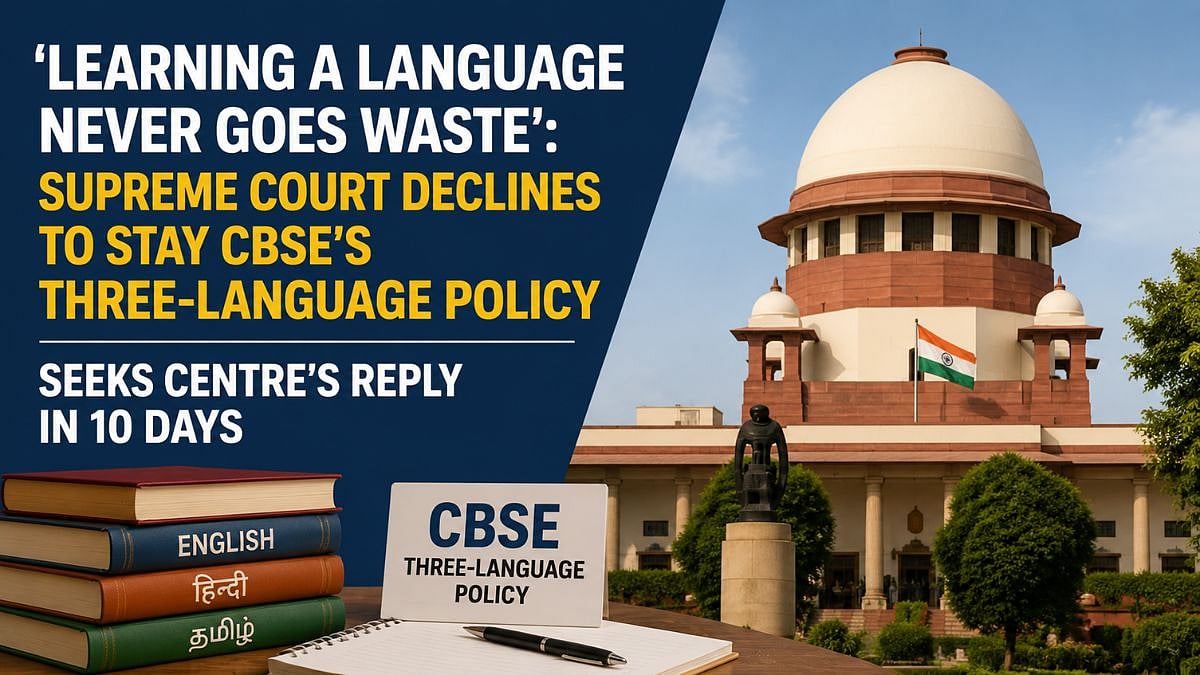
The Supreme Court on Tuesday refused to stay the Central Board of Secondary Education's (CBSE) three-language policy, which was introduced for the 2026-27 academic year. The policy requires students from Class 9 to study two Indian languages, in addition to English.
A bench comprising Chief Justice of India Surya Kant, Justice Joymalya Bagchi, and Justice V. Mohana Prasad issued notice on the fresh petitions and fixed the matter for a detailed hearing next Wednesday. The Court did not grant any interim relief, despite requests from petitioners to halt the implementation of the policy until schools have adequate teachers and textbooks.
The petitioners argued that the revised policy would force students to discontinue languages they had been learning since Class 5. They also contended that English had been classified as a non-native language, and raised concerns over the lack of teachers and textbooks for several Indian languages.
Senior Advocate Anand Grover submitted that the CBSE circulars had no statutory backing and argued that only the National Council of Educational Research and Training (NCERT) was authorised to frame such academic requirements. He stated that the circulars were without authority of law and that the CBSE was imposing languages without giving options.
Other senior advocates, including Gopal Sankaranarayanan, Shyam Divan, and Mukul Rohatgi, also raised concerns about the policy. They argued that the policy treated English as a non-native language, while making Indian languages compulsory, and that significant concerns remained unresolved despite the CBSE's relaxation of certain requirements.
The Court has sought the Centre's reply within 10 days, and the matter will be reviewed next week. The petitioners have requested that the policy should not be implemented until schools have adequate teachers and textbooks.
The CBSE's three-language policy has been a topic of debate, with some arguing that it promotes the learning of Indian languages and others arguing that it imposes undue burden on students. The policy is part of the National Education Policy, which envisages implementation by 2030. However, the CBSE has advanced the implementation to the current academic year.
The Supreme Court's decision to refuse the stay and seek the Centre's reply is a significant development in the case. The Court's review of the policy will be closely watched, as it has implications for students, schools, and the education system as a whole.
In the context of India's education system, the three-language policy is an attempt to promote the learning of Indian languages and reduce the dominance of English. However, the implementation of the policy has raised concerns about the availability of resources, including teachers and textbooks.
The Supreme Court's decision will have significant implications for the education system in India. The Court's review of the policy will provide clarity on the implementation of the three-language policy and its impact on students and schools.
In conclusion, the Supreme Court's refusal to stay the CBSE's three-language policy is a significant development in the case. The Court's review of the policy will be closely watched, and its decision will have implications for the education system in India. The policy's implementation has raised concerns about the availability of resources, and the Court's decision will provide clarity on the way forward.