Kharif Crop Concerns Remain Despite Improved Rainfall
Rainfall deficiency at 24%, crop sowing lags behind last year's level.
'%3E%3Crect%20width%3D'96'%20height%3D'96'%20fill%3D'%23B3261E'%2F%3E%3Ccircle%20cx%3D'30'%20cy%3D'24'%20r%3D'44'%20fill%3D'%23fff'%20opacity%3D'.12'%2F%3E%3Ccircle%20cx%3D'60'%20cy%3D'74'%20r%3D'40'%20fill%3D'%23000'%20opacity%3D'.10'%2F%3E%3C%2Fg%3E%3Cg%20fill%3D'%23fff'%3E%3Crect%20x%3D'29'%20y%3D'49'%20width%3D'8'%20height%3D'19'%20rx%3D'1'%2F%3E%3Crect%20x%3D'39'%20y%3D'40'%20width%3D'9'%20height%3D'28'%20rx%3D'1'%2F%3E%3Crect%20x%3D'50'%20y%3D'45'%20width%3D'8'%20height%3D'23'%20rx%3D'1'%2F%3E%3Crect%20x%3D'60'%20y%3D'53'%20width%3D'7'%20height%3D'15'%20rx%3D'1'%2F%3E%3Crect%20x%3D'41'%20y%3D'34'%20width%3D'5'%20height%3D'6'%2F%3E%3C%2Fg%3E%3C%2Fsvg%3E)
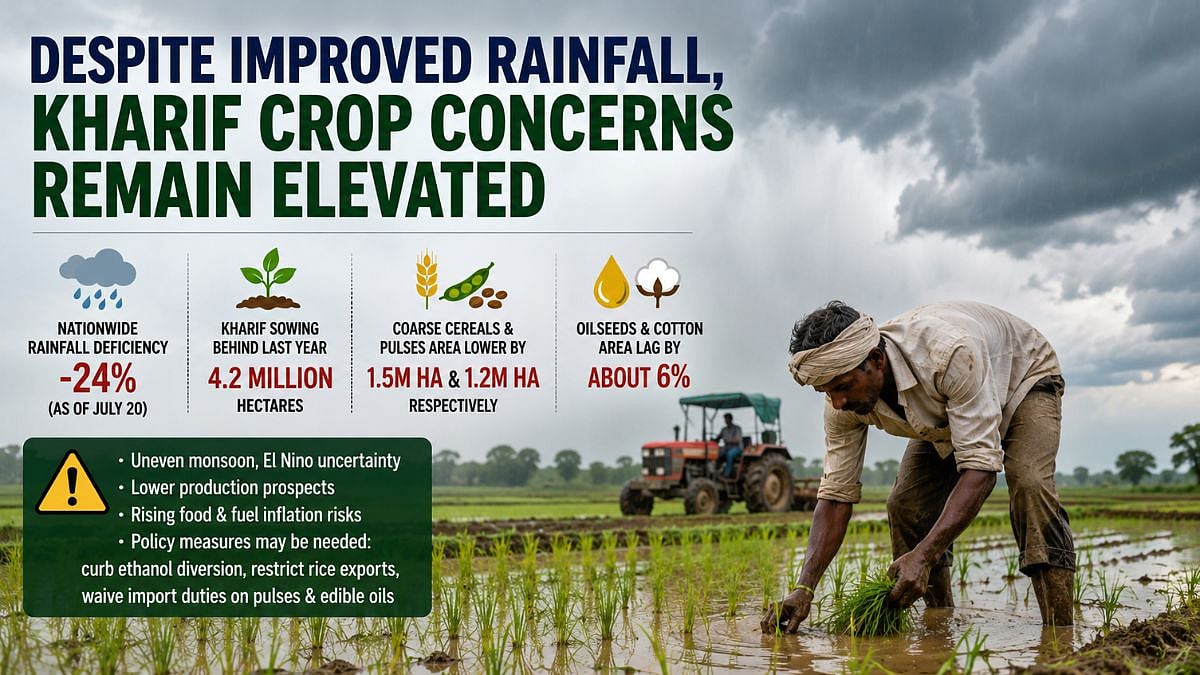
The country has witnessed significant rainfall activity since July 1, bringing hope that widespread drought may be avoided. However, concerns regarding Kharif crops remain elevated. As of July 20, the nationwide rainfall deficiency stands at 24%, with 23 out of 36 meteorological subdivisions recording a 25% to 50% deficiency.
These subdivisions are mainly located in the west, northwest, east, northeast, and central parts of the country, affecting states such as Rajasthan, Punjab, Haryana, Bihar, and Jharkhand, as well as parts of Madhya Pradesh, Maharashtra, Andhra Pradesh, and Karnataka. The uneven spatial distribution of the southwest monsoon has resulted in a lag in crop sowing.
According to the Central Weather Watch Group, the progress of area coverage for Kharif crops continues to lag behind last year's level. The overall decline in planted area was 4.2 million hectares as of July 19. Acreage for coarse cereals and pulses is still lower than it was at this time last year by 1.5 million hectares and 1.2 million hectares, respectively.
Oilseeds and cotton have also seen a decline in planted area by about 6%. The delayed onset and tardy progress of the southwest monsoon have closed the planting window, and any further planting is subject to weather risk. The weekly sowing report from the Union Ministry of Agriculture shows a compilation of reports filed by state governments, but there is usually a lag in data collection and dissemination.
By early August, a reasonably good idea about the planted area and crop prospects can be gathered. However, weather uncertainty persists, and the spatial distribution of rainfall for the rest of this month and August will be crucial. The potential strengthening of El Niño and its impact on precipitation in August adds to the uncertainty.
It is premature to talk about harvest prospects at this point, but the country may need to brace for lower production of rice, coarse cereals, pulses, oilseeds, and cotton. The harvest size may be lower than not just the target but also last Kharif's levels. Looming production shortfalls, tightening supply-demand fundamentals, and food inflation are concerns that cannot be ignored.
The situation is exacerbated by renewed hostilities in the Persian Gulf region, which has led to a closure of passage through the critical Strait of Hormuz and a spike in energy prices. Brent is currently above $90 a barrel. The combination of climate and geopolitics means that inflation risks are increasing.
In conclusion, despite improved rainfall, concerns regarding Kharif crops remain elevated due to the uneven spatial distribution of the southwest monsoon, lag in crop sowing, and weather uncertainty. The country may need to prepare for lower production and potential food inflation.
The impact of the monsoon on agriculture is a critical factor in India's food security and economy. The government and farmers will need to closely monitor the situation and take necessary steps to mitigate the effects of the potential crop shortfall. The situation will become clearer by early August, and it is essential to be prepared for any eventuality.
The monsoon-dependent agriculture sector is a significant contributor to India's economy, and any disruption can have far-reaching consequences. The current situation highlights the need for effective planning, management, and mitigation strategies to ensure food security and minimize the impact of climate-related uncertainties.
In the coming weeks, the progress of the monsoon and its impact on Kharif crops will be closely watched. The government will need to take proactive steps to address the potential crop shortfall and ensure that the country's food security is not compromised. The situation is complex, and a comprehensive approach will be necessary to mitigate the effects of the monsoon and geopolitical uncertainties.
The potential consequences of the monsoon and geopolitical uncertainties on India's economy and food security are significant. It is essential to be prepared for any eventuality and to take necessary steps to mitigate the effects of the potential crop shortfall. The government, farmers, and other stakeholders will need to work together to ensure that the country's food security is not compromised.
In the end, the situation regarding Kharif crops is complex and uncertain. While there is hope that widespread drought may be avoided, concerns regarding crop sowing and weather uncertainty persist. The country will need to be prepared for any eventuality and take necessary steps to mitigate the effects of the potential crop shortfall.
Frequently asked questions
What is the current rainfall deficiency in India?
The nationwide rainfall deficiency stands at 24% as of July 20.
Which states are affected by the uneven spatial distribution of the southwest monsoon?
States such as Rajasthan, Punjab, Haryana, Bihar, and Jharkhand, as well as parts of Madhya Pradesh, Maharashtra, Andhra Pradesh, and Karnataka are affected.