
Malvani Cuisine in Mumbai: Coastal Konkan Flavours
Where to eat fiery Malvani-Konkan food in Mumbai — sol kadhi, tisrya, bombil fry and kombdi vade — mapped by area, dish, rough ₹ price and nearest station.
'%3E%3Crect%20width%3D'96'%20height%3D'96'%20fill%3D'%23E65100'%2F%3E%3Ccircle%20cx%3D'30'%20cy%3D'24'%20r%3D'44'%20fill%3D'%23fff'%20opacity%3D'.12'%2F%3E%3Ccircle%20cx%3D'60'%20cy%3D'74'%20r%3D'40'%20fill%3D'%23000'%20opacity%3D'.10'%2F%3E%3C%2Fg%3E%3Cg%3E%3Ccircle%20cx%3D'48'%20cy%3D'48'%20r%3D'15'%20fill%3D'none'%20stroke%3D'%23fff'%20stroke-width%3D'3'%2F%3E%3Cpath%20fill%3D'%23fff'%20d%3D'M48%2037%20l3.5%2011%20-3.5%2011%20-3.5%20-11%20z'%2F%3E%3Ccircle%20cx%3D'48'%20cy%3D'48'%20r%3D'2.2'%20fill%3D'%23fff'%2F%3E%3C%2Fg%3E%3C%2Fsvg%3E)
The Top 10
- 01
Gajalee
Vile Parle East (also outlets at Lower Parel/Phoenix and elsewhere) approx ₹1,500–2,000 for two (₹₹₹)Go for: Mumbai's best-known Malvani seafood name — Bombil (Bombay duck) fry, tandoori crab, prawns koliwada and sol kadhi.
Go to the original Vile Parle East kitchen and ask for the day's fresh catch rather than ordering off-season fish.
- 02
Satkar Rice Plate House
Goregaon East (outside the station) approx ₹500–700 for two (₹)Go for: 60-year-old legacy for ultra-fresh Malvani thalis — bombil fry, mori (shark) masala, surmai and hearty mutton thali.
Tiny and no-frills; go early for lunch as the fresh thalis run out fast.
- 03
Sindhudurg
Dadar West approx ₹600–900 for two (₹₹)Go for: Decades-old, air-conditioned spot for authentic Malvani-Konkani fish curry and quick-fire thalis (surmai, bombil, prawn).
Order the fish thali of the day and the sol kadhi; come for the food, not the ambiance.
- 04
Chaitanya (Assal Malvani)
Dadar West / Shivaji Park approx ₹700–1,000 for two (₹₹)Go for: Cult prawns thali with several prawn preparations, plus its signature crab lollipop and bombil fry.
Very small and packed on weekends — go on a weekday and be ready for a short wait.
- 05
Highway Gomantak
Bandra East (Western Express Highway service road) approx ₹600–900 for two (₹₹)Go for: Homestyle Malvani since 1991 (Potnis family) — surmai curry thali, bombil fry and sol kadhi.
Closed Thursdays; lunch is roughly 11–3:30 and dinner 7–10:30, so time your visit.
- 06
Acharekar's Malvan Katta
Dadar West (also Lower Parel) approx ₹800–1,000 for two (₹₹)Go for: Authentic Malvan-style cooking — mutton sukha, prawns tawa fry, bombil fry and sol kadi.
Plain decor, food-first; try the Malvani mutton if you want a break from seafood.
- 07
Ratnagiri Malvani Food
Goregaon East (also Lower Parel) approx ₹400–600 for two (₹)Go for: Great-value Malvani fish thalis where you pick your fish, plus prawns koliwada and bombil fry.
One of the best budget thalis in the city; there are separate family and bar sections.
- 08
Pradeep Gomantak Bhojanalaya
Fort (near the Fort Fire Brigade) approx ₹300–450 for two (₹)Go for: Cheap, homestyle Malvani-Gomantak thalis — bombil, surmai, chicken/mutton liver thali with sol kadhi.
Closed Sundays; expect a lunchtime queue and shared tables with the office crowd.
- 09
The Konkan Cafe
Cuffe Parade (Vivanta President / IHCL SeleQtions) approx ₹3,500–4,500 for two (₹₹₹₹)Go for: The refined, upscale take on coastal Konkan-Malvani cooking — appam, prawn curry, coconut gassi and an elaborate thali.
The air-conditioned splurge option; reserve ahead and go for the full thali experience.
- 10
Diva Maharashtracha
Mahim approx ₹1,000–1,500 for two (₹₹)Go for: Chef Deepa Awchat's Maharashtrian restobar with a strong Malvani-Konkan seafood section, sol kadhi and kombdi vade.
The menu is broadly Maharashtrian, so ask specifically for the Malvani/Konkan seafood dishes.
Ranked by our Mumbai desk · prices are approximate — confirm before you go.
Malvani food is the fierce, coconut-and-kokum coastal cooking of the Sindhudurg belt on Maharashtra’s Konkan coast — think sol kadhi, tisrya (clams), bombil fry and kombdi vade. In Mumbai, the Dadar–Prabhadevi corridor is the heartland to eat it, with more spread across the western suburbs. This is where to find the real thing, what to order, and roughly what it costs.
Ask a Mumbaikar for “coastal food” and you’ll get pointed at glossy Mangalorean seafood palaces. Malvani is a narrower, sharper thing. It comes from Malvan and the Sindhudurg district at the southern end of the Konkan, and it leans on a specific trinity: freshly ground red Malvani masala, coconut in every form (fresh, dry, milk), and the sour-plum tang of kokum. The result is redder, hotter and more astringent than a generic fish curry — food built to cut through humidity and heat.
Quick reference: where to eat Malvani in Mumbai
Prices are per-person or per-two bands for a typical room and move with the daily fish market — a big whole pomfret or crab always pushes a bill higher than the printed thali rate. Confirm the showpiece price before ordering.
| Restaurant | Area | Order this | Rough price (₹) | Nearest station |
|---|---|---|---|---|
| Chaitanya (Assal Malvani) | Prabhadevi (SK Bole Rd) | Chicken/fish thali | 500–900 pp | Dadar / Elphinstone Rd |
| Sindhudurg | Dadar West | Fish curry, home-style | 400–800 for two | Dadar |
| Acharekar’s Malvan Katta | Dadar West | Fish thali, oysters | 400–800 pp | Dadar |
| Gajalee | Vile Parle | Rava-fried surmai, prawns | 1,500–2,500 for two | Vile Parle |
| Highway Gomantak | Bandra East | Fish thali, fried bangda | 400–800 for two | Bandra |
What makes Malvani different
Malvani cuisine is not just “Maharashtrian seafood.” A few markers set it apart:
- The masala. A distinctive dry-roasted blend heavy on Kashmiri and hot chillies, coriander and coconut, giving curries their brick-red colour and slow-building burn.
- Kokum everywhere. The dried sour fruit shows up in curries and, most famously, in sol kadhi.
- Rice, not wheat. This is a rice belt, so breads are rice-based — vade (puffy fried rice-flour rounds), ghavane and amboli rather than chapati.
- Nothing wasted. Small fry, dried fish (sukat, bombil) and shellfish like clams are as central as the prized pomfret and surmai.
The dishes to order
If it’s your first time, order across these:
- Sol kadhi — the pink, silky drink of coconut milk and kokum. Cooling, digestive, and the non-negotiable companion to a spicy Malvani meal.
- Tisrya (clams) — usually as tisrya masala or a dry sukka with coconut. Small, sweet and deeply savoury; a true Malvani signature.
- Bombil fry — Bombay duck, the soft local fish, dredged in rava (semolina) and shallow-fried until the edges crisp. Order it hot off the pan.
- Kombdi vade — the belt’s most famous plate: a robust Malvani chicken curry (kombdi) mopped up with those fried rice-flour vade. Non-negotiable if you eat meat.
- Fish thali — the complete introduction: rice, two fish curries, a fried fish, a dry sukat or kismur side, sol kadhi and vade or bhakri. The best-value way in.
- Surmai or pomfret fry — kingfish and pomfret in the classic rava crust, or stuffed barlela pomfret at the more ambitious places.
Where to eat: the Dadar–Prabhadevi heartland
The stretch around Dadar and Prabhadevi is the city’s Malvani core, thanks to a long-settled Konkani community. It’s all within a short auto ride, so you can compare rooms in a single afternoon.
- Chaitanya (Assal Malvani) on SK Bole Road, near Siddhivinayak, has served Malvani thalis since the early 1990s. Its chicken and fish thalis, paired with vade, amboli and sol kadhi, are the standard-bearer here. Roughly ₹500–900 a head.
- Sindhudurg in Dadar is a decades-old, no-frills room with a short menu — the fish curry is the reason regulars keep coming. Home-style and unglamorous; roughly ₹400–800 for two.
- Acharekar’s Malvan Katta in Dadar West is a tiny, cult-followed spot known for a well-balanced (not brutally hot) fish thali, Malvani oysters and stuffed pomfret. Small and often full, so time it off-peak. Roughly ₹400–800 a head depending on what you order.
Prices track the daily fish market, so a big whole pomfret or crab will always push a bill higher than the printed thali rate — confirm before ordering the showpiece.
Beyond Dadar: the suburbs
Malvani cooking has spread north with the Konkani diaspora:
- Gajalee (Vile Parle and other outlets) is the upmarket coastal choice — Malvani seafood done polished, with rava-fried surmai, prawns and squid. Roughly ₹1,500–2,500 for two, more for a large whole fish.
- Highway Gomantak in Bandra East is the home-style Malvani-Gomantak stalwart, serving fish thali, fried bangda and sol kadhi at modest prices — roughly ₹400–800 for two. It typically shuts one day a week (Thursdays), so check before you go.
- Around suburban railway stations you’ll also find small, unbranded “lunch home” rooms doing a cheap pomfret or surmai thali. These come and go, so ask locally rather than chasing a specific name — the format is reliable even when the signboard changes.
For a wider view of the city’s coastal scene, our guides to seafood restaurants in Mumbai and Maharashtrian food in Mumbai cover the overlapping Mangalorean, Gomantak and Kolhapuri traditions.
Malvani vs Gomantak vs Mangalorean: telling the coastal cuisines apart
Mumbai’s “coastal food” umbrella hides at least three distinct kitchens, and mixing them up is the fastest way to order the wrong thing:
- Malvani (Malvan–Sindhudurg, south Konkan Maharashtra): the fieriest of the three, built on a dry-roasted red house masala, heavy coconut and sour kokum. Redder, hotter, more astringent — think tisrya sukka, bombil fry, kombdi vade.
- Gomantak / Goan-Hindu (Goa and the coast just south): closely related and often served alongside Malvani in the same rooms (as at Highway Gomantak), but a touch tangier and sometimes gentler, leaning on teppal (Sichuan-pepper-like) and triphal in places.
- Mangalorean (coastal Karnataka): the “glossy seafood palace” default — ghee-roast prawns, neer dosa, gassi curries rich with coconut and a different chilli profile (the bright red byadagi). Milder-looking but deeply flavoured.
If you want the sharpest, most chilli-forward coastal plate, Malvani is the one to seek out. If you want something rounder and coconut-sweet, drift towards Mangalorean.
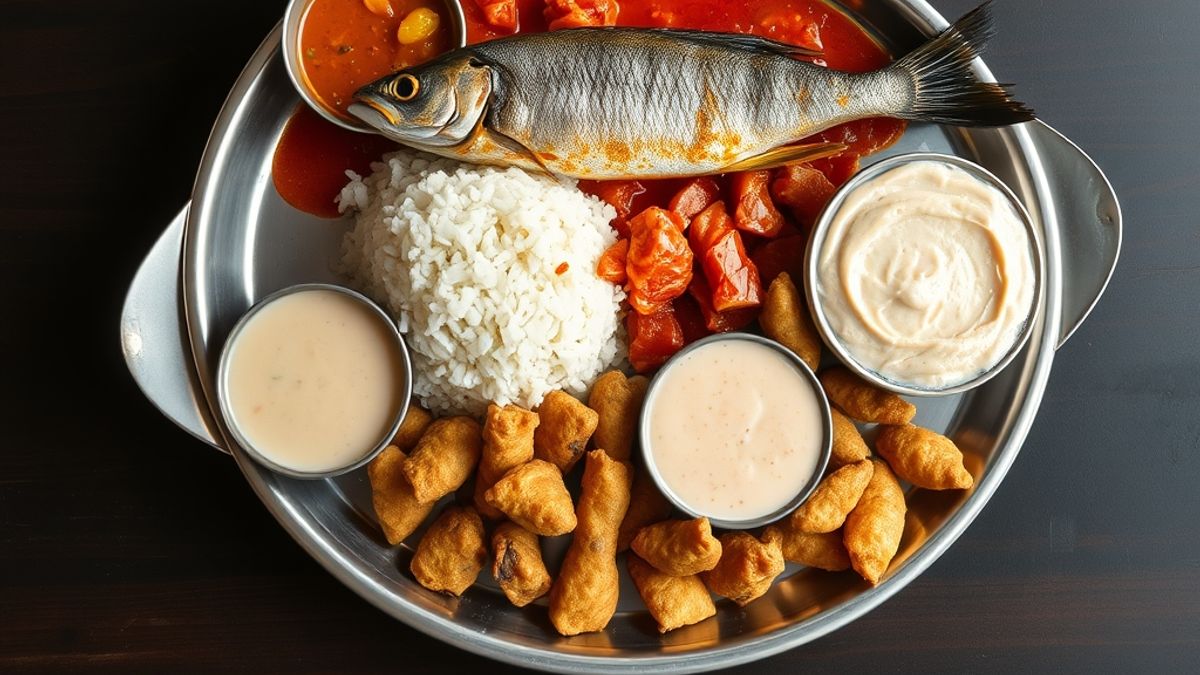
The Malvani thali, decoded
A full Malvani fish thali can arrive as a slightly bewildering spread of small bowls. Here’s what you’re looking at, left to right:
- Rice and vade/bhakri — the base; vade (fried rice-flour puffs) are the treat, bhakri the everyday bread.
- The rassa (kalvan) — a thin, fiery fish or prawn curry meant to be poured over rice.
- A dry sukka — coconut-heavy, less soupy, for texture and to eat with bhakri.
- The fried fish — usually rava-crusted surmai, pomfret or bombil; the piece that’s “counted” while rice and curry are often unlimited.
- Kismur or a dry-prawn side — a small, intense relish; don’t skip it.
- Sol kadhi — the pink coolant, sipped throughout to reset your palate.
Order the thali on your first visit, work out which curry you loved, and come back for that fish cooked whole.
What to expect inside a Malvani room
Malvani rooms are, by and large, unpretentious. The classic spots are functional, brightly lit, often family-run, and busy at lunch. Thalis are frequently unlimited on rice, curry and sol kadhi — the fried fish is what’s counted. Service is quick and unfussy; this is everyday eating, not a tasting menu. If you want the atmosphere of a working coastal kitchen rather than a designed restaurant, that’s precisely the point.
How to read the menu like a local
A little vocabulary saves you from ordering timidly:
- Sukka vs rassa: sukka is a dry, coconut-heavy preparation; rassa (or kalvan) is the thin, fiery curry meant for rice. Order one of each to taste the range.
- Kismur: a dry relish of crushed dried prawns or Bombay duck with coconut and onion — a small, punchy side that regulars never skip.
- Vade vs bhakri: vade are the puffy fried rice-flour rounds that partner kombdi; bhakri is a flatter rice or nachni (ragi) bread. Both mop curry better than plain rice.
- Barlela: stuffed — a barlela pomfret is stuffed with green masala and shallow-fried, the ambitious-kitchen showpiece.
Best time to go, and the monsoon catch
Malvani food is a year-round pleasure, but there’s a monsoon catch: from roughly June to August, when the sea-fishing season pauses, fresh marine fish can be limited and some kitchens lean on prawns, dried fish and chicken (kombdi vade shines here). For the fullest fresh-fish spread, the cooler months from October onward are ideal. If you visit during the Mumbai monsoon, a hot bombil fry and a bowl of sol kadhi is exactly the right thing to eat.
The easiest way in is geographic: Dadar is the interchange of the Western and Central lines and a short walk or auto from the Prabhadevi/Siddhivinayak cluster. The suburban spots sit near their own stations — Vile Parle and Bandra on the Western line — all quick by local train or cab. As with most Mumbai food crawls, the train beats a car at peak hours.
Insider tips for eating Malvani
- Respect the heat. Authentic Malvani masala is genuinely fiery. Ask for it milder if you’re heat-shy, and keep the sol kadhi coming — it’s the built-in coolant.
- Go for the thali first. It’s the cheapest and most complete way to taste the range in one sitting before you commit to a whole fish.
- Eat what’s fresh. Ask the day’s catch; bombil, prawns and clams are best when the counter is moving fast.
- Lunch beats dinner at the old-school places, when the thalis are freshest and fullest and the market fish has just arrived.
- Carry cash. Some of the smaller, older rooms are cash-first, and the counter queue moves faster when you’re not fishing for a card.
- Check the weekly day off, especially at home-style spots like Highway Gomantak that shut once a week — a wasted trip to Bandra East on a Thursday is a Mumbai rite of passage best avoided.
Do that, and Malvani gives you the most honest coastal meal in the city: brick-red curry, crisp rava-fried fish, a puff of vade and a cold glass of pink sol kadhi to put the fire out. Start in Dadar, order the thali, and come back for the whole pomfret once you know your sukka from your rassa.
Frequently Asked Questions
What is the difference between Malvani food and generic Mumbai seafood?
Malvani is the specific coastal cuisine of the Malvan–Sindhudurg belt on Maharashtra's Konkan coast, built on a fiery dry-roasted house masala, heavy coconut and sour kokum. It's redder, hotter and more astringent than the broader Mangalorean or Gomantak seafood you'll find across the city.
What should a first-timer order at a Malvani restaurant?
Start with a fish thali plus a bowl of sol kadhi — it gives you two curries, a fried fish, a dry side and rice-flour vade in one plate, which is the cheapest and most complete way in. If you eat meat, add kombdi vade; if you love shellfish, order tisrya (clams).
Is Malvani food very spicy?
Yes, authentic Malvani masala runs genuinely hot. Most places will tone it down on request, and the pink coconut-and-kokum sol kadhi is specifically meant to cool the palate between bites. Keep it coming through a spicy meal.
Where is the best area for Malvani food in Mumbai?
The Dadar–Prabhadevi corridor is the city's Malvani heartland, thanks to a long-settled Konkani community — Chaitanya, Sindhudurg and Acharekar's Malvan Katta cluster here. Gajalee in Vile Parle and Highway Gomantak in Bandra East cover the suburbs.
What is sol kadhi and why is it served with Malvani food?
Sol kadhi is a pink, silky drink of coconut milk and sour kokum. It's cooling and digestive, which is exactly why it's the non-negotiable companion to a fiery Malvani meal — it settles a heavy seafood lunch and takes the edge off the chilli heat.
Can you get good Malvani food in Mumbai during the monsoon?
You can, but with a catch: from roughly June to August the sea-fishing season pauses, so fresh marine fish can be limited and kitchens lean on prawns, dried fish and chicken (kombdi vade shines). For the fullest fresh-fish spread, come from October onward.