

Starring
About the film
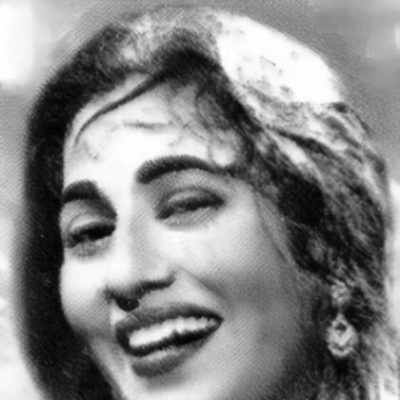
Mumtaz Jehan Begum Dehlavi (14 February 1933 – 23 February 1969), known professionally as Madhubala (pronounced [məd̪ʱubɑːlɑː]), was an Indian actress who worked in Hindi films. She is regarded to have been one of the greatest and finest actresses in the history of Indian cinema. One of the country's highest-paid stars in the 1950s, Madhubala appeared in over 70 films—ranging from slapstick comedies to historical dramas—in a two decade-long career. Long after her death, she remains a Bollywood icon, particularly noted for her beauty and unconventional screen persona. Media outlets often refer to her as "The Venus of Indian cinema".
Born and raised in Delhi, Madhubala relocated to Bombay (now Mumbai) with her family when she was 8 years old and shortly after began playing minor roles, starting with Basant (1942). She progressed to leading roles in the late 1940s, and earned success with the dramas Neel Kamal (1947) and the horror film Mahal (1949), the romantic films Badal (1951), Tarana (1951), and Amar (1954). Following a brief setback, Madhubala found continued success with her roles in the comedies Mr. & Mrs. '55 (1955), Chalti Ka Naam Gaadi (1958) and Half Ticket (1962), the crime films Howrah Bridge and Kala Pani (both 1958), and the musical Barsaat Ki Raat (1960).
Life and career
Madhubala was born as Mumtaz Jehan Begum Dehlavi in Delhi, British India, on 14 February 1933. She was the fifth of eleven children of Ataullah Khan and Aayesha Begum. Khan belonged to the Yusufzai tribe of Pashtuns from Peshawar valley, originating from Swabi District, North-West Frontier Province, and was an employee at the Imperial Tobacco Company in Delhi. Aayesha Begum was originally from Lahore. Five of Madhubala's siblings died in infancy; her sisters who survived to adulthood were Kaneez Fatima, Altaf, Zeb (known professionally as Chanchal), Shahida and Madhur Bhushan (née Zahida). Unknown to her family members, Madhubala was born with a ventricular septal defect, a congenital heart disorder which had no treatment at the time.
Madhubala spent most of her childhood in Delhi and grew up without any kind of health issues. Owing to the orthodox ideas of their Muslim father, neither Madhubala nor any of her sisters, except Bhushan, attended school. Madhubala nevertheless learnt Urdu and Pashto under her father's guidance. An avid movie viewer from a young age, she often performed her favorite scenes for her mother and spent her time dancing and imitating film characters to entertain herself.
In 1940, Khan lost his job for misbehaving with a senior officer, leaving the family without an income. To help earn money, seven-year-old Madhubala began working at All India Radio, singing compositions by Khwaja Khurshid Anwar. She continued to work there for several months and became acquainted with Rai Bahadur Chunnilal, the general manager of the Bombay Talkies studio in Bombay. Chunnilal took an immediate liking to Madhubala and suggested that Khan visit Bombay for better employment opportunities.
Screen persona and reception
Madhubala was one of the most celebrated Indian actors of the post-independence era, a period referred to by film historians as the Golden Age of Hindi cinema. Her rise to stardom in the early 1950s coincided with the rapid expansion of the Indian film industry, and some international outlets referred to her as the industry's top star. A 1952 feature in Theatre Arts Magazine, written by David Cort, described Madhubala as "the biggest star in the world" in terms of potential audience size, noting that her local reach extended across the 420 million people of India and Pakistan. An Indian Daily Mail article published in 1955 stated her to be the "highest-paid star of the East". In the textbook A History of World Civilization (1957), American historian Max Savelle contrasted Madhubala's status as India's highest-paid film star to what he described as the traditional seclusion of women in India.
Madhubala's contemporary image was shaped by her widely acknowledged physical attractiveness, and she was dubbed the "Venus of the Indian screen" by editor Baburao Patel. Film journalist B. K. Karanjia recalled being "quite stunned" when he first met Madhubala, writing, "I thought, how could the camera have so signally failed to capture that quite extraordinary beauty? ... None of her photographs did her enough justice." Scholar Dina Khdair writes that Madhubala earned success featuring as a "scopophilic gem" in roles that often relied on her beauty and sex appeal. For example, she portrayed mysterious and alluring women in the noir films Mahal (1949) and Howrah Bridge (1958), while appearing as a modern and "Westernized" star in such comedies as Mr. & Mrs. '55 (1955) and Chalti Ka Naam Gaadi (1958). Unconventional for a leading lady at the time, Madhubala built a reputation for her performances in comic roles, and her image was associated with a range of modern fashion trends, including off-shoulder dresses, trousers, and a distinctive wavy hairstyle, which contrasted with the more traditional attire commonly worn by Hindi film actresses of the period.
Cort argued in 1952 that Madhubala's screen persona embodied the ideal of post-independent Indian woman, and described her as "a new type in India" and a "symbol of the advance guard of a revolution". Critic Jacob Levich describes Madhubala as "a sort of sub-continental cross between Rita Hayworth and Ingrid Bergman", while film historian Bhagwan Das Garga situates Madhubala within a broader shift in Hindi cinema's depiction of femininity, in which "the vamp and the virgin merged", producing a new kind of sex symbol. According to Khdair, Madhubala's image blended "innocence" and "sensuality" and elicited comparisons with Hollywood actress Marilyn Monroe, which contributed to her eroticized image and further international attention.
Key details
| Release year | 1950 |
|---|---|
| Language | Hindi |
| Starring | Madhubala |
Frequently Asked Questions
When was Madhubala released?
Madhubala is a Hindi-language film released in 1950.
Who stars in Madhubala?
Madhubala stars Madhubala.
What is Madhubala about?
Mumtaz Jehan Begum Dehlavi (14 February 1933 – 23 February 1969), known professionally as Madhubala (pronounced [məd̪ʱubɑːlɑː]), was an Indian actress who worked in Hindi films. She is regarded to have been one of the greatest and finest actresses in the history of Indian cinema.
Where can I watch Madhubala?
Madhubala may be available on major streaming platforms or for digital rental — check current OTT listings for availability in your region.
Reference: Wikipedia
← Back to the Bollywood Hub