Pune Prioritises HCMTR To Ease Traffic Congestion
Pune Municipal Corporation to focus on High Capacity Mass Transit Route, a 36-km elevated corridor
'%3E%3Crect%20width%3D'96'%20height%3D'96'%20fill%3D'%23B3261E'%2F%3E%3Ccircle%20cx%3D'30'%20cy%3D'24'%20r%3D'44'%20fill%3D'%23fff'%20opacity%3D'.12'%2F%3E%3Ccircle%20cx%3D'60'%20cy%3D'74'%20r%3D'40'%20fill%3D'%23000'%20opacity%3D'.10'%2F%3E%3C%2Fg%3E%3Cg%20fill%3D'%23fff'%3E%3Crect%20x%3D'29'%20y%3D'49'%20width%3D'8'%20height%3D'19'%20rx%3D'1'%2F%3E%3Crect%20x%3D'39'%20y%3D'40'%20width%3D'9'%20height%3D'28'%20rx%3D'1'%2F%3E%3Crect%20x%3D'50'%20y%3D'45'%20width%3D'8'%20height%3D'23'%20rx%3D'1'%2F%3E%3Crect%20x%3D'60'%20y%3D'53'%20width%3D'7'%20height%3D'15'%20rx%3D'1'%2F%3E%3Crect%20x%3D'41'%20y%3D'34'%20width%3D'5'%20height%3D'6'%2F%3E%3C%2Fg%3E%3C%2Fsvg%3E)
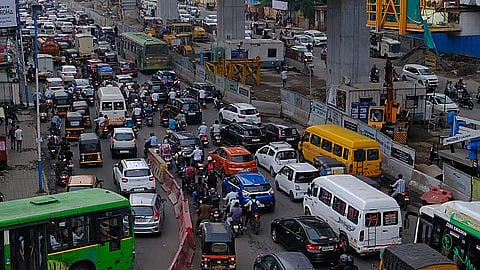
The Pune Municipal Corporation (PMC) has decided to prioritise the High Capacity Mass Transit Route (HCMTR) to reduce traffic congestion in the city. According to Municipal Commissioner Naval Kishore Ram, the HCMTR will be the first major infrastructure project under the city's long-term mobility plan.
The proposed HCMTR is a 36-km elevated corridor with a width of 24 metres, and it has already received the required approvals. However, the project has remained pending for several years. The commissioner said that a large part of the alignment passes through existing roads, reducing the need for major land acquisition.
Nearly 85 per cent of the land required for the project belongs to government departments, while only around 15 per cent is privately owned. This is expected to make the land acquisition process easier. To speed up the project, PMC will set up a dedicated HCMTR cell to oversee planning and implementation.
The civic body will soon prepare proposals to acquire government land and begin discussions with private landowners wherever land acquisition is required. The land acquisition for the project is expected to cost around ₹1,300 crore. Since most of the corridor falls within PMC limits, the civic body plans to use transferable development rights (TDR) and floor space index (FSI) to acquire land.
PMC is also appointing an international financial consultant to study different funding options for the project. The commissioner said that the HCMTR will remain a toll-free corridor, and the civic body is exploring different financial models to complete the project without charging a toll from commuters.
The HCMTR will be integrated with the proposed outer ring road, the Metro network, and future underground road corridors to create a seamless transport system for the city. The proposed outer ring road connecting Pune, Pimpri-Chinchwad, and 44 surrounding villages, along with underground road corridors, will be taken up in later phases based on the city's needs.
The decision to prioritise the HCMTR is a significant step towards reducing traffic congestion in Pune. The city has been struggling with traffic issues for years, and the completion of the HCMTR is expected to provide much-needed relief to commuters.
The project is also expected to have a positive impact on the city's economy and environment. By reducing traffic congestion, the HCMTR will help to decrease travel times, reduce air pollution, and improve the overall quality of life for citizens.
In conclusion, the prioritisation of the HCMTR is a major push towards reducing traffic congestion in Pune. The project has the potential to transform the city's transport system and provide a seamless and efficient travel experience for commuters. With the civic body's commitment to completing the project without charging a toll, the HCMTR is expected to be a game-changer for the city.
The success of the HCMTR will depend on the effective implementation of the project. The civic body will need to work closely with government departments, private landowners, and other stakeholders to ensure that the project is completed on time and within budget. With the right planning and execution, the HCMTR has the potential to become a model for other cities in India to follow.
The Pune Municipal Corporation's decision to prioritise the HCMTR is a significant step towards creating a more sustainable and livable city. The project is expected to have a positive impact on the city's environment, economy, and quality of life, and it will be closely watched by citizens and stakeholders in the coming months and years.
As the project moves forward, it will be important to monitor its progress and ensure that it is completed on time and within budget. The civic body will need to be transparent and accountable in its implementation of the project, and it will need to work closely with citizens and stakeholders to ensure that the project meets their needs and expectations.
In the end, the success of the HCMTR will depend on the civic body's ability to deliver a high-quality project that meets the needs of citizens and stakeholders. With the right planning, execution, and monitoring, the HCMTR has the potential to become a landmark project that transforms the city's transport system and provides a better quality of life for citizens.