
Kolhapuri Food in Mumbai: Tambda-Pandhra Rassa & Misal
Where to eat fiery Kolhapuri food in Mumbai: tambda-pandhra rassa mutton thalis, dry sukka and blistering misal, plus areas, ordering tips and ₹ price bands.
'%3E%3Crect%20width%3D'96'%20height%3D'96'%20fill%3D'%23E65100'%2F%3E%3Ccircle%20cx%3D'30'%20cy%3D'24'%20r%3D'44'%20fill%3D'%23fff'%20opacity%3D'.12'%2F%3E%3Ccircle%20cx%3D'60'%20cy%3D'74'%20r%3D'40'%20fill%3D'%23000'%20opacity%3D'.10'%2F%3E%3C%2Fg%3E%3Cg%3E%3Ccircle%20cx%3D'48'%20cy%3D'48'%20r%3D'15'%20fill%3D'none'%20stroke%3D'%23fff'%20stroke-width%3D'3'%2F%3E%3Cpath%20fill%3D'%23fff'%20d%3D'M48%2037%20l3.5%2011%20-3.5%2011%20-3.5%20-11%20z'%2F%3E%3Ccircle%20cx%3D'48'%20cy%3D'48'%20r%3D'2.2'%20fill%3D'%23fff'%2F%3E%3C%2Fg%3E%3C%2Fsvg%3E)
The Top 8
- 01
Purepur Kolhapur
Vile Parle East (also Dadar West) ~₹700–1,000 for two (approx)Go for: The city's benchmark for Kolhapuri: chicken/mutton thali with fiery tambda rassa, creamy pandhra rassa, kharda and hot bhakri.
Order the thali and ask for the kharda on the side; the Vile Parle branch is generally more consistent than Dadar.
- 02
Lai Bhari Kolhapuri
Chakala, Andheri East ~₹600–900 for two (approx)Go for: Dedicated Kolhapuri kitchen; the Kolhapuri thali packs pandhra + tambda rassa, chicken masala, egg curry, bhakri, rice and solkadhi.
Go hungry and split a thali plus an extra rassa refill; spice runs authentically hot.
- 03
Hotel Kolhapuri Katta
Prabhadevi ~₹600–900 for two (approx)Go for: Reliable Mumbai-proper Kolhapuri; non-veg thali with ghee mutton fry, mutton masala, tambda and pandhra rassa, solkadhi.
The ghee mutton fry is the standout add-on; lunch service (from ~12:15pm) is freshest.
- 04
Hotel Kolhapur
Thane ~₹500–800 for two (approx)Go for: No-frills legacy spot famed for its tambda–pandhra rassa and sumptuous mutton/chicken thalis.
Come for the thali rather than à-la-carte; it's the best-value way to taste both rassas.
- 05
Tambda Pandhra Kolhapuri
Vasant Vihar, Thane West ~₹500–800 for two (approx)Go for: Named for the twin rassas; specialises in spicy Kolhapuri mutton and chicken gravies with bhakri.
Order both the tambda and pandhra rassa to taste the classic red-and-white pairing side by side.
- 06
Kolhapuri Thecha (Family Restaurant)
Naupada, Thane West ~₹500–800 for two (approx)Go for: Homely Kolhapuri-style thalis and thecha-forward heat; good chicken and mutton rassa plates.
Ask how spicy before ordering the thecha; it's genuinely pungent for the uninitiated.
- 07
Kolhapuri Kanteen
Airoli, Navi Mumbai ~₹400–700 for two (approx)Go for: Casual, wallet-friendly Kolhapuri thalis and rassa plates; a dependable Navi Mumbai option.
Best for a quick, cheap thali fix; go at peak meal times when curries are freshly made.
- 08
Kolhapuri Malvani
Panch Pakhadi, Thane West ~₹600–900 for two (approx)Go for: Runs both Kolhapuri and Malvani lines; order the Kolhapuri mutton/chicken rassa with bhakri here.
Stick to the Kolhapuri side of the menu (rassa + bhakri) to stay on theme rather than the seafood.
Ranked by our Mumbai desk · prices are approximate — confirm before you go.
Kolhapuri food is the fiery, meat-forward cooking of Western Maharashtra — built around the twin mutton gravies tambda rassa (fiery red) and pandhra rassa (silky white), plus dry sukka and blistering misal. In Mumbai, the Dadar–Matunga–Vile Parle belt is where to eat it, led by dedicated Kolhapuri thali houses.
Kolhapur eats differently from the rest of Maharashtra. This is not the coconut-sweet coastal cooking of the Konkan, nor the everyday zunka-bhakar of the Deccan. It is unapologetically carnivorous, powered by a scorching house masala (kanda-lasun masala, heavy on onion, garlic and dry-roasted red chillies) and a signature two-gravy system that no other regional cuisine quite copies. Mumbai’s large Western-Maharashtra community means you don’t have to travel 400 kilometres south to taste it — you just have to know which rooms to walk into. This guide covers what the food actually is, how to order it without embarrassing yourself, which neighbourhoods to aim for, and roughly what it costs.
Quick reference: what to order
Use this as a cheat sheet before you sit down. Prices are per-person bands for a typical suburban Kolhapuri room, not quoted figures — treat them as ballparks that drift with the meat rate and the neighbourhood.
| Order this | What you get | Heat | Rough price |
|---|---|---|---|
| Mutton thali | Rice/bhakri, mutton sukka, tambda + pandhra rassa | High | ₹450–900 |
| Chicken (kombdi) thali | Same format, chicken instead of mutton | Medium–high | ₹350–650 |
| Mutton sukka (à la carte) | Dry roasted-coconut mutton, for bhakri | High | ₹250–450 |
| Kolhapuri misal | Matki usal, fiery tarri, farsan, pav | Very high | ₹80–160 |
| Tambda rassa (extra bowl) | The red mutton broth, often refillable | Very high | Usually free/₹50 |
| Solkadhi or taak | Kokum or buttermilk cooler | None | ₹40–80 |
What makes Kolhapuri food its own thing
A few markers separate genuine Kolhapuri cooking from a generic “Maharashtrian non-veg thali”:
- Tambda rassa. The famous fiery red mutton broth, its colour and heat coming from Kolhapur’s prized red chillies (the Lavangi and Sankeshwari varieties) and that pungent onion-garlic masala. It’s thin, drinkable and genuinely hot.
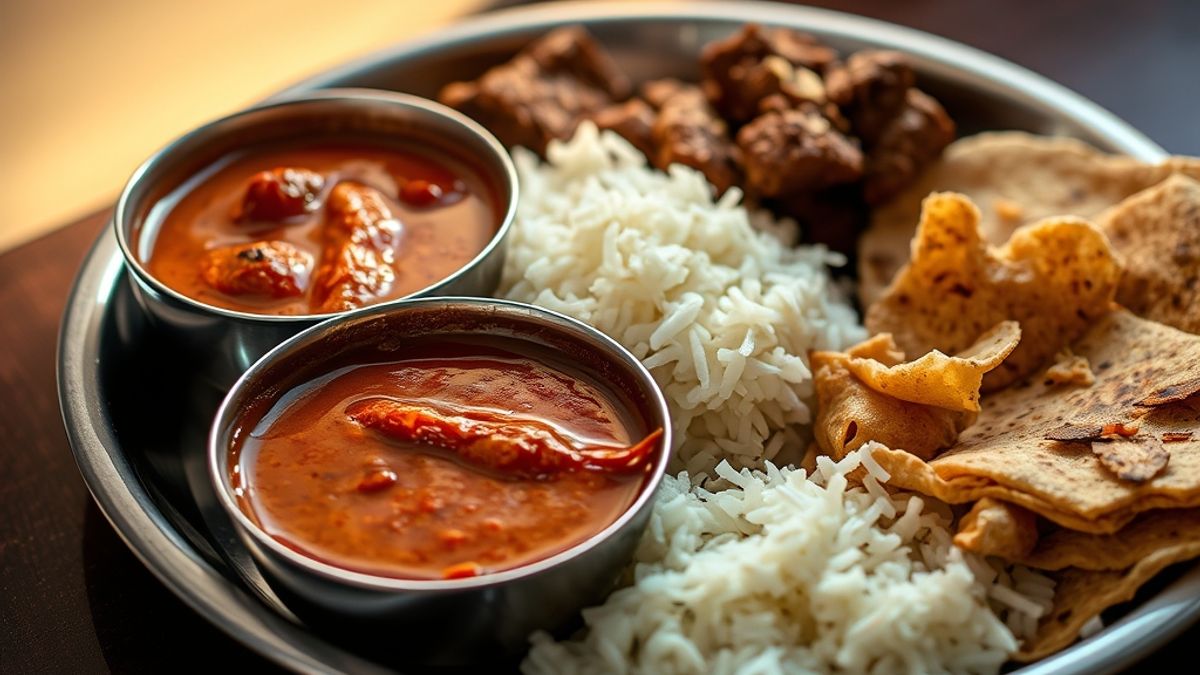
- Pandhra rassa. The counterpoint — a pale, soothing white gravy of mutton stock, coconut, ginger-garlic and cashew or poppy-seed body. Sipped alongside the red to cool the palate. The two are almost always served together.
- Sukka / sukka mutton. A dry, deeply spiced preparation of mutton or chicken coated in roasted-coconut masala, meant for bhakri rather than rice.
- Kanda-lasun masala. The blistering onion-garlic-chilli blend that underpins nearly everything, and the reason Kolhapuri food is a byword for tikhat (hot).
- Bhakri. Jowar or bajra flatbread is the natural partner, though rice and pav show up too.
Put simply: if a “Maharashtrian” menu offers you just one gravy and calls it Kolhapuri, it isn’t the real deal. The two-bowl system is the tell. For the broader map of how this fits into the state’s cooking — from Puneri to Vidarbha’s Saoji — start with our overview of Maharashtrian food in Mumbai and then come back here for the fiery specifics.
The tambda–pandhra rassa system, decoded
The heart of a Kolhapuri meal is not a single dish but a pairing, and understanding it is the difference between a good lunch and a great one.
Tambda rassa
Tambda simply means “red.” This is a thin, near-drinkable broth built on mutton stock, that scorching kanda-lasun masala, and a heavy dose of Kolhapur’s red chillies. The colour is deep brick-orange, slicked with a film of chilli oil on top. It is not a thick curry you eat with a spoon — it’s meant to be sipped from the small bowl or poured over rice. First-timers underestimate it every single time. The heat is clean and building rather than instant, so you take one sip, think “that’s fine,” and regret it thirty seconds later. That is by design.
Pandhra rassa
Pandhra means “white,” and this is the mercy in the meal. It’s a pale, milky gravy made from the same mutton stock but finished with coconut, ginger-garlic paste and a thickening of cashew or poppy seed, with almost no chilli. Sipped on its own it’s gentle, nutty and faintly peppery. Its real job is to reset your palate between hits of the red. Think of it less as a second soup and more as the fire extinguisher that lets you keep going.
How to actually drink them
At a proper house you’ll get two small steel bowls (vaatya), one of each, refilled on request. The ritual is to alternate: a fiery sip of tambda, a cooling sip of pandhra, a bite of bhakri or a forkful of sukka, repeat. Don’t drown your rice in the red all at once — you’ll flame out before the meal is over. Pace the tambda, lean on the pandhra, and keep a glass of water and a bowl of plain rice within reach as a third-tier coolant.
Building your thali: what to order
The Kolhapuri mutton thali is the flagship, and it rewards a bit of strategy.
Mutton vs chicken vs the rest
Order the mutton thali if you can — mutton is the heart of Kolhapuri cooking, and the rassa is genuinely richer and deeper when it’s built on mutton bones and stock. Chicken (kombdi) thalis are lighter, a notch less intense and usually a little cheaper, which makes them the sensible pick if you’re heat-nervous or ordering for a mixed table. Most rooms also do egg (anda) and kheema (mince) versions, and a few offer a tambda–pandhra combo where you get a taste of both proteins. If it’s your first Kolhapuri meal and you eat mutton, get the mutton thali — it’s the truest and best-value way to taste the whole system in one sitting.
Bhakri, rice and the sides
The classic partner is bhakri — an unleavened jowar or bajra flatbread that’s slightly coarse and perfect for scooping up dry sukka. Rice is the softer alternative and the better vehicle for the rassa. Most thalis let you have both, plus raw onion, a wedge of lemon, and sometimes a thecha (crushed green-chilli-and-garlic relish) that is its own small act of violence — taste a fleck before you commit. Don’t over-order sides; the thali is designed to be complete and the refills of rassa and bhakri will fill you long before the extras arrive.
For vegetarians
Kolhapuri cooking is unapologetically meat-first, so vegetarians are less spoiled at a dedicated thali house. The great veg-friendly showstopper is misal (below), which is fully vegetarian in its base form. Beyond that, look for pithla-bhakri (a quick gram-flour curry), zunka, spiced vangi (brinjal) or a Kolhapuri-style veg rassa on the à-la-carte side. If most of your group is vegetarian, you’ll have a better all-round spread at a general Maharashtrian or pure-veg restaurant and can treat the misal here as the headline.
Kolhapuri misal: the city’s spiciest bowl
If you eat one thing, make it misal. Kolhapuri misal is a different beast from the milder Puneri version: a bowl of spiced sprouted-matki (moth bean) usal, drowned in a slick of fiery red tarri (the spiced oil-broth spooned on top), then piled with crunchy farsan, raw onion and coriander, and eaten with pav. The tarri is where the legend lives — you’ll often be asked how much you want, and the honest answer for a first-timer is “less than you think.”
By tradition it’s a breakfast and mid-morning dish, which is why the best bowls at the busiest spots are often gone by early afternoon. Order it with an extra portion of pav to mop up, a glass of taak (buttermilk) if you need to douse the flames, and cutting chai to finish. Keep water on the table and accept that your nose will run — that’s not a flaw, it’s the point.
Mumbai takes its misal seriously across styles, from the sweeter Puneri and Nagpuri versions to the Kolhapuri furnace. For the fiercest end of the spectrum and the wider misal-pav map — including which stations to get off at — see our street food in Mumbai guide, and if you want to build a whole morning around fried-and-fiery snacking, the vada pav trail pairs naturally with a misal stop.
Where to eat Kolhapuri in Mumbai
There’s no single Kolhapuri “district,” but the cuisine clusters tightly around a few pockets of the Western-Maharashtra community.
The Dadar–Matunga–Prabhadevi core
The Dadar–Prabhadevi belt around SK Bole Road is the broader Western-Maharashtra food core, where Kolhapuri, Malvani and Gomantak kitchens sit close together, often on the same lane. It’s the single best neighbourhood to base a Kolhapuri crawl: you can start with a mutton thali, wander over for solkadhi, and finish with mithai without moving more than a few hundred metres. Dadar’s the obvious anchor because it’s a rail interchange, and the area’s food density is genuinely hard to beat — our Dadar food trail and Matunga food trail guides map the surrounding options if you want to make an afternoon of it.
Purepur Kolhapur and the dedicated houses
Purepur Kolhapur is the city’s best-known dedicated Kolhapuri address, with outlets around Vile Parle East, Dadar West (near Siddhivinayak), Matunga and out towards Thane and Navi Mumbai. This is the reliable introduction: full tambda-pandhra rassa thalis, mutton and chicken sukka, and the two-gravy ritual done properly. Reckon on roughly ₹500–900 a head for a mutton thali, less for chicken — again, a band rather than a quote, and higher if you add extra sukka or à-la-carte plates. A handful of similar family-run Kolhapuri houses dot the western suburbs; the branded chain is simply the easiest to find and the safest first bet.
For misal specifically
For misal, Mumbai’s famous misal houses skew towards the Kolhapuri-hot end. Mamledar Misal in Thane (running since 1952) is the region’s most storied misal institution — not strictly branded “Kolhapuri,” but firmly in that fiery, tarri-heavy tradition, with outlets that have since spread across Mumbai. Expect roughly ₹80–160 a plate. Because these are morning-first spots, arrive before the lunch rush if you want the tarri at its freshest.
The unbranded khanaval
Small Kolhapuri lunch-homes also open and close near suburban stations all the time. If someone points you to an unbranded “Kolhapuri khanaval,” the format is trustworthy even when the signboard changes — these places live and die on regulars, so a full room at 1pm is a better signal than any name. Just confirm it’s open before you go rather than chasing a name that may have moved, and don’t be put off by a plain interior; the plainer the room, often the truer the rassa.
What a Kolhapuri meal actually costs
Kolhapuri food is honest value, not a splurge. A solo mutton thali at a suburban house lands somewhere in the ₹450–900 band; a chicken thali runs lower, roughly ₹350–650. Misal is street-food cheap at ₹80–160. A relaxed lunch for two, with a couple of extra sukka plates and buttermilk, will usually come in well under a comparable fine-dining bill — this is everyday feasting, priced for people who eat it every week. The refills of rassa and bhakri at the classic places mean you rarely need to over-order, so the sensible move is to start with the thali and add on only if you’re still hungry. Carry some cash: a few of the older rooms are cash-first, and the misal joints almost always are.
How to handle the heat
Kolhapuri food is one of the hottest regional cuisines in the country, and there’s no shame in managing it.
- Ask for it milder. Most kitchens will tone down the tarri or the tambda if you request it when you order — say “kami tikhat” (less spicy).
- Lean on the coolants. Pandhra rassa, plain rice, pav and a glass of taak or solkadhi are your built-in fire extinguishers. Use them early, not once you’re already in trouble.
- Go slow on the tarri. When they ask how much red tarri you want on your misal, ask for it on the side the first time. You can always add.
- Water and chai are part of the ritual, not an afterthought. Keep both close.
- Don’t fight it. The heat is meant to build and then break with a cooling sip — that rhythm is the whole pleasure. Treat it as a wave, not a wall.
What to expect in the room
Kolhapuri rooms are working-class, functional and busy — steel plates, quick service, and thalis that keep coming until you tap out. This is not fine dining and it doesn’t pretend to be. Portions are generous, the rassa refills at the classic places, and the pace is fast at lunch, when tables turn quickly. Service is brisk rather than fussy; you order, it arrives, you eat, you’re refilled without much ceremony. Come hungry, dress for a bit of a mess (chilli oil finds shirts), and don’t over-order the sides — the thali alone is usually plenty.
Best time to go
Kolhapuri food is a year-round pleasure and, unlike coastal cuisine, doesn’t depend on the fishing season — mutton and chicken are the stars, so the Mumbai monsoon is actually a fine time for a hot bowl of tambda rassa or a fiery misal; there’s a real case that a scorching thali is at its best when it’s grey and pouring outside, which is exactly the logic behind a lot of the city’s monsoon food. Lunch (roughly 12.30–3pm) is when the thali houses are freshest and fullest; misal is best in the morning and often sold out by mid-afternoon at the busy spots. For a cooler, more comfortable feast where the heat of the food isn’t competing with the heat of the day, October to February is the easiest stretch weather-wise.
How to get there
The Dadar–Matunga–Prabhadevi core is the easy win. Dadar is the interchange of the Western and Central railway lines, and Matunga sits one stop away on both — walkable or a short auto ride to the main Kolhapuri addresses. Vile Parle is a straight run north on the Western line. For the Thane misal institutions, take a Central-line local to Thane and cab the short distance from the station. As with most Mumbai food crawls, the local train beats a car at peak hours — the local train guide and our general notes on getting around Mumbai will save you both time and a jammed parking hunt. For more on the wider regional scene, see our guides to Maharashtrian food in Mumbai and Malvani cuisine in Mumbai — the coastal, coconut-forward counterpoint to Kolhapur’s fire.
Frequently Asked Questions
What is the difference between tambda and pandhra rassa?
Tambda rassa is the fiery red mutton broth coloured and heated by Kolhapur's Lavangi and Sankeshwari chillies and its pungent onion-garlic (kanda-lasun) masala. Pandhra rassa is the pale, soothing white gravy built on the same mutton stock but finished with coconut, ginger-garlic and cashew or poppy seed, with almost no chilli. They're served together in two small bowls so you can alternate a hot sip of red with a cooling sip of white, mopping between with bhakri.
How spicy is Kolhapuri food, really?
It's one of the hottest regional cuisines in Maharashtra, thanks to the kanda-lasun masala and, in misal, the red tarri. The heat tends to build rather than hit instantly, so first-timers routinely underestimate it. Most places will tone it down if you ask for 'kami tikhat' (less spicy), and the pandhra rassa, plain rice, pav and a glass of buttermilk are your built-in coolants.
Where can I eat authentic Kolhapuri food in Mumbai?
Head to the Dadar–Matunga–Vile Parle belt, the core of the city's Western-Maharashtra food scene. Dedicated houses such as Purepur Kolhapur serve the full tambda-pandhra rassa thali with mutton or chicken sukka, typically around ₹500–900 a head for mutton. For fiery misal in the same tradition, Mumbai's famous misal institutions, including Mamledar Misal in Thane, are worth the trip.
How is Kolhapuri misal different from Puneri misal?
Kolhapuri misal is far hotter and oilier than the milder, slightly sweeter Puneri version. It's a bowl of sprouted-matki usal drowned in a slick of fiery red tarri, then topped with crunchy farsan, raw onion and coriander and eaten with pav. You'll often be asked how much tarri you want, and for a first-timer the honest answer is 'less than you think' — or ask for it on the side so you can add it gradually.
Is there vegetarian Kolhapuri food in Mumbai?
Yes, though the cuisine is meat-first so the choice is narrower at a dedicated thali house. The star vegetarian dish is misal, which is fully veg in its base form, alongside options like pithla-bhakri, zunka and a Kolhapuri-style veg rassa. If most of your group is vegetarian, you'll get a fuller spread at a general Maharashtrian or pure-veg restaurant and can treat the misal as the headline.
How much does a Kolhapuri mutton thali cost in Mumbai?
At a typical suburban Kolhapuri house, a mutton thali usually lands in the ₹450–900 per-person band, with chicken (kombdi) thalis a little cheaper at roughly ₹350–650. Misal is street-food priced at around ₹80–160 a plate. These are ballpark ranges that move with the meat rate and the neighbourhood, not fixed prices, and many older rooms are cash-first, so carry some cash.