
The Colaba Neighbourhood Guide
A local's guide to Colaba, Mumbai's southern tip — the Gateway of India, Causeway shopping, dawn at Sassoon Dock, Regal Cinema and the old cafés.
'%3E%3Crect%20width%3D'96'%20height%3D'96'%20fill%3D'%23E65100'%2F%3E%3Ccircle%20cx%3D'30'%20cy%3D'24'%20r%3D'44'%20fill%3D'%23fff'%20opacity%3D'.12'%2F%3E%3Ccircle%20cx%3D'60'%20cy%3D'74'%20r%3D'40'%20fill%3D'%23000'%20opacity%3D'.10'%2F%3E%3C%2Fg%3E%3Cg%3E%3Ccircle%20cx%3D'48'%20cy%3D'48'%20r%3D'15'%20fill%3D'none'%20stroke%3D'%23fff'%20stroke-width%3D'3'%2F%3E%3Cpath%20fill%3D'%23fff'%20d%3D'M48%2037%20l3.5%2011%20-3.5%2011%20-3.5%20-11%20z'%2F%3E%3Ccircle%20cx%3D'48'%20cy%3D'48'%20r%3D'2.2'%20fill%3D'%23fff'%2F%3E%3C%2Fg%3E%3C%2Fsvg%3E)
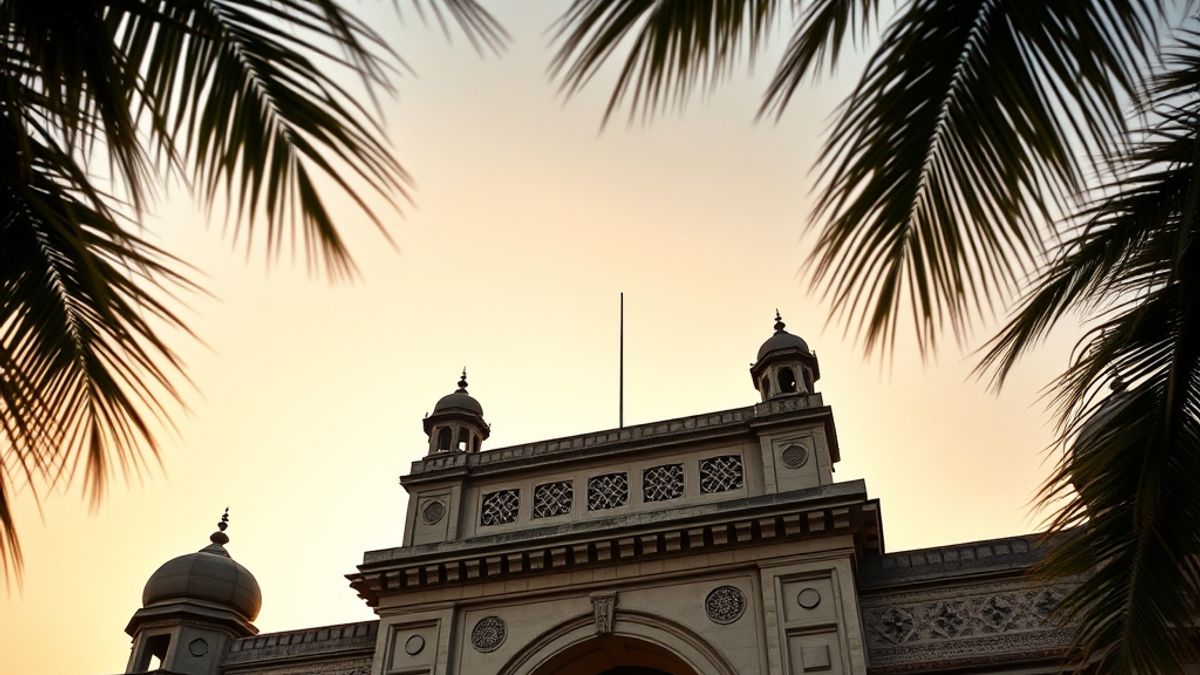
Photo: Wikimedia Commons · CC BY-SA 3.0 · via Wikimedia Commons
Colaba is the very tip of Mumbai — the peninsula’s pointed end, and for most visitors the city’s front door. It holds the Gateway of India and the Taj, the shopping street everyone knows, an art-deco cinema, a working fish dock older than most countries’ constitutions, and a couple of cafés that have been serving beer and stories since the nineteenth century. It is compact, walkable and dense with history, which is exactly why it rewards a slow day rather than a rushed one. Come early, wear comfortable shoes, and let the harbour bookend your morning and evening. Here is how to make sense of it.
Colaba at a glance
If you only have a day, this is the shape of it. Everything below is within easy walking distance except the ferries, which leave from the Gateway jetty.
| Spot | Best time | Rough cost | Good for |
|---|---|---|---|
| Gateway of India | Sunrise or dusk | Free | Photos, people-watching |
| Taj waterfront | Anytime; tea in the afternoon | Free to browse | Architecture, a splurge |
| Elephanta ferry | Depart 9–11 am | ~₹200–260 return + caves ticket | Half-day trip (closed Mon) |
| Colaba Causeway | Late morning or evening | ₹100–500 a souvenir | Shopping, curios, books |
| Sassoon Dock | Before sunrise, 5–7 am | Free | Fish-market spectacle |
| Regal & the museums | Daytime | Free to ~₹150 entry | Art-deco, art, history |
| Leopold / Mondegar | Lunch or evening | ₹500–900 a head | Beer, café culture |
| Afghan Church | Daytime, quiet | Free | Gothic calm, fewer crowds |
Getting your bearings
Think of Colaba as a long, narrow finger of land running north to south, with the harbour on the east and the open sea on the west. The busy, tourist-facing half sits at the top — the Gateway, the Taj, the top of the Causeway and Regal — while the southern end tapers into the quieter Navy Nagar and Cuffe Parade districts, where the crowds thin and the streets go residential.
The single most useful thing to know is that almost everything worth seeing lines up along one axis: from the Regal roundabout at the north, the Colaba Causeway runs south past shops, cafés, Parsi housing colonies and old churches, with the Gateway and the waterfront just off to the east. Walk the Causeway once end to end and you will have brushed past most of the neighbourhood’s highlights. If Colaba is your first stop, it pairs naturally with the rest of the peninsula — you can read it alongside our wider Mumbai neighbourhoods guide to see how the southern districts connect.
The Gateway and the waterfront
The Gateway of India — a great basalt arch on the harbour, completed in 1924 — is the neighbourhood’s anchor and Mumbai’s most photographed monument. Built in an Indo-Saracenic style and standing roughly 26 metres tall, it was raised to mark a royal visit and later became, by coincidence of history, the ceremonial spot from which the last British troops departed India. Today it faces the sea and the grand Taj Mahal Palace Hotel, and it is the departure point for ferries out into the harbour.
The plaza is busy at practically all hours, thick with families, photographers, balloon-sellers and the men who will offer to sell you a strip of pigeon feed. Come at early morning for calmer photos and softer light off the water, or at dusk, when the whole city seems to gather and the arch glows against the harbour. Entry is free; there is no ticket and no set closing time for the plaza itself. If you want the fuller history and the best photo angles, our dedicated Gateway of India guide goes deeper than we can here.
The Taj across the road
Facing the Gateway is the Taj Mahal Palace, the domed hotel that opened in 1903 and has been the grande dame of South Bombay ever since. You do not need to be a guest to appreciate it — the exterior alone, with its red-tiled dome and Florentine-Gothic flourishes, is one of the city’s signature silhouettes. If you want to step inside, the classic non-splurge move is afternoon tea or a coffee in one of its lounges; expect grand-hotel prices, and dress a notch smarter than beach clothes. It sits comfortably among the city’s finest addresses in our roundup of Mumbai’s luxury hotels, if a night here is on the wish-list.
Ferries from the jetty
The Gateway jetty is where day-trips begin. Two are worth planning around:
- Elephanta Caves. Roughly an hour across the harbour lies Gharapuri island and its UNESCO-listed rock-cut cave temples to Shiva, carved centuries ago into the basalt. Ferries run through the morning and early afternoon; a return ticket sits in the low-to-mid hundreds of rupees, with a small extra fee for the upper deck, plus a modest entry ticket at the caves (foreign visitors pay more). Crucially, Elephanta is closed on Mondays, so plan around it — the full logistics are in our Elephanta Caves day-trip guide.
- Alibaug. The other popular hop is the fast catamaran across to the Konkan coast, a beachy weekend escape of forts, seafood and slow mornings. If you want the sand-and-palms version of a day out, our Alibaug beach day-trip guide covers timings and what to expect.
A practical note for both: sea conditions and the monsoon dictate everything. Ferry services thin out or stop entirely in the heavy-rain months, and even in the dry season it is worth checking the last return time before you commit to the outward leg.
Colaba Causeway
Running back from the Gateway is Colaba Causeway (officially Shahid Bhagat Singh Road), the long shopping street that defines the neighbourhood’s daytime energy — costume jewellery, cotton kurtas and dresses, leather bags, sunglasses, curios, incense, second-hand books and every category of souvenir, most of it laid out on pavement stalls and all of it bargainable. It is touristy, and it knows it, but it is genuinely fun, and it is where most first-time visitors do their souvenir shopping. For a stall-by-stall breakdown, our Colaba Causeway shopping guide is the companion piece.
How to shop it
The rhythm of the Causeway is bargaining, and it is expected rather than rude. A few honest ground rules:
- Halve it, then meet in the middle. Opening prices for pavement goods are quoted high. Counter at roughly half and settle somewhere sensible; small souvenirs land in the ₹100–500 band once you have negotiated, larger items more.
- Walk away — gently. The single most effective tactic is a polite retreat; prices often follow you down the lane.
- Carry small cash. Many stalls prefer notes, and a fat wallet weakens your bargaining face. Keep valuables zipped away in the crowd.
- Fixed-price shops exist too. Interspersed with the stalls are proper storefronts — branded cotton, homeware, cafés — where the tags are firm and you can browse in air-conditioning without the haggle.
Beyond the stalls
The Causeway is more than shopping. Look up and you will notice the Parsi housing colonies — the leafy, low-rise baugs like Cusrow Baug — that give this stretch its calm, old-Bombay texture. The book-sellers’ tables are a genuine pleasure to graze, and the side lanes hide bakeries, small eateries and the odd antique dealer. It is the kind of street where the wandering is the point.
Sassoon Dock at dawn
For something completely different, get up early and walk to Sassoon Dock, a working wholesale fish market built in 1875 and one of the oldest docks in the city. Before sunrise it roars to life — Koli fisherfolk sorting the night’s catch, auctioneers calling out over crates of pomfret and prawns, ice being shovelled, trucks loading, gulls wheeling overhead. It is a raw, unforgettable slice of the real working city, the counterweight to the polished waterfront a few minutes north. The full experience, including how to behave and what you will see, is laid out in our Sassoon Dock guide.
A few things to get right:
- Go at dawn. The action peaks in the pre-sunrise hours and fades by mid-morning; arrive around 5–7 am for the real spectacle.
- Dress for mess. The ground is wet, slippery and pungent. Wear old, closed shoes and expect the smell to follow you.
- Ask before you photograph. Photography of the working dock can be restricted, and you are a guest in someone’s workplace. Be respectful, ask before pointing a camera at people, and read the room.
Regal and the old cinema-going city
Where the Causeway meets the top of Colaba stands the Regal Cinema, an art-deco theatre that opened in 1933 and was India’s first air-conditioned cinema. Even if you do not catch a film, its curved façade and period lettering are a lovely piece of the city’s picture-going heritage and a useful landmark — the Regal roundabout is one of Colaba’s main orientation points.
The circle around it is a small concentration of grand civic Bombay. Within a few minutes’ walk north you reach the museum quarter — the domed Chhatrapati Shivaji Maharaj Vastu Sangrahalaya (the old Prince of Wales Museum), the National Gallery of Modern Art and the galleries of Kala Ghoda — a rewarding half-day for anyone who likes art and history, and all covered in our museums and art galleries guide. Keep going and you cross into Fort and Kala Ghoda, the heritage-architecture heart of the city; the natural way to link the two is on foot, and our Fort and Kala Ghoda guide and heritage architecture walk both pick up where Colaba leaves off.
The legendary cafés
Colaba’s café culture is a destination in itself, and it belongs to a wider South Bombay tradition of Irani and old-world cafés that our Irani cafés guide traces across the district:
- Café Leopold, going since 1871, is the most famous — a big, buzzy, tourist-heavy bar-restaurant that is nonetheless a genuine institution. It is loud, the menu is long and forgiving, and a meal with a beer will run you somewhere in the ₹500–900-a-head band. It is also, quietly, a place of memory: Leopold and the Taj were among the sites of the November 2008 attacks on the city, and the café has kept some of the bullet marks in its walls. Most visitors pass them without noticing; those who know, pause.
- Café Mondegar (“Mondy’s”) is smaller and beloved for its Mario Miranda wall murals — a cheerful cartoon crowd painted around the room — and its jukebox. It is a classic spot for a cold beer and a plate of food, a little more neighbourhood-y than Leopold and just as steeped in decades of stories.
Both are relaxed, unpretentious and unhurried. Neither is a place you go for a refined meal; they are places you go to sit, drink, watch the room and understand why generations of travellers have made Colaba their first stop. For a broader sweep of the district’s coffee and café options, our cafés of South Mumbai guide runs from these old institutions to the newer specialty roasters.
Quieter Colaba
Most visitors never get past the Gateway-to-Regal strip, which is a shame, because Colaba’s southern half is one of the most peaceful stretches in South Mumbai. Walk down the Causeway and keep going, past the point where the stalls thin out, and you reach the district of tree-lined lanes, naval quarters and old churches.
The standout here is the Afghan Church (the Church of St John the Evangelist), a Gothic-revival church consecrated in 1858 to commemorate the soldiers lost in the disastrous First Afghan War. Its tall spire, stained glass and quiet, echoing interior make it a genuine hidden corner — you will often have it almost to yourself, a world away from the plaza crowds twenty minutes north. It is the kind of place that reminds you Colaba was a garrison and a port long before it was a photo op. If you enjoy this seam of preserved old-Bombay life, the pocket-sized Khotachiwadi heritage village a little north in Girgaon makes a good follow-on.
Where to eat beyond the cafés
Leopold and Mondegar get the headlines, but Colaba eats well beyond them. The neighbourhood has long been a seafood quarter — this is a fishing peninsula, after all — and you will find everything from old Koli-style fish thali joints to Mangalorean and coastal-Konkani kitchens tucked into the lanes off the Causeway; our seafood restaurants guide points to the styles worth seeking out. The back lanes behind the Taj are famous after dark for their late-night kebab and roll stalls, a Colaba institution in their own right, grilling well past midnight for a mixed crowd of night-owls and post-club diners.
Prices span the full range. You can eat a plate of pav or a roll off a stall for well under ₹150, sit down to a mid-priced meal at a café or seafood house for ₹400–800 a head, or splurge properly at the Taj’s restaurants. The pleasure of Colaba is that all three are within a few minutes of each other.
Where to stay
Colaba is a natural base if you want to wake up in the thick of old Mumbai and walk to the sights. At the top end sits the Taj and its harbour views; at the more characterful middle sit the district’s boutique and heritage hotels, converted old buildings with high ceilings and period bones, many gathered in our boutique and heritage hotels guide. There is also a long-standing budget-and-backpacker scene of guesthouses in the lanes behind the Causeway — a legacy of Colaba’s decades as travellers’ first landing in the city. Whichever tier you choose, staying here means the Gateway, the Causeway and the cafés are all on foot, which is worth a great deal in a city where getting around otherwise eats your day.
A suggested day in Colaba
- Dawn: Sassoon Dock for the fish-market spectacle — optional, for early risers, but hard to forget.
- Morning: the Gateway of India and the Taj waterfront in the soft early light, then shop the Causeway while it is still quiet and the touts are half-awake.
- Late morning: wander north to the Regal, the museum quarter and, if you have the appetite, into Fort and Kala Ghoda.
- Lunch: a plate and a beer at Leopold or Mondegar, or seafood in a Causeway side-lane.
- Afternoon: browse the back lanes, then walk south to the calm of the Afghan Church.
- Evening: back to the Gateway at dusk as the crowds and the light both turn golden, then dinner in Colaba — or a ferry-planning stop for tomorrow’s Elephanta trip.
Seasons and timing
The single biggest variable in Colaba is the weather, because so much of the neighbourhood is exposed to the harbour.
- October to March is the pleasant window — cooler, drier, comfortable for walking from morning to night. This is peak season and the plaza is at its liveliest.
- April and May are hot and sticky; the Gateway plaza is unshaded and brutal at midday, so front-load your sightseeing to the early morning and save indoor stops — cafés, museums — for the worst of the afternoon.
- June to September is the monsoon. Colaba in the rain has a moody charm, but the waterfront gets lashed, ferries to Elephanta and Alibaug thin out or stop, and you will want an umbrella and shoes you do not mind soaking. Time your walking around the downpours.
Whatever the month, the two golden hours are just after sunrise and just before sunset — cooler, softer-lit, and far less crowded than the middle of the day. Colaba also happens to sit near some of the city’s best evening views over the water, which our sunset viewpoints guide maps out.
Practical tips
- Getting there. Colaba has no railway station of its own; the nearest are CSMT and Churchgate, a short taxi or bus ride away. The grand terminus itself is worth the detour — see our CSMT / Victoria Terminus guide — and for the wider transport picture, our getting around Mumbai guide covers trains, buses and app-cabs. South Mumbai’s black-and-yellow taxis are the classic, characterful way to arrive; the meter’s minimum fare covers the first kilometre and a half.
- Walk it. The whole neighbourhood is compact and best explored on foot. Taxis and autos are for getting to Colaba, not around it.
- Mind your pockets in the crowd. The Gateway plaza and the busiest stretch of the Causeway are pickpocket territory, as any dense tourist spot is. Keep bags zipped and in front of you; be politely firm with persistent sellers and unofficial “guides.”
- Ferries have a last boat. For Elephanta especially, note the closing day (Monday) and the last return sailing before you set out, so you are not stranded on the island at dusk.
- Carry water and small change. The plaza is hot and shadeless, and small notes make both bargaining and street-food easier.
The bottom line
Colaba packs an astonishing amount of Mumbai into a small, walkable tip: an iconic monument, a great shopping street, a dawn fish market, an art-deco cinema, quiet old churches and cafés that have outlasted empires. Give it an unhurried day. Start early to beat the crowds and the heat, walk everywhere, haggle with good humour on the Causeway, and let the Gateway bookend your morning and your evening. It is the classic first taste of the city — and, more than a century after that basalt arch went up on the harbour, it still delivers. From here, the rest of Mumbai is only a short taxi ride north; our things to do in Mumbai guide is the natural next stop.
Frequently Asked Questions
How much time do you need in Colaba?
A full but unhurried day is ideal. That gives you time for the Gateway of India and the Taj waterfront in the morning, souvenir shopping along Colaba Causeway, a long lunch at Leopold or Mondegar, the museums and Regal Cinema in the afternoon, and a sunset return to the Gateway. Early risers can add a pre-dawn visit to Sassoon Dock, and anyone taking the Elephanta ferry should budget a separate half-day for that.
What is the best time of day to visit the Gateway of India?
Come at early morning or dusk. Just after sunrise the plaza is calm, the light off the harbour is soft, and you can photograph the arch without the crowds. At dusk the whole city seems to gather and the Gateway glows against the water. The middle of the day is hot, shadeless and packed, so it is worth avoiding, especially in the April–May heat.
How do you get to Colaba by public transport?
Colaba has no railway station of its own. The nearest stations are CSMT and Churchgate, both a short taxi, app-cab or bus ride away. South Mumbai's black-and-yellow metered taxis are the classic way to arrive, and buses run down to the Colaba depot. Once you are there, the neighbourhood is compact and best explored entirely on foot.
Is Colaba Causeway good for shopping, and should you bargain?
Yes — Colaba Causeway is the neighbourhood's main shopping street, lined with stalls selling costume jewellery, cotton clothes, bags, curios and books. Bargaining is expected on the pavement stalls: counter at roughly half the opening price and settle in the middle, and a polite walk-away often brings the price down. Interspersed fixed-price shops let you browse without haggling. Carry small cash and keep valuables secure in the crowds.
When is Sassoon Dock most worth visiting?
Go before sunrise, roughly between 5 and 7 am, when the working fish market is at its loudest and most dramatic, with Koli fisherfolk, auctions and the night's catch. Wear old, closed shoes because the ground is wet and pungent, and always ask before photographing people, as photography of the working dock can be restricted and you are a guest in a workplace.
Can you take a ferry to Elephanta Caves from Colaba, and is it open every day?
Yes. Ferries to Elephanta Caves leave from the Gateway of India jetty and take about an hour each way, with return tickets in the low-to-mid hundreds of rupees plus a small entry fee at the caves. Sailings run through the morning and early afternoon, but Elephanta is closed on Mondays, so plan around that, and always check the last return boat so you are not stranded on the island.