
Mumbai's Breakfast Spots: Idli to Kheema Pav
Where to eat breakfast in Mumbai: Irani bun-maska, kheema pav, Matunga idli-dosa and quick poha — what to order, price bands and the best time to go.
'%3E%3Crect%20width%3D'96'%20height%3D'96'%20fill%3D'%23E65100'%2F%3E%3Ccircle%20cx%3D'30'%20cy%3D'24'%20r%3D'44'%20fill%3D'%23fff'%20opacity%3D'.12'%2F%3E%3Ccircle%20cx%3D'60'%20cy%3D'74'%20r%3D'40'%20fill%3D'%23000'%20opacity%3D'.10'%2F%3E%3C%2Fg%3E%3Cg%3E%3Ccircle%20cx%3D'48'%20cy%3D'48'%20r%3D'15'%20fill%3D'none'%20stroke%3D'%23fff'%20stroke-width%3D'3'%2F%3E%3Cpath%20fill%3D'%23fff'%20d%3D'M48%2037%20l3.5%2011%20-3.5%2011%20-3.5%20-11%20z'%2F%3E%3Ccircle%20cx%3D'48'%20cy%3D'48'%20r%3D'2.2'%20fill%3D'%23fff'%2F%3E%3C%2Fg%3E%3C%2Fsvg%3E)
The Top 12
- 01
Kyani & Co.
Dhobi Talao (near Marine Lines) ₹300–500 for two (approx.)Go for: Mumbai's oldest Irani cafe (est. 1904) — bun maska with Irani chai, keema pav, akuri and cherry custard under century-old decor.
Come on a weekday morning for the calmest chai-and-newspaper vibe; it fills up fast with office-goers.
- 02
Cafe Madras
Matunga East (King's Circle) ₹300–500 for two (approx.)Go for: 75-year-old South Indian institution famed for its filter coffee, idli, uttapam, and seasonal sheera specials.
Reach before 9 am on weekends — the queue outside gets long and it shuts between breakfast and lunch.
- 03
Ram Ashraya
Matunga East (Bhandarkar Road) ₹200–350 for two (approx.)Go for: Beloved for fresh-off-the-griddle idli, medu vada, dosa and uttapam with excellent filter coffee.
Regulars start queuing from around dawn; the earlier you go, the fresher the batter and shorter the wait.
- 04
Aaswad
Dadar West (Shivaji Park) ₹250–450 for two (approx.)Go for: Award-winning misal pav (once voted world's tastiest veg dish), plus thalipeeth, sabudana vada and piyush.
Order the misal with extra farsan and a cold piyush to balance the heat; go early on weekends.
- 05
B. Merwan & Co.
Grant Road East (opposite the station) ₹200–400 for two (approx.)Go for: Irani cafe since 1914 celebrated for its melt-in-mouth mawa cake, bun maska and Irani chai.
Mawa cakes sell out by mid-morning — get there early and grab a few to take away.
- 06
Yazdani Bakery
Fort (near Flora Fountain) ₹150–350 for two (approx.)Go for: Old-world Irani bakery-cafe known for brun maska, mawa cake, apple pie and strong Irani chai.
Dip the crusty brun in the chai the local way; it's cash-only and shut on Sundays.
- 07
Prakash Shakahari Upahar Kendra
Dadar West (Gokhale Road) ₹250–450 for two (approx.)Go for: Maharashtrian breakfast landmark famous for sabudana vada, piyush, thalipeeth and puri-shrikhand.
Pair the sabudana vada with a chilled piyush; expect a short wait for a table at peak morning hours.
- 08
Olympia Coffee House
Colaba (Colaba Causeway) ₹300–550 for two (approx.)Go for: Century-old Irani-style cafe loved for its rich kheema pav (with a half-fry egg) and bun maska.
It's cash-only with old wooden interiors — go for the kheema breakfast, not fancy ambience.
- 09
Vinay Health Home
Charni Road / Girgaon (Thakurdwar) ₹250–450 for two (approx.)Go for: Spotless veg spot doing both Maharashtrian and South Indian breakfast — misal, thalipeeth, pohe and butter idli.
Opens around 7 am and is closed Wednesdays; ideal for an early, hygienic sit-down breakfast.
- 10
Cafe Mysore
Matunga East (King's Circle) ₹250–450 for two (approx.)Go for: South Indian veteran since the 1930s — Mysore masala and dilkhush dosas, rasam vada and pineapple sheera with filter coffee.
Try the pineapple sheera alongside a dosa; weekend mornings are busiest, so arrive early.
- 11
Panshikar Aahar
Girgaon (near Opera House) ₹200–400 for two (approx.)Go for: Old Girgaon favourite for batata vada, thalipeeth, piyush and traditional Maharashtrian breakfast bites and sweets.
Grab the piyush and a batata vada for a classic quick Girgaon breakfast on the go.
- 12
A. Rama Nayak's Udupi Shri Krishna Boarding
Matunga East ₹300–500 for two (approx.)Go for: Classic Udupi eatery serving traditional South Indian breakfast — idli, dosa and set meals on a banana leaf.
Best for a leisurely sit-down, banana-leaf breakfast; go early before the lunch-thali rush begins.
Ranked by our Mumbai desk · prices are approximate — confirm before you go.
TL;DR: Mumbai eats breakfast differently in every neighbourhood — bun-maska and chai at the old Irani cafes of Fort and Marine Lines, kheema pav in a Ballard Estate bungalow, filter-coffee idli in Matunga, and quick poha or upma at a Maharashtrian counter — mostly for roughly ₹50–250 a head. Eat where the locals do: early, fast, and close to a station.
Nobody in Mumbai does one breakfast. The city wakes up in shifts and in languages, and its morning meal splits cleanly along the lines of the communities that built it — Parsi and Irani, South Indian, Maharashtrian, and the Muslim quarters of the old town. What ties them together is a shared rhythm: cheap, fast, fresh off the griddle or out of the tawa, eaten shoulder-to-shoulder with strangers before the trains fill up. This is a roundup of where to start your morning, community by community — with the practical detail you actually need to plan it: what to order, when to go, what it costs, and which station to get off at.
Think of it less as a single meal and more as four parallel breakfasts happening across the city at the same hour. You can spend a morning inside any one of them, or — if you are the kind of traveller who plans a day around food — string two together with a short cab ride in between. Either way, the honest advice is the same: go early, carry small cash, and don’t overthink the menu.
The Mumbai breakfast at a glance
If you only skim one thing, skim this. Each row is a distinct morning, tied to a different community and part of the city, with a rough price band per head. Treat the prices as bands, not quotes — they move with where you sit and what you add.
| Style | Signature plate | Where to find it | Price band (per head) | Best for |
|---|---|---|---|---|
| Irani cafe | Bun-maska + Irani chai | Marine Lines, Fort, Dhobi Talao | ₹80–150 | A slow, nostalgic start |
| Parsi / Muslim | Kheema pav | Ballard Estate, Mohammed Ali Road | ₹150–300 | A heavy, savoury breakfast |
| South Indian | Idli, dosa, filter coffee | Matunga, King’s Circle | ₹100–250 | Vegetarian, fast, reliable |
| Maharashtrian | Poha, upma, sabudana khichdi | Counters and stalls citywide | ₹40–80 | A quick commuter bite |
Bun-maska and chai at the Irani cafes
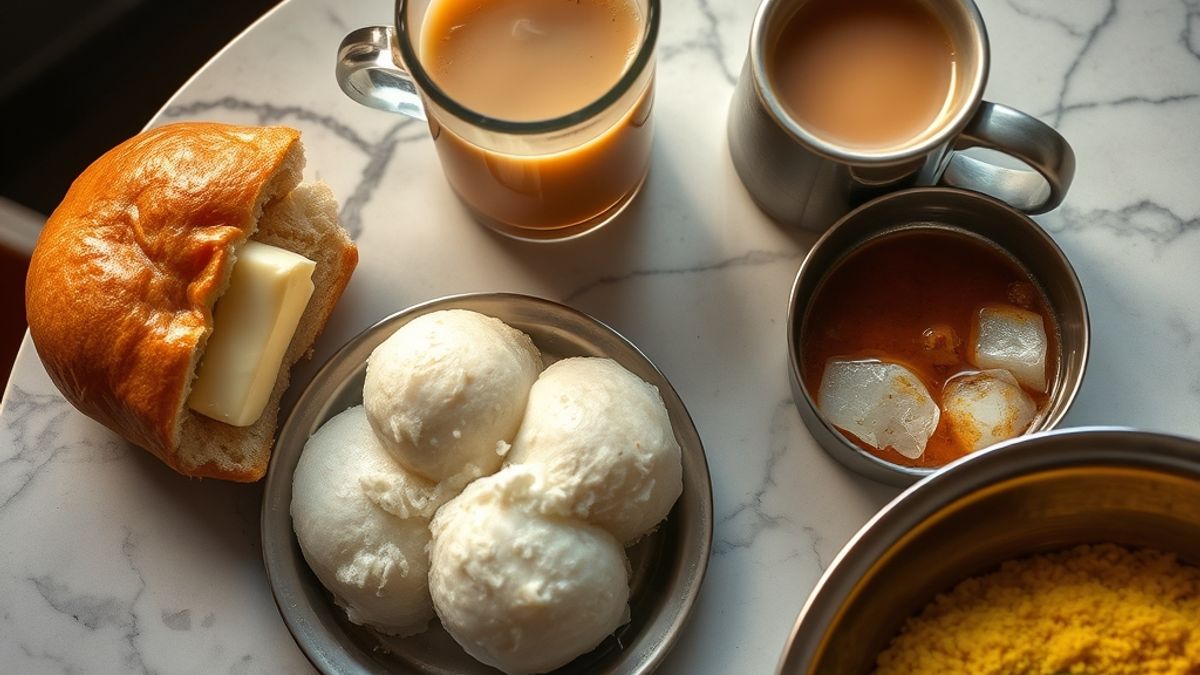
The most romantic Mumbai breakfast is the simplest: a soft bun-maska — a bun split and slathered with a thick slab of butter — dunked into sweet, milky Irani chai. This is the legacy of the Zoroastrian immigrants from Iran who opened hundreds of cafes across the city in the early 1900s; fewer than forty of the originals survive today. What you are eating, in other words, is a small piece of a disappearing institution, which is reason enough to sit a little longer over it.
Kyani & Co. near Marine Lines, one of the oldest still running, is the classic morning stop — bun-maska, brun-maska, fried eggs and sausages under whirring ceiling fans and marble-topped tables. Yazdani Bakery in Fort is beloved for its freshly baked brun (a harder-crusted bun), its generous maska and its own chai; regulars also swear by the apple pie. For the full history and etiquette of these places, see our guide to Irani cafes in Mumbai.
What to order beyond the bun
The bun-maska-chai combination is the anchor, but the Irani breakfast table has more to give. A brun-maska trades the pillow-soft bun for a crustier one that stands up better to butter and dunking. If you want eggs, ask for akuri — spiced, soft-scrambled eggs with onion, chilli and coriander, eaten with pav or brun — or a plain fried-egg-and-sausage plate, which is about as close as the city gets to a colonial English breakfast. On the sweeter side, the glass cases usually hold mawa cakes, khari (flaky, savoury puff biscuits) and Osmania-style biscuits that travel well if you want to carry breakfast onto a train.
The etiquette, and the caveats
The drill is unhurried but efficient: sit, order chai and bun, tear, dunk, repeat. Do not expect a menu with prices to the rupee — a chai-and-bun breakfast here typically lands around ₹80–150. A few honest caveats: seating is often communal, service is brisk rather than warm, and several of the old cafes still nudge you along if a queue forms. Many keep hand-lettered rules on the walls — no smoking, no fighting, no combing your hair — that are half house policy, half theatre. Take them in the spirit they’re offered. Cash is still king at the older places, though most now accept UPI.
Kheema pav: the heartiest morning plate
If you want something to actually fill you up, order kheema pav — spiced minced mutton (or chicken) cooked down with onions, tomatoes and masala, mopped up with soft pav. It is a Parsi-Irani and Muslim breakfast staple, and it is deeply satisfying at 9am whether or not that feels reasonable. The best versions are unapologetically rich: a slick of oil on top, plenty of masala, and pav soft enough to fall apart in the gravy.
The most famous version sits in a colonial bungalow in Ballard Estate: Britannia & Co., whose kheema — and whose berry pulao at lunch — is genuinely legendary. It keeps limited hours and the wait can be long, so go early. Because Britannia opens for a narrow window and closes on its own schedule, this is one place where it genuinely pays to check the day and time before you set out rather than turning up on spec.
The old town, and its Ramzan season
Across the old town around Mohammed Ali Road and Bhendi Bazaar, small restaurants serve robust kheema pav and nihari-style breakfasts to a devoted local crowd; this is the same quarter that comes alive during Ramzan, and it overlaps with our Mughlai and kebab territory. If your kheema comes topped with a fried egg — sometimes called kheema-per-eedu on Parsi menus — take it; the runny yolk stirred through the mince is the point. Expect roughly ₹150–300 for a proper kheema-pav plate depending on where you sit. During Ramzan the rhythm inverts: the quarter’s real energy is at pre-dawn and after sunset, and the daytime is quiet, so plan around the calendar if you’re visiting in that month. For the wider Parsi table — dhansak, salli boti, patra ni machhi — see Parsi food in Mumbai.
Idli, dosa and filter coffee in Matunga
Head to Matunga, the city’s South Indian heartland since families migrated here for work in the 1930s, and breakfast changes entirely: steaming idli, crisp medu vada, paper-thin dosa, fluffy uttapam and, crucially, strong South Indian filter coffee poured between tumbler and davara. The coffee is not an afterthought here; it is the reason many regulars come, decanted from a height to build the froth and served scalding.
The Matunga institutions are the real thing. Cafe Madras near King’s Circle is a fan favourite for idli-butter-podi and Mysore masala dosa; Ram Ashray in Matunga East is the neighbourhood’s go-to breakfast joint for dosa, vada and idli; Cafe Mysore and the air-conditioned Rama Nayak’s Udupi round out the shortlist. These are share-a-table, quick-turnover places — you queue, you eat well, you leave. A full South Indian breakfast here usually runs about ₹100–250. Our South Indian food in Mumbai guide goes deeper on the region’s spread.
A few ordering notes for the uninitiated. Ask for idli-vada to get one of each with sambar and two chutneys, the safest first order anywhere. A Mysore masala dosa comes smeared inside with fiery red chutney; a plain masala dosa is milder. If you like heat, ask them to add podi — the coarse “gunpowder” spice mix — to your idli with a spoon of ghee. Weekend mornings, especially, some places run daily specials like rava idli or a soft pongal; if the counter is calling out a special, it usually means the kitchen is proud of it. Everything here is vegetarian, which makes Matunga the easiest neighbourhood in the city for a purely veg breakfast.
Getting there
Matunga is served by both Matunga (Central line) and Matunga Road (Western line) stations, and King’s Circle on the Harbour line — genuinely one of the easiest food neighbourhoods to reach by train. That triangle of stations means you can arrive from almost any suburb with a single change, and most of the famous joints are a short, walkable stretch from the platforms.
Poha, upma and the Maharashtrian morning
The everyday Maharashtrian breakfast is lighter and quicker: poha (flattened rice tempered with mustard seeds, turmeric, onion and a squeeze of lime), upma (savoury semolina), and sabudana khichdi (tapioca-pearl khichdi, popular on fasting days). You will find these at humble Udupi-style joints, Maharashtrian snack counters and railway-side stalls across the city, often for as little as ₹40–80 a plate. Poha comes in small local variations — kanda (onion) poha is the everyday standard, and some counters finish it with a scatter of sev, grated coconut and fresh coriander.
This is the breakfast of the daily commuter — eaten standing, finished in minutes, washed down with cutting chai. If you have a little more appetite, the same counters often carry sheera (a warm semolina halwa), sabudana vada or, in some places, a plate of misal — a spicy sprouted-bean curry with pav that sits somewhere between breakfast and an early, fortifying lunch. If you are building a broader food itinerary, it pairs naturally with the Maharashtrian food and street food trails, and with the city’s beloved vada pav, which doubles as a mid-morning snack for many.
What to order, community by community
A quick cheat-sheet if you only have one morning:
- Irani cafe: bun-maska + Irani chai; add a plate of akuri (spiced scrambled eggs) or a fried-egg-and-sausage plate.
- Parsi/Muslim quarter: kheema pav, and — if it’s on — a bowl of nihari or paya with pav.
- Matunga (South Indian): idli-vada with sambar and chutney, a masala dosa, and filter coffee. Ask for the podi if you like heat.
- Maharashtrian counter: poha or sabudana khichdi with cutting chai.
And if you have two mornings, the natural pairing is a slow Irani or Parsi breakfast on day one and a fast, vegetarian Matunga spread on day two — two very different sides of the same city, both before 10am.
Best time to go
Breakfast in Mumbai is an early affair, and freshness rewards the early riser. Aim for 8–10am: the idli is just off the steamer, the kheema is fresh in the pot, and the queues at the famous spots have not yet stacked up. Turn up at 11 and you’re in a different city — the popular counters are running low on the morning’s first batch, the tables are full, and the unhurried mood has curdled into a lunch-rush scramble. The old-town kheema places and Britannia keep their own limited hours, so check before you set out.
In the monsoon (June–September), a hot breakfast against grey, rain-soaked streets is one of the city’s quiet joys — a plate of steaming idli or a bowl of kheema while the rain sheets down outside is deeply worth the soggy walk to get there. Just build in extra time: waterlogging can slow both trains and cabs, so the early start matters even more. See monsoon in Mumbai for timing the rains. In the hotter, drier months either side of it, the lighter Maharashtrian and South Indian breakfasts — poha, idli, plenty of chutney and coffee — sit far more comfortably than a heavy kheema plate.
How to get around
Almost every breakfast worth crossing town for sits near a suburban railway station, which is how most Mumbaikars reach them:
- Fort / Ballard Estate (near CSMT and Churchgate) for Britannia and the Fort Irani cafes.
- Marine Lines (Western line) for Kyani & Co.
- Matunga / King’s Circle for the South Indian belt.
- Mohammed Ali Road / Bhendi Bazaar (walkable from CSMT or by cab) for kheema and old-town breakfasts.
Trains are fastest but brutal at peak hours; if you can, travel a little before or after the office crush, or take a cab or auto for the last stretch to keep it civil. Carry small cash — many of these places still prefer it, though UPI is now widely accepted — and don’t count on card machines at the smaller counters. Portions tend to be generous and cheap, so it’s easy (and encouraged) to order a couple of things and share across the table.
Two useful detours from the classic morning: for a coffee-forward start instead of chai, our specialty coffee cafes guide covers the newer, slower-brew scene that has grown up alongside the old Irani chai; and if you’re keeping the whole day cheap, budget eats in Mumbai rounds up low-cost options that carry the same value from breakfast right through to dinner.
Whichever morning you choose, the spirit is the same one that has fed this city’s commuters for a century: something hot, something fresh, eaten quickly and close to the tracks. Start early, follow the queues of regulars, and you will eat as well as anyone in Mumbai does before the trains fill up.
Frequently Asked Questions
What is the most famous breakfast dish in Mumbai?
There is no single one, but the two most iconic are Irani bun-maska with sweet chai and kheema pav (spiced minced mutton with soft pav). The bun-maska comes from the city's century-old Zoroastrian-run Irani cafes, while the most legendary kheema pav is served at Britannia & Co. in Ballard Estate. Both are best eaten early in the morning when everything is freshest.
Where can I get an authentic South Indian breakfast in Mumbai?
Head to Matunga, the city's South Indian heartland since families migrated there for work in the 1930s. Institutions like Cafe Madras near King's Circle, Ram Ashray in Matunga East, Cafe Mysore and Rama Nayak's Udupi serve idli, medu vada, dosa, uttapam and strong filter coffee. It is reachable by three separate railway lines — Matunga (Central), Matunga Road (Western) and King's Circle (Harbour) — making it one of the easiest food neighbourhoods to get to.
What time do breakfast places open in Mumbai?
Most breakfast spots are busiest between 8am and 10am, which is also when the food is freshest — idli just off the steamer and kheema fresh in the pot. Turn up after 11am and popular counters may have sold out of the morning's first batch. Note that famous old-town kheema places and Britannia & Co. keep their own limited hours, so it's worth checking the day and time before you set out.
Is breakfast in Mumbai good for vegetarians?
Yes, very. The entire South Indian belt in Matunga — idli, dosa, vada, uttapam and filter coffee — is vegetarian, as are the everyday Maharashtrian options like poha, upma and sabudana khichdi. Irani cafes also serve vegetarian bun-maska and chai, so only the kheema pav and egg dishes are non-vegetarian.
How much should I budget for breakfast in Mumbai?
Breakfast is cheap by design. A Maharashtrian plate of poha or upma can cost as little as ₹40–80, a chai-and-bun Irani breakfast around ₹80–150, a full South Indian spread roughly ₹100–250, and a hearty kheema-pav plate about ₹150–300 per head. Treat these as rough bands that vary with where you sit and what you add, and carry small cash since many older places still prefer it.
What should a first-timer order for breakfast in Mumbai?
For a gentle introduction, start at an Irani cafe with bun-maska and Irani chai, then add a plate of akuri (spiced scrambled eggs) if you want something more. If you prefer South Indian, order idli-vada with sambar and chutney plus a masala dosa and filter coffee in Matunga. Ask for podi with your idli if you like heat, and don't be shy about sharing several dishes across the table.