
A Short History of Mumbai: From Seven Islands to Megacity
How Mumbai grew from seven Koli fishing islands through Portuguese and British rule, cotton mills, Bollywood and finance into India's restless megacity.
'%3E%3Crect%20width%3D'96'%20height%3D'96'%20fill%3D'%23E65100'%2F%3E%3Ccircle%20cx%3D'30'%20cy%3D'24'%20r%3D'44'%20fill%3D'%23fff'%20opacity%3D'.12'%2F%3E%3Ccircle%20cx%3D'60'%20cy%3D'74'%20r%3D'40'%20fill%3D'%23000'%20opacity%3D'.10'%2F%3E%3C%2Fg%3E%3Cg%3E%3Ccircle%20cx%3D'48'%20cy%3D'48'%20r%3D'15'%20fill%3D'none'%20stroke%3D'%23fff'%20stroke-width%3D'3'%2F%3E%3Cpath%20fill%3D'%23fff'%20d%3D'M48%2037%20l3.5%2011%20-3.5%2011%20-3.5%20-11%20z'%2F%3E%3Ccircle%20cx%3D'48'%20cy%3D'48'%20r%3D'2.2'%20fill%3D'%23fff'%2F%3E%3C%2Fg%3E%3C%2Fsvg%3E)
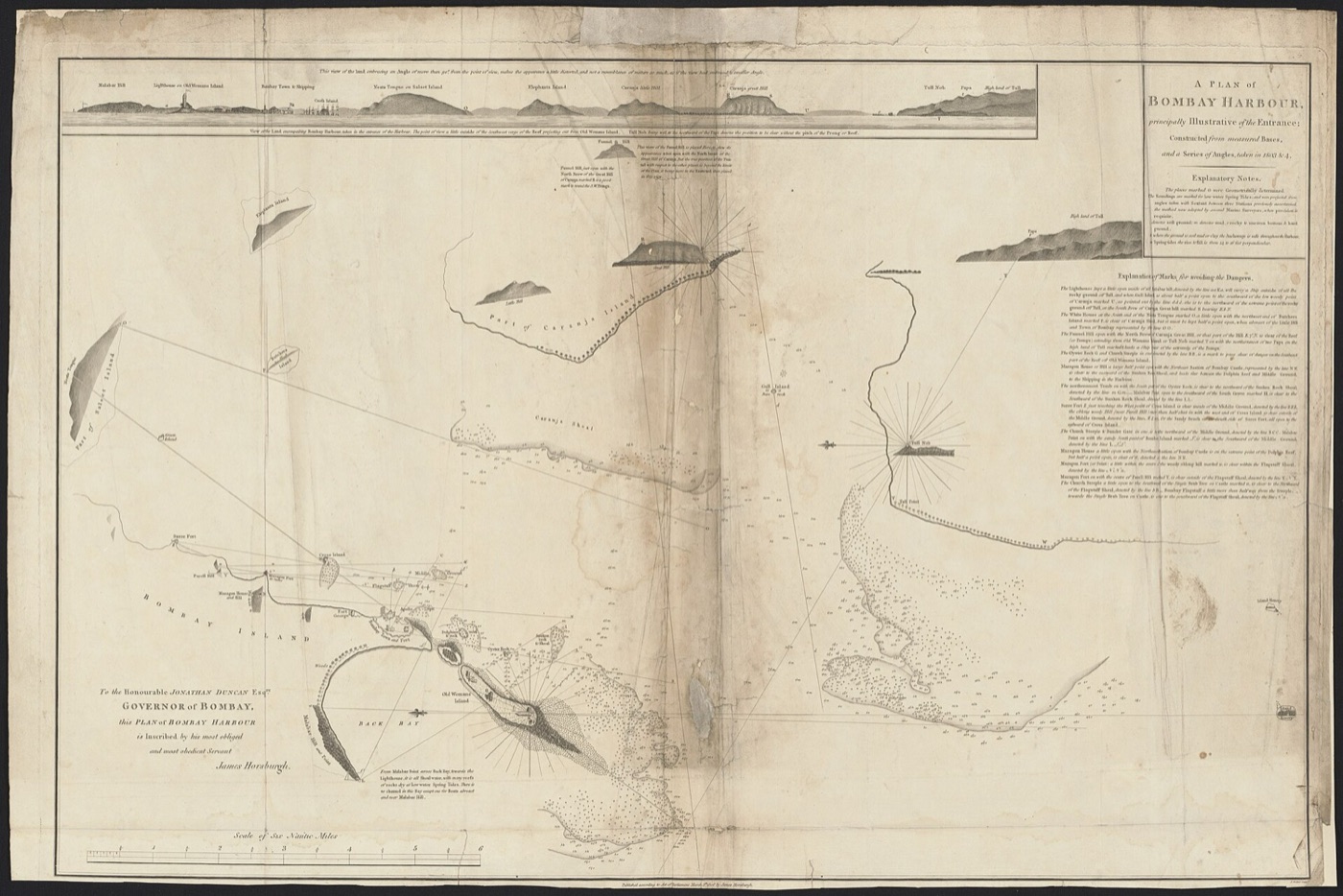
Photo: James Horsburgh, 1762-1836 · Public domain · via Wikimedia Commons
Stand on Marine Drive at high tide and it is hard to believe the ground under your feet was ever the sea. Yet most of the city you are looking at simply did not exist a few centuries ago. Mumbai is a made place — literally reclaimed from water, one causeway at a time — and its history is the story of how seven marshy islands became the densest, most ambitious city in India. This is the short version, told the way I wish someone had told me: not as a list of dates to memorise, but as a walk through the neighbourhoods where you can still see the joins.
The useful thing about Mumbai’s past is that it is not hidden in a museum. It is stacked in plain sight — a Buddhist cave above a national park, a Koli fishing net drying under a modern flyover, a mill chimney rising behind a nightclub. Once you know what each layer looks like, the whole chaotic, magnificent city starts to make sense.
The whole story at a glance
Here is the arc in one table. Everything below simply fills it in.
| Era | Roughly when | What happened | Where to read it today |
|---|---|---|---|
| Ancient rock-cut caves | c. 1st century BCE onward | Buddhist and Hindu cave temples carved into the hills | Kanheri Caves, Elephanta |
| Koli fishing islands | Before the 1500s | Seven islands, fishing villages, the goddess Mumbadevi | Worli Koliwada, Sassoon Dock, Mumbadevi Temple |
| Portuguese century | 1534–1661 | A minor Portuguese possession; a lasting Catholic community | Bandra villages, Mount Mary |
| British & Company | 1661 onward | Dowry to the Crown, leased to the East India Company, reclamation | Fort, Horniman Circle |
| Cotton & mills | 1860s–1980s | Cotton boom, Suez Canal, Girangaon mills and chawls | Lower Parel, Kamala Mills |
| Empire’s monuments | 1870s–1920s | The Victorian Gothic and Art Deco building spree | CSMT, Gateway of India |
| Freedom & renaming | 1942–1995 | Quit India, Maharashtra in 1960, renamed Mumbai in 1995 | August Kranti Maidan |
| Bollywood & finance | 20th century onward | Hindi cinema, the stock exchange, corporate towers | Film City, Dalal Street, BKC |
The oldest layer: caves in the rock
Before the islands were islands in any political sense, people were carving prayer into their hills. The two great survivals are worth seeing precisely because they predate almost everything else in this article by more than a thousand years.
Kanheri, a complex of over a hundred Buddhist rock-cut caves inside what is now Sanjay Gandhi National Park, was chiselled out from roughly the first century BCE onwards and stayed a living monastery for centuries. You can still see the water cisterns, the prayer halls and the stone benches where monks studied. Elephanta, on an island an hour’s ferry from the Gateway, holds magnificent Hindu cave sculpture usually dated to around the fifth to seventh centuries CE — its three-headed Shiva is one of the finest carvings in the country and a UNESCO World Heritage Site.
Keep these in mind as your baseline. When people say Mumbai is a “young” city, they mean the metropolis is young. The land is ancient, and it was sacred long before it was commercial.
Before the city: the Koli and the seven islands
Long before there were skyscrapers or stock exchanges, there were fishermen. The Koli community are the original inhabitants of this coast, and they were here casting nets when the land was still a scattered archipelago. The name “Mumbai” itself is usually traced to Mumbadevi, the goddess whose small temple still stands near Bhuleshwar in the crowded lanes of the old town — a good first stop if you want to touch the pre-colonial city.
The seven islands are worth knowing by name, because their ghosts are everywhere in modern geography:
- Colaba and Old Woman’s Island (Little Colaba) at the southern tip
- Bombay Island — the harbour-facing spine that became the Fort area
- Mazagaon, Parel, Worli and Mahim running north
Between them lay tidal creeks and swamp. When locals talk about “the island city” versus the suburbs, this archipelago is the deep memory underneath the phrase. It also explains why the old town floods so readily in a hard monsoon: you are standing on filled-in sea, and water has a long memory too. Another quiet witness to this early era is Banganga Tank at Walkeshwar on Malabar Hill — a sacred stepped water tank, traditionally dated to around the twelfth century, still ringed by temples and old rest-houses. Read more in our guide to Banganga and Walkeshwar.
See it today
The clearest surviving window into Koli Mumbai is Worli Koliwada, a working fishing village tucked below the Bandra–Worli Sea Link, and Sassoon Dock in Colaba at dawn, where the night’s catch is auctioned in a roar of ice, gulls and Marathi bargaining. Go early — the fish auction winds down by about 8am. Entry is free; just be respectful, and ask before photographing people at work. This is a livelihood, not a set.
The Portuguese century
In 1534 the Portuguese took the islands from the Sultan of Gujarat, and for more than a hundred years this was a minor Portuguese possession — valued for its harbour, not much developed. They called it “Bom Bahia,” the good bay, and that name, worn smooth by other tongues, is one popular theory for how “Bombay” arrived. The Portuguese left far less architecture here than in Goa, but their real legacy is human: the coconut groves, the chapels, and a Catholic community that endures to this day.
See it today
Head to Bandra, where the East Indian Catholic community traces its roots to this era. Mount Mary Basilica, perched above Bandra Bandstand, draws enormous crowds during the September Bandra Fair, and the quiet lanes of Ranwar — with their tiled cottages, wayside crosses and a hush that feels a world away from the traffic — are a lovely, free morning wander. For a second, even more perfectly preserved pocket of this world, cross town to Khotachiwadi near Girgaon, a tiny surviving cluster of Portuguese-Indian wooden houses. Reach Bandra easily on the Western Line; alight at Bandra station and take an auto to the Bandstand side.
The British turn: a wedding gift that changed everything
The hinge of Mumbai’s history is oddly domestic. In 1661 the islands came to the British Crown as part of the dowry when Catherine of Braganza married Charles II. A few years later the Crown leased them to the English East India Company — for a famously trivial rent, said to be around £10 a year — and the Company saw at once what the Portuguese had underused: a deep, sheltered, all-weather harbour on India’s west coast, safer than silt-prone Surat to the north.
The Company got to work, and its favourite verb was reclaim. Through the eighteenth and nineteenth centuries a series of engineering projects — the Hornby Vellard, a great causeway completed in the 1780s, among them — walled off the sea and gradually welded the islands into a single landmass. Reclamation is the recurring theme of this city’s biography. Every time Mumbai runs out of room, it tends to answer by taking a little more from the water. Almost nothing you walk on in the southern city is where the original shoreline was.
See it today
The old business district is still called Fort, after the walls the Company built and later demolished. Wander from Horniman Circle, a graceful colonial crescent around a garden, past the neoclassical steps of the Asiatic Society library, and you are walking the Company’s Bombay. Our Fort and Kala Ghoda guide maps the best of it in a single loop.
Cotton, mills and the making of a working city
The nineteenth century turned Bombay from a trading post into an industrial powerhouse, and the fuel was cotton. When the American Civil War in the 1860s choked off supplies of American cotton to the mills of Britain, Bombay’s traders stepped into the gap and grew spectacularly rich almost overnight. The boom was wild and speculative, and its crash was brutal — but it left behind capital, confidence and a lasting appetite for grand building.
The opening of the Suez Canal in 1869 shortened the sea route to Europe and cemented Bombay’s role as India’s gateway to the West. Cotton money and civic pride together produced the extravagant Victorian skyline you still see today.
Then came the mills themselves. Central Mumbai — Girangaon, literally “the village of mills” — filled with textile factories and the chawls, the dense tenement housing where the workers who ran them lived, often a whole family to a single room sharing a common corridor and tap. For roughly a century this was the beating industrial heart of the city and the crucible of a fierce labour and political culture. The Great Bombay Textile Strike of 1982, led by union leader Datta Samant, brought hundreds of thousands of workers out for months; it effectively broke the industry, and one by one the mills fell silent.
See it today
The mill lands have had a dramatic second life. Lower Parel and Kamala Mills are now full of restaurants, offices and nightlife built inside old industrial shells, and Phoenix Mills became one of the city’s landmark malls. Evening is the time to go, when the after-work crowds arrive; a coffee or a meal here can run anywhere from a few hundred rupees to a serious splurge, depending on where you land. For the human history behind the glamour, walk a block or two off the main drag into the surrounding chawls — the older city is still legible in the brickwork, the shared verandahs and the tiny temples at the corners.
The monuments of empire
The Victorian and Edwardian building spree gave Mumbai an architectural inheritance that is genuinely world-class — so much so that the ensemble of Victorian Gothic and, later, Art Deco buildings along the Oval Maidan was inscribed as a UNESCO World Heritage Site in 2018.
- Chhatrapati Shivaji Maharaj Terminus (CSMT) — the extravagant Gothic railway station, itself a separate UNESCO site and still one of the busiest in India. Admire it from the outside for free; it is genuinely breathtaking when floodlit after dark.
- The Gateway of India in Colaba — built to mark the 1911 royal visit of King George V and completed in 1924, and later, poignantly, the arch through which the last British troops departed in 1948. Free to visit; go early to beat the crowds and the hawkers.
- Bombay High Court, the University of Mumbai with its Rajabai Clock Tower, and the museum now named Chhatrapati Shivaji Maharaj Vastu Sangrahalaya (the old Prince of Wales Museum). Indian-visitor entry is modest; foreigners typically pay a few hundred rupees. Allow a half day, and see our full round-up of the city’s museums and galleries.
A walking tip
The whole ensemble is compact and best done on foot. Start at CSMT, walk to Horniman Circle and Fort, then down to the Gateway — a gentle two to three hours. Our heritage architecture walk strings the highlights together in order. Do it in the cooler months of November to February, or early on a monsoon morning when the stone glistens and the light goes soft and grey.
Freedom, renaming and a changing self-image
Bombay was central to India’s freedom struggle. The Quit India movement was launched here in August 1942 at Gowalia Tank, the ground now fittingly renamed August Kranti Maidan — “August Revolution Field.” After independence in 1947 the city kept growing at a furious pace, absorbing migrants from every corner of the country and every language group, a churn that never really stopped.
In 1960, after the Samyukta Maharashtra movement redrew India’s states along linguistic lines, the city became the capital of the new state of Maharashtra. And in 1995 it was officially renamed Mumbai, reclaiming the older Marathi and Gujarati name over the anglicised “Bombay.” Both names are still used affectionately, often in the same sentence, and which one a person reaches for first can quietly signal their generation, their mother tongue and sometimes their politics.
Dream factory and money machine
Two industries define modern Mumbai’s global image, and both are essentially twentieth-century inventions layered on top of everything older.
The first is the movies. Bollywood — the Hindi film industry — grew up here and turned Mumbai into the dream factory for well over a billion people. The studios of Film City in Goregaon and the star bungalows of Bandra and Juhu are woven into the city’s mythology, and a surprising amount of daily life still orbits the industry. If you want a taste of it, an evening at a grand single-screen cinema or a plush multiplex remains one of the great affordable thrills of the city, with tickets ranging from very cheap matinees to premium recliner prices.
The second is money. Mumbai is India’s undisputed financial capital: the Reserve Bank of India, the Bombay Stock Exchange on Dalal Street — established in 1875 and the oldest stock exchange in Asia — and the newer glass corporate towers of the Bandra Kurla Complex (BKC) all sit here. The old cotton-trader instinct for risk and reward never really left the city; it simply changed its clothes and moved into air-conditioning.
See it today
Dalal Street and the BSE area buzz on weekday mornings — go during market hours to feel the energy, though the exchange itself is not a casual tourist site and there is little to actually enter. For the newer face of finance, BKC is all glass, ambition and traffic. Neither is a “sight” in the postcard sense, but both are essential to understanding what the city runs on.
A city still being built
What ties five hundred years together is that single restless habit: Mumbai keeps remaking its own ground. The Bandra–Worli Sea Link curving across the water, the new Coastal Road reclaimed along the western shore, the steadily expanding Metro burrowing under old neighbourhoods — these are the Hornby Vellard’s direct descendants, the latest chapters in a very old argument between this city and the sea. The debate over how much more coastline to build on, and who pays the environmental price, is the same debate the Company started three centuries ago, only louder.
Read the layers yourself: a one-day walk
To feel the whole arc in a single day, work south to north through time:
- Dawn at Sassoon Dock for the Koli city — the oldest layer still at work.
- Mid-morning in Fort and at the Gateway, following the heritage walk through the Company town and the monuments of empire.
- Lunch, then head north to Bandra for the Portuguese-Catholic villages and the film-star glamour of the modern city.
A few practical notes. Travel by local train and auto rather than fighting traffic in a cab — the train is not just faster, it is itself a piece of the industrial history you came to see; our guide to getting around Mumbai covers tickets and etiquette. Keep small cash for entry fees, ferries and snacks, since many older sites and Koli markets are cash-first. Pick the cooler, drier months of November to February if you possibly can. And if you want to structure the day around distinct districts rather than eras, the neighbourhoods guide and our round-up of things to do will help; for the sacred layer specifically, see the temples of Mumbai.
Mumbai does not preserve its past in glass cases. It lives on top of it — layer over reclaimed layer, prayer hall under mill under mall. Once you can read those layers, you are no longer just visiting a crowded city. You are watching five centuries argue with the sea, and mostly winning.
Frequently Asked Questions
Why is Mumbai called the city of seven islands?
Mumbai was originally an archipelago of seven separate islands — Colaba, Old Woman's Island, Bombay Island, Mazagaon, Parel, Worli and Mahim — inhabited by the Koli fishing community. From the 18th century onward, British-era engineering projects such as the Hornby Vellard causeway progressively reclaimed the tidal creeks between them. Over roughly a century this joined the islands into the single landmass you walk on today, which is why locals still distinguish the 'island city' from the suburbs.
How did Bombay get its name, and why was it changed to Mumbai?
The name 'Mumbai' is usually traced to the goddess Mumbadevi, whose temple still stands near Bhuleshwar in the old town. 'Bombay' most likely came from the Portuguese 'Bom Bahia', meaning 'good bay', worn smooth over centuries of use. In 1995 the city was officially renamed Mumbai to reclaim the older Marathi and Gujarati name over the anglicised 'Bombay'. Both names are still used affectionately today.
What made Bombay grow so rich in the 19th century?
Cotton was the main engine. When the American Civil War of the 1860s cut off American cotton to Britain's mills, Bombay's traders filled the gap and grew spectacularly wealthy almost overnight. The opening of the Suez Canal in 1869 then shortened the route to Europe and cemented the city as India's western gateway. That capital funded both the Victorian Gothic building spree and the textile mills of Girangaon in central Mumbai.
What is the best way to see Mumbai's history in one day?
Work south to north through time. Start at dawn at Sassoon Dock in Colaba for the Koli fishing city, then spend the morning walking the Fort heritage cluster and the Gateway of India for the colonial layer. After lunch, head to Bandra for the Portuguese-Catholic villages and modern film-star glamour. Travel by local train and auto rather than cab, carry small cash for entry fees, and go in the cooler months of November to February.
How old are the Kanheri and Elephanta caves near Mumbai?
They are the oldest surviving layer of the region's history, predating the modern city by well over a thousand years. The Buddhist rock-cut caves at Kanheri, inside Sanjay Gandhi National Park, were carved from roughly the 1st century BCE onward and remained a monastery for centuries. The Hindu cave sculptures at Elephanta Island, a short ferry ride from the Gateway of India, are usually dated to around the 5th to 7th centuries CE and are a UNESCO World Heritage Site.
What happened to Mumbai's textile mills?
Central Mumbai's Girangaon district was once packed with textile mills and the chawls that housed their workers, forming the industrial heart of the city for about a century. The Great Bombay Textile Strike of 1982, led by union leader Datta Samant, kept hundreds of thousands of workers out for months and effectively broke the industry. The silent mills were later redeveloped — areas like Lower Parel and Kamala Mills are now offices, malls and nightlife built inside the old industrial shells.